Can Probiotics Prevent Infections? It Depends on the Outcome
Probiotics may help prevent one kind of diarrhea during antibiotic treatment, but that doesn’t make them a general defense against infection.
Probiotics haven’t been shown to prevent infections across the board. A review found a small possible reduction in C. difficile-associated diarrhea among people taking antibiotics, while a trial of one product in older hospital patients found no significant reduction in C. difficile infection. A small pregnancy trial found no significant reduction in recurrent vaginal infections. The infection, product, and population all matter. 5 3 2
If a bottle says it “supports immunity,” the question is what that means for you. Did people taking that probiotic actually have fewer diagnosed infections? Or did researchers measure something else, such as a change in gut bacteria or an immune marker?
Those aren’t interchangeable results. Probiotics contain different organisms and strains, and products may combine several of them. A finding for one formulation in one group of people doesn’t establish what another product will do. 1
During antibiotics, two diarrhea outcomes tell different stories
Antibiotics can disrupt gut microbes, creating an opportunity for Clostridioides difficile (C. difficile) to cause diarrhea. In a 2025 Cochrane review of 38 trials involving 13,179 adults and children taking antibiotics, C. difficile-associated diarrhea occurred in 1.6% of probiotic recipients and 3.2% of controls. That’s a 1.6-percentage-point absolute difference, despite a larger-sounding 50% relative reduction. The review rated the evidence low certainty, so this is a possible, modest benefit, not reliable protection for any individual. 5
The review also examined antibiotic-associated diarrhea from any cause. Across 40 trials involving 13,419 participants, it occurred in 23% of probiotic recipients and 27.4% of controls. That outcome is broader than C. difficile-associated diarrhea. If a probiotic reduces diarrhea during antibiotics, it doesn’t follow that it prevents respiratory, vaginal, or other infections. The review rated this evidence low certainty too. 5
Even results for the same infection can differ by setting. A cluster-randomized trial tested Bio-K+, a particular three-strain product, in patients aged 55 and older receiving antibiotics at four hospitals. After adjustment, researchers found no statistically significant reduction in hospital-acquired C. difficile infection. The hospitals had a low baseline infection rate, which matters when weighing this result against the pooled review. Neither finding tells you that an unrelated probiotic on a store shelf will work the same way. 3 5
Pregnancy: a specific recurrence question, not an immunity test
In a small randomized trial, pregnant women were treated for a vaginal infection and then assigned an oral probiotic containing six species or a placebo until delivery. Among the 47 women analyzed, the probiotic group did not have a statistically significant reduction in recurrent vaginal infections. The study tested recurrence after treatment, not prevention of a first infection or treatment of an active one. 2
The researchers also reported no difference in pregnancy outcomes between groups. With so few participants, that finding can’t establish safety for every probiotic formulation in pregnancy. Nor does a pregnancy recurrence trial answer whether taking probiotics postpartum prevents infections. 2
An immune measurement isn’t an infection outcome
A trial in 120 children who had recurrent respiratory infections illustrates the distinction. After 180 days, children assigned two named probiotic strains had fewer reported respiratory infections and symptoms than children assigned placebo. Researchers also reported comparatively stable levels of the measured immune markers IgG, IgM, and complement C3 in the probiotic group. Those marker findings help describe what was measured alongside the clinical results; marker levels alone aren’t proof that a probiotic prevents illness. 4
The trial provides evidence about those two strains in children with recurrent respiratory infections. It doesn’t show that probiotics generally prevent colds in adult women, or that a product with different strains will produce the same result. 4 1
How to read an infection-prevention claim
Start with the outcome: fewer diagnosed infections, fewer episodes of diarrhea, or only a laboratory measurement? Then compare the people studied with the people the claim targets. Finally, look for the strains or formulation actually tested. “Lactobacillus” on a label is less specific than the named strains used in a trial, and a higher colony-forming unit (CFU) count doesn’t necessarily mean a product works better. Many commercial probiotic products haven’t been examined in research studies. 1
For example, evidence about C. difficile-associated diarrhea during antibiotic use may be relevant to that particular decision. It isn’t evidence that the same product will prevent your next respiratory infection. That narrower comparison is more useful than a broad promise to “boost immunity.” 5 1
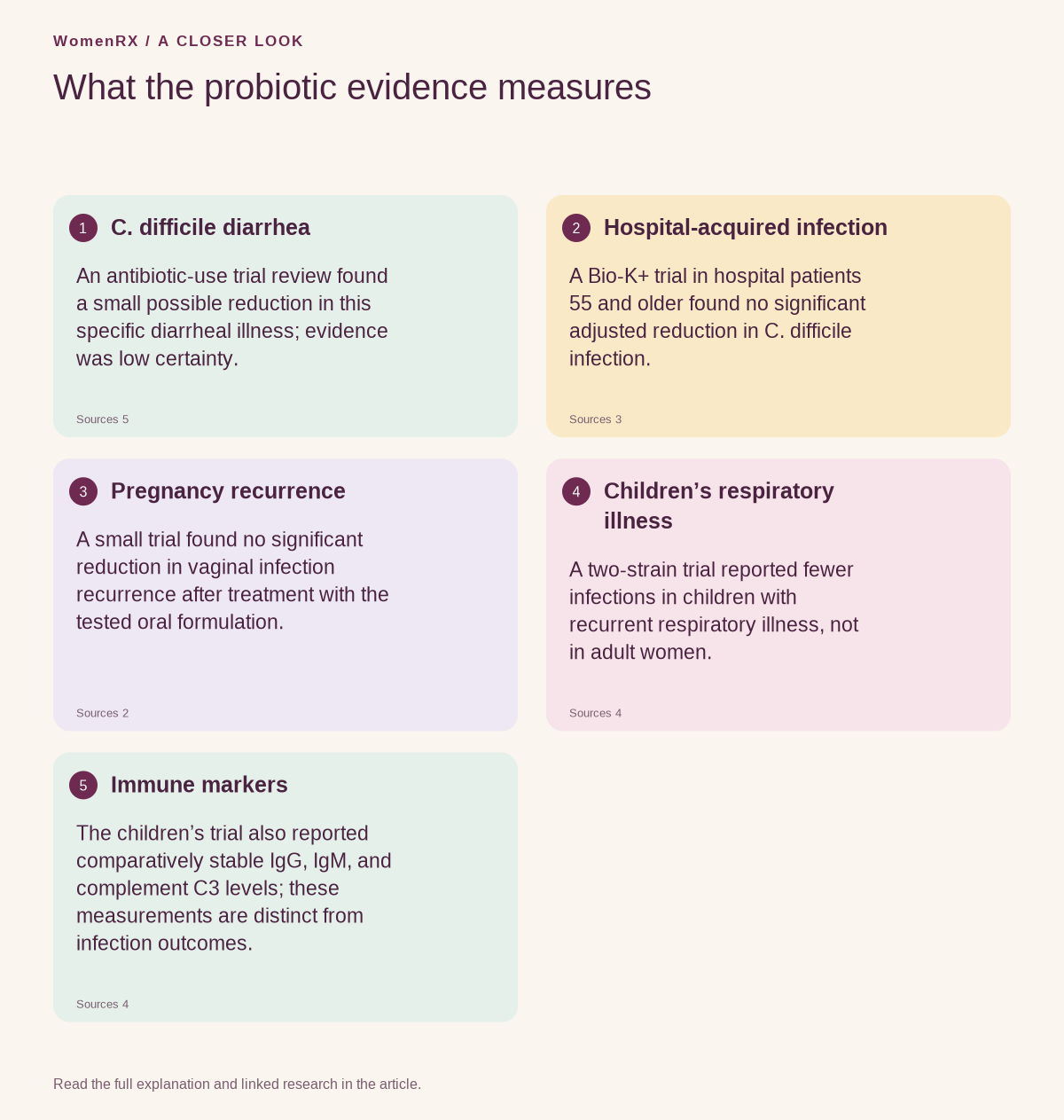
What the probiotic evidence measures
C. difficile diarrhea: An antibiotic-use trial review found a small possible reduction in this specific diarrheal illness; evidence was low certainty.5
Hospital-acquired infection: A Bio-K+ trial in hospital patients 55 and older found no significant adjusted reduction in C. difficile infection.3
Pregnancy recurrence: A small trial found no significant reduction in vaginal infection recurrence after treatment with the tested oral formulation.2
Children’s respiratory illness: A two-strain trial reported fewer infections in children with recurrent respiratory illness, not in adult women.4
Immune markers: The children’s trial also reported comparatively stable IgG, IgM, and complement C3 levels; these measurements are distinct from infection outcomes.4
Read the figure as text
Read each finding with its outcome and study population attached; these results cannot be swapped between products.- C. difficile diarrhea: An antibiotic-use trial review found a small possible reduction in this specific diarrheal illness; evidence was low certainty.5
- Hospital-acquired infection: A Bio-K+ trial in hospital patients 55 and older found no significant adjusted reduction in C. difficile infection.3
- Pregnancy recurrence: A small trial found no significant reduction in vaginal infection recurrence after treatment with the tested oral formulation.2
- Children’s respiratory illness: A two-strain trial reported fewer infections in children with recurrent respiratory illness, not in adult women.4
- Immune markers: The children’s trial also reported comparatively stable IgG, IgM, and complement C3 levels; these measurements are distinct from infection outcomes.4
More questions, answered
Does a higher CFU count mean better infection protection?
No. CFU describes the number of viable cells, but higher counts aren’t necessarily more effective. Look for evidence involving the product or strains and the specific outcome you care about. 1
Sources you can check
- Probiotics - Health Professional Fact SheetAccessed 2026-09-25Return to first citation
- Oral Probiotics to Prevent Recurrent Vulvovaginal Infections During Pregnancy-Multicenter Double-Blind, Randomized, Placebo-Controlled Trial.Nachum Z, Suleiman A, Colodner R, Battino S, Wattad M, Kuzmin O, Yefet E. · Nutrients · 2025Return to first citation
- Effectiveness of Bio-K+ for the prevention of Clostridioides difficile infection: Stepped-wedge cluster-randomized controlled trial.Leal J, Shen Y, Faris P, Dalton B, Sabuda D, Ocampo W, Bresee L, Chow B, Fletcher JR, Henderson E, Kaufman J, Kim J, Raman M, Kraft S, Lamont NC, Larios O, Missaghi B, Holroyd-Ledu... · Infection control and hospital epidemiology · 2024Return to first citation
- Probiotic Supplementation Reduces RRTIs and Enhances Gut Microbial and Immunity in Children: A Randomized Controlled Trial.Chen K, Ma W, Zhong J, Yang P, He N, Li X, Zhai Y, Yuan J, Liong MT, Liu C, Guan Y. · Journal of microbiology and biotechnology · 2026Return to first citation
- Probiotics for the prevention of Clostridioides difficile-associated diarrhea in adults and children.Esmaeilinezhad Z, Ghosh NR, Walsh CM, Steen JP, Burgman AM, Mertz D, Johnston BC. · The Cochrane database of systematic reviews · 2025Return to first citation