Should You Take Probiotics With Food?
Follow your product’s directions; there isn’t one meal-timing rule that fits every probiotic.
Take a probiotic with food or on an empty stomach according to its specific label. Probiotic effects and recommendations can depend on the strain and product, so a general rule about meals may not fit yours. Lab testing of one strain found different viability under fed and fasting conditions, but that does not establish which timing improves results for people taking supplements. 1 2
Start with the label, not a universal rule
If your probiotic label says to take it with a meal or on an empty stomach, follow that direction. Probiotic products differ in their strains and formats, and recommendations can depend on the specific product. 1
If the label doesn’t specify a meal timing, there isn’t a sound basis for choosing “with food” or “empty stomach” as the rule for all probiotics. Pick a time that fits your routine, and check the product’s storage and use instructions too. Some probiotics need refrigeration; others can be stored at room temperature. 1
Why meal timing may not transfer between products
A probiotic is identified by its genus, species, and strain. Results for one strain aren’t automatically evidence for another, and the National Institutes of Health Office of Dietary Supplements notes that clinical recommendations should be strain-specific. 1
Food and the digestive tract can affect whether microorganisms remain viable, but lab findings don’t necessarily tell you when to take a particular supplement. For example, a laboratory characterization of Lactobacillus rhamnosus strain 044AE reported different viability under fed and fasting conditions. That is a finding about one strain in testing, not a comparison of supplement-taking schedules or health outcomes in people. 2
Products also come in different formats, including capsules, powders, and liquids, but this evidence does not establish a meal-timing advantage for one format over another. 1 A capsule or powder you have may contain a different strain from the one studied.
So, a study suggesting that food changes survival for one strain doesn’t establish that every probiotic works better with a meal, or that every product should be taken on an empty stomach.
If your goal is vaginal or urinary health
Don’t assume that a probiotic with general gut-health evidence has also been shown to help vaginal or urinary health. Check whether research examined the exact strain in your product and the outcome you care about. Probiotic effects can be strain-specific, so evidence for a different strain or a different health outcome doesn’t establish the same benefit. 1
This is a separate question from whether to take a product with food. Meal timing can’t make a strain-specific benefit established if it hasn’t been shown for that strain and outcome.
Match the strain and product directions to your goal
- Read the product directions. Use the meal timing and storage instructions on your specific label.
- Check what the product contains. Look for the strain designation, not just a familiar genus such as Lactobacillus or Bifidobacterium. Strain identity matters when matching a product to research. 1
- Match the evidence to your reason for taking it. A study of another strain, or a different health outcome, doesn’t establish the same effect for your product. 1
- If the label is unclear, ask about that product. A pharmacist or the manufacturer can help interpret its directions; avoid substituting a general online timing rule for product-specific instructions.
The useful distinction is simple: label instructions guide how to take the product; research on the exact strain and outcome is what informs whether it may help with your goal.
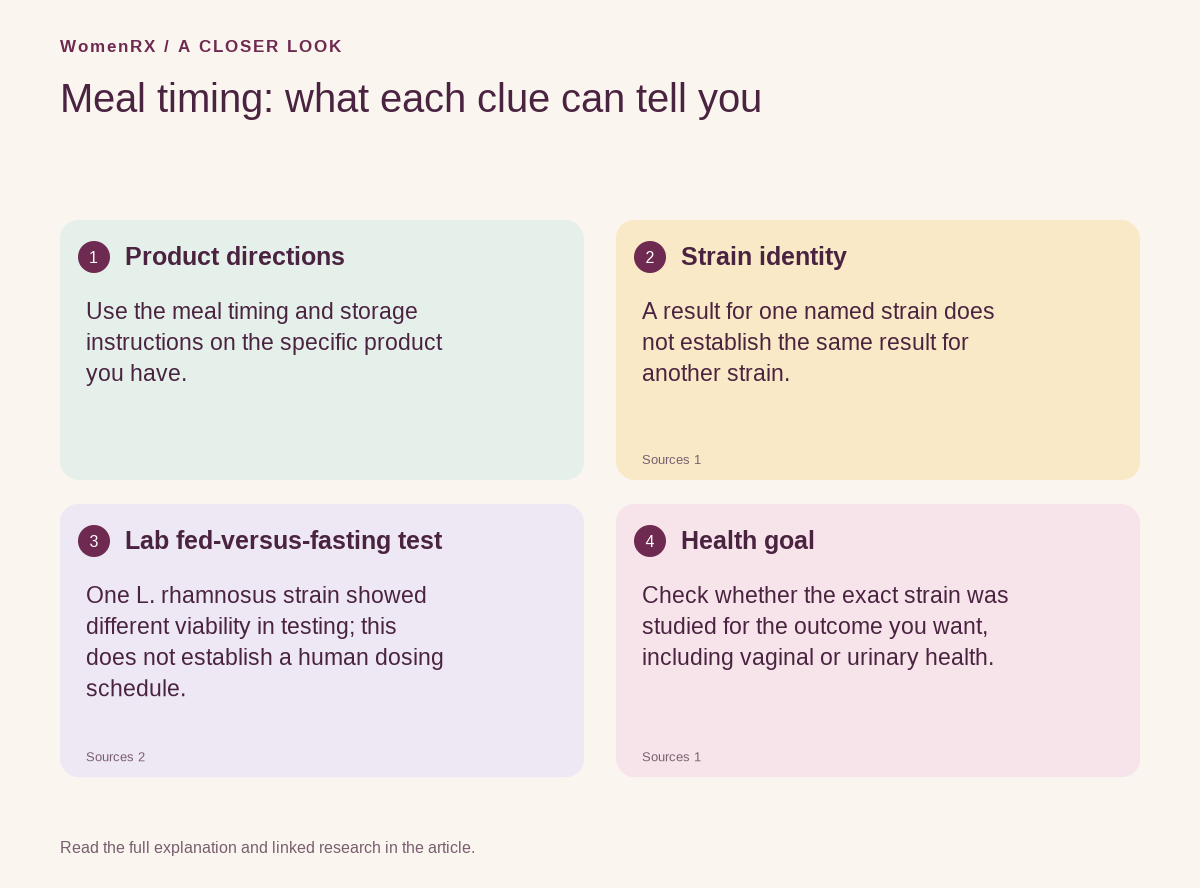
Meal timing: what each clue can tell you
Product directions: Use the meal timing and storage instructions on the specific product you have.
Strain identity: A result for one named strain does not establish the same result for another strain.1
Lab fed-versus-fasting test: One L. rhamnosus strain showed different viability in testing; this does not establish a human dosing schedule.2
Health goal: Check whether the exact strain was studied for the outcome you want, including vaginal or urinary health.1
Read the figure as text
Separate product directions, laboratory findings, and health-outcome evidence before choosing when to take a probiotic.- Product directions: Use the meal timing and storage instructions on the specific product you have.
- Strain identity: A result for one named strain does not establish the same result for another strain.1
- Lab fed-versus-fasting test: One L. rhamnosus strain showed different viability in testing; this does not establish a human dosing schedule.2
- Health goal: Check whether the exact strain was studied for the outcome you want, including vaginal or urinary health.1
More questions, answered
What if my probiotic label doesn’t say whether to take it with food?
There isn’t a universal timing rule to fill in the gap. Choose a time that fits your routine, follow the product’s other directions, and ask a pharmacist or the manufacturer if you need clarification for that specific product.
Sources you can check
- Probiotics - Health Professional Fact SheetAccessed 2026-09-25Return to first citation
- Unveiling the probiotic potential of L. rhamnosus strain 044AE by genomic and phenotypic characterization.Inamdar A, Kumar V, Chauhan A, Dixit Y, Bhingardeve N, Ambavale K, Saroj D. · AIMS microbiology · 2026Return to first citation