How to Judge a Probiotic for IBS
A probiotic’s evidence belongs to the strain and product studied, not to every supplement with similar bacteria.
Some probiotic products have shown symptom improvements in adults with IBS, but results vary and the overall evidence remains uncertain. To judge a product, match its full strain name, dose, formulation, and the IBS type and outcome studied. A larger CFU number alone doesn’t mean a product is more effective. IBS trials don’t establish effectiveness or safety in pregnancy or breastfeeding, which require separate evidence checks. 1 3
“Probiotic” isn’t one treatment
Probiotics are live microorganisms, but products can contain different strains, combinations, and amounts. Evidence for one particular blend or strain does not establish that another product will help, even if its label lists the same bacterial species. The NIH Office of Dietary Supplements notes that many commercial products have not been examined in research and that higher CFU counts aren’t necessarily more effective. 1
That distinction matters for irritable bowel syndrome (IBS), where symptoms and bowel patterns differ. A study in people with IBS with constipation (IBS-C) doesn’t automatically answer whether a product helps IBS with diarrhea (IBS-D), or whether it improves pain, bloating, stool frequency, or another outcome.
What the IBS evidence suggests
A 2026 systematic review and meta-analysis brought together 40 placebo-controlled trials in adults with IBS. Across those studies, probiotic groups had IBS Symptom Severity Scale scores that were an average of 33.42 points lower than placebo groups. But the review rated the evidence as low certainty, mainly because results varied between studies. Its trial-sequential analysis also found that the evidence had not reached the information size needed for a firm conclusion. Quality-of-life scores did not improve significantly overall. So there’s a possible symptom benefit, but not a dependable result for every product or person. 3
Individual trials show why the details matter. In one 84-day trial, 200 people with non-constipated IBS were assigned a blend containing Lactobacillus acidophilus LA-5 and Bifidobacterium animalis subsp. lactis BB-12 or placebo. At day 28, the reported global improvement response was 19.3% with the blend and 8.9% with placebo. The trial’s abstract doesn’t report the blend’s dose, so that detail can’t be compared from the abstract alone. The result applies to the tested blend and study participants; it doesn’t establish that other products containing either species will have the same effect. 4
A separate, smaller trial assigned 30 people with IBS-C to Lacticaseibacillus rhamnosus IDCC 3201 or placebo for eight weeks. The study reported improvements in some bowel and symptom measures with the probiotic. The trial tested a dose of 1 × 10¹⁰ CFU per day. This is an example of a studied product and dose, not a general dose recommendation. 5
The route of administration matters, too. A small trial in people with IBS-D tested probiotics sprayed into the right colon during colonoscopy. That is not the same intervention as taking a capsule or powder by mouth, so its results shouldn’t be treated as evidence for an ordinary retail supplement. 2
A practical product-checking list
Before considering a product for IBS, compare its label and evidence with these four details:
- Full strain name: Look beyond a species such as Lactobacillus. Check whether the strain identifier matches the one in the study. A product with a different strain, or an unspecified strain, doesn’t match that evidence. 1 4 5
- IBS group studied: Check whether the participants had IBS-C, IBS-D, or another defined group, and whether that matches the problem you want to address. Don’t transfer findings from a different group without evidence. 2 4 5
- Outcome and timeframe: Ask what changed in the study: overall symptoms, pain, bloating, bowel habits, or quality of life. Check how long participants used the product. A change in one measure over a particular study period doesn’t promise the same change in another outcome or timeframe. 3 4 5
- Product details: Compare the strain combination and dose when the study reports them, not just the front-label CFU total. The 84-day blend trial’s abstract does not state its dose; the separate IDCC 3201 trial reports a dose, but that dose applies only to the product and study tested. The NIH Office of Dietary Supplements advises looking for CFU listed through the end of the product’s shelf life, because live microorganisms can die during storage. A higher CFU count by itself isn’t proof of greater benefit. 1 4 5
If the strain, dose, formulation, or IBS group doesn’t match, the evidence is a weaker fit. And if you can’t find a human study of that specific product, a claim based on a similar-sounding probiotic isn’t the same as product-level evidence.
What this means for women
The 2026 meta-analysis described above studied adults with IBS; the 84-day blend trial enrolled 200 people with non-constipated IBS. These findings don’t establish whether benefits or risks differ by sex. They also don’t answer pregnancy and breastfeeding as interchangeable categories: effectiveness and safety should be checked separately for pregnancy and for breastfeeding. 3 4
The cited IBS trials don’t establish that a probiotic helps with vaginal or urinary concerns; an IBS finding is specific to digestive symptoms and can’t be carried over to another body site or condition. The studies also don’t establish safety for people who are immunocompromised. 2 3 4 5
A sensible takeaway is to treat a probiotic label as the start of the comparison, not the end of it: match the exact strain and product details to the specific IBS population and outcome studied, and keep the limits of that evidence in view.
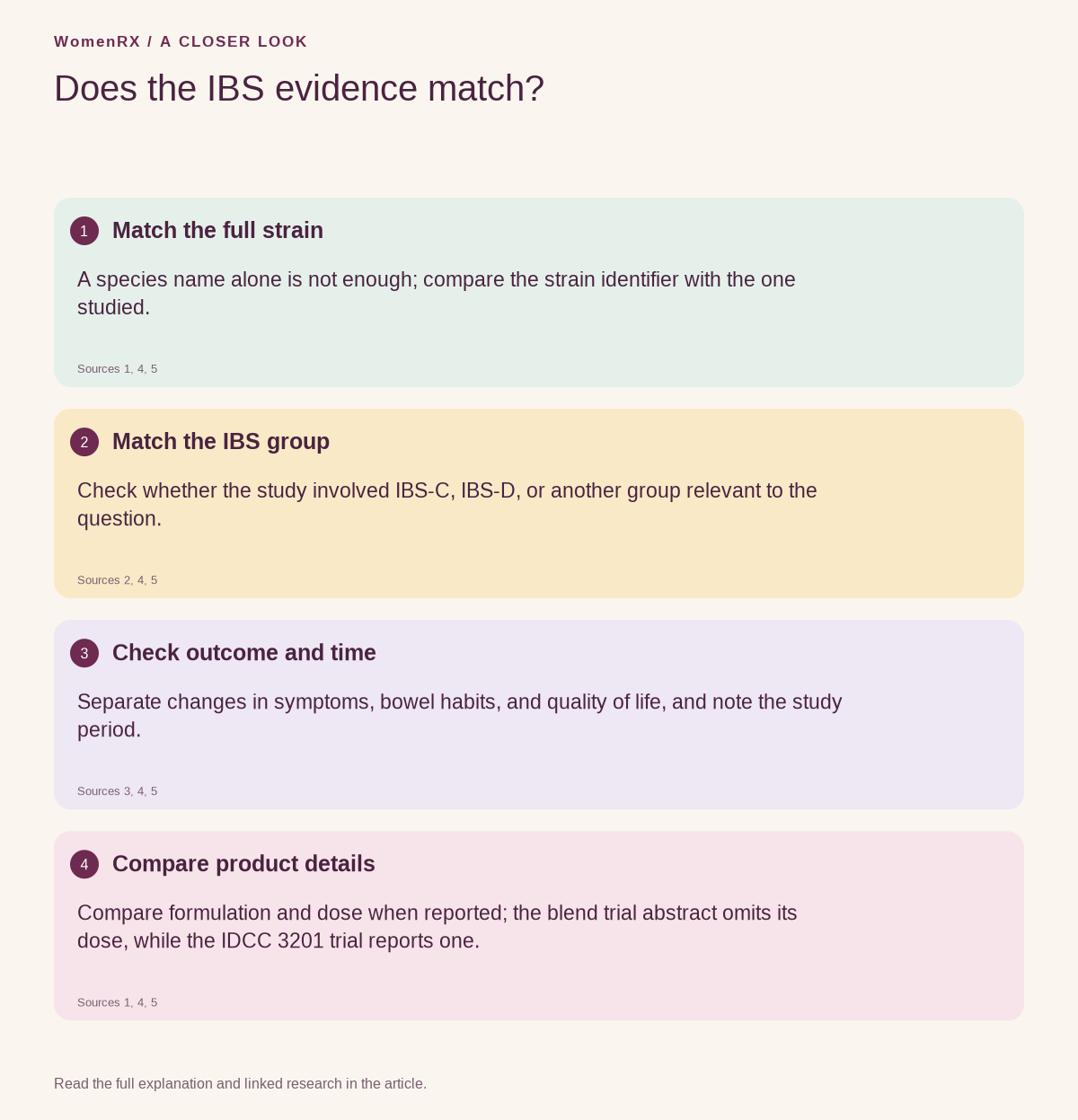
Does the IBS evidence match?
Match the full strain: A species name alone is not enough; compare the strain identifier with the one studied.145
Match the IBS group: Check whether the study involved IBS-C, IBS-D, or another group relevant to the question.245
Check outcome and time: Separate changes in symptoms, bowel habits, and quality of life, and note the study period.345
Compare product details: Compare formulation and dose when reported; the blend trial abstract omits its dose, while the IDCC 3201 trial reports one.145
Read the figure as text
Compare the product label with the actual trial details before treating a study result as relevant to that product.- Match the full strain: A species name alone is not enough; compare the strain identifier with the one studied.145
- Match the IBS group: Check whether the study involved IBS-C, IBS-D, or another group relevant to the question.245
- Check outcome and time: Separate changes in symptoms, bowel habits, and quality of life, and note the study period.345
- Compare product details: Compare formulation and dose when reported; the blend trial abstract omits its dose, while the IDCC 3201 trial reports one.145
More questions, answered
Does a higher CFU count mean a probiotic will work better?
No. CFU indicates the number of viable microorganisms, but a higher count isn’t necessarily more effective. Look for evidence on the specific strain, formulation, and IBS outcome, as well as CFU through the end of shelf life. 1
Sources you can check
- Probiotics - Health Professional Fact SheetAccessed 2026-09-25Return to first citation
- Colonoscopic administration of probiotics to treat irritable bowel syndrome with predominant diarrhea: a randomized placebo-controlled clinical trial.Wei JJ, Zhang PH, Yang ZY, Liu LP, Lian TT, Isomoto H, Zhuang ZH. · Surgical endoscopy · 2025Return to first citation
- Probiotics for Irritable Bowel Syndrome: An Updated Systematic Review and Meta-Analysis With Trial Sequential Analysis.Tang ASP, Quek J, Sulaimi F, Sim B, Kai TOS, Soon EY, Goh CN, Hsu JLJ, Lee CKL, Chong SKS, Sule AA, Ling RR, Siah KTH, Ng QX. · Journal of gastroenterology and hepatology · 2026Return to first citation
- Probiotic Blend of Lactobacillus acidophilus LA-5 and Bifidobacterium animalis ssp. Lactis BB-12 in Non-constipated Irritable Bowel Syndrome: A Double-Blind Randomized Placebo-Controlled Trial.Ghoshal UC, Ramakrishna BS, Rathi PM, Shukla A, Panigrahi MK, Jain S, Saha I, Chakravartty K, Singh M, Mustafa U, Sahu S, Ghoshal U, Chandnani S, Goenka MK, Mitra M. · Journal of gastroenterology and hepatology · 2026Return to first citation
- Effect of Lacticaseibacillus rhamnosus IDCC 3201 on irritable bowel syndrome with constipation: a randomized, double-blind, and placebo-controlled trial.Kwon H, Nam EH, Kim H, Jo H, Bang WY, Lee M, Shin H, Kim D, Kim J, Kim H, Lee J, Jung YH, Yang J, Won DD, Shin M. · Scientific reports · 2024Return to first citation