How to Tell Whether a Probiotic Strain Is Helping
A useful probiotic trial is tied to a particular strain, condition, outcome, and reassessment point, not just the word “probiotic” on a label.
There’s no single timeline for probiotics: results depend on the specific product and condition studied. Before judging yours, match its full strain name and viable dose to a clinical trial for your symptom, then check what the trial measured and when it reassessed people. A change in a different symptom, or in a different condition, doesn’t establish that the probiotic worked for your reason. 1
Start with the strain, not the species
“Lactobacillus” or “Bifidobacterium” identifies a broad group, not a specific probiotic. A study’s finding applies most directly to the strain or combination it actually tested. So when you compare a bottle with a trial, look for the full strain designation, not only the genus or species. A multi-strain product is not automatically a match because it contains a familiar species. 1
Also check how much was tested. Labels may list colony-forming units (CFU), a measure of viable microorganisms. The NIH Office of Dietary Supplements notes that products vary in strains and doses, that many commercial products have not been studied, and that a higher CFU count does not necessarily mean better results. It also advises looking for CFU listed through the end of shelf life, rather than only at manufacture. 1
A close match means the trial and product align on the strain or mixture and the dose and formulation as well as the intended use. If those details aren’t clear on the label, you may not be able to tell whether the research applies to that product.
Match the condition and the outcome
A trial for one condition does not establish benefit for another. Digestive symptoms, for example, are not interchangeable: reflux, diarrhea, and irritable bowel syndrome (IBS) are distinct study targets. And an improvement in one outcome, such as fatigue, is not proof of improvement in another, such as abdominal pain.
One example: a randomized, placebo-controlled trial studied the specific strain Bifidobacterium breve Bif195 in 61 people with diarrhea-predominant IBS for eight weeks. The strain did not improve the trial’s primary or secondary outcomes, which included IBS symptom severity. Fatigue scores were lower in the probiotic group, but that was an exploratory finding, not the main result. For someone considering a probiotic for IBS symptoms, that distinction matters: the trial did not show improvement in its main symptom measure. 3
Another trial tested a four-strain product in 61 people with IBS-like symptoms alongside inflammatory bowel disease. After three months, 45% of participants assigned the probiotic and 33% assigned placebo reached the study’s symptom-improvement threshold; the difference was not statistically significant. The results don’t establish that the product helped, even though the percentage was higher in the probiotic group. 4
These examples also show why it helps to check what counted as improvement before reading a result. A trial might measure a validated symptom score, a specific symptom, or the proportion of participants who meet a defined response threshold. A change in gut microbes or another lab measure is not the same thing as feeling better.
Use the trial’s reassessment point, not a universal countdown
Probiotic studies don’t establish one waiting period that applies to every product and symptom. The IBS-D trial above assessed its main outcomes after eight weeks of treatment, while the IBS/IBD-overlap trial reassessed symptoms after three months. Those are study designs for those interventions, not a promise that another product should work by either point. 3 4
A different example makes the condition-specific timing clearer: a randomized trial of a three-strain formulation used with the reflux medicine rabeprazole assessed participants over an intervention lasting up to 12 weeks. Because the probiotic was tested alongside a medication, that result cannot show what the probiotic alone would do, or establish a timeline for other products or symptoms. 2
For your own decision, use the trial’s actual reassessment point as a reference only when the product and condition are a close match. Ask what symptom should change, how the study measured it, and at what point. If you’re informally judging a product, comparing the same symptom over time is more informative than relying on a general feeling that your gut is “better.” But everyday changes can’t replace a controlled trial, where researchers compare groups and account for change that might have happened anyway.
Keep women’s health claims specific, too
A study of digestive symptoms doesn’t establish a benefit for vaginal symptoms. For a women-specific use, look for a trial of the particular strain or formulation in that context, with a relevant outcome measured. Don’t assume that a product’s “women’s probiotic” label, or evidence for a different health goal, answers the question. Evidence from pregnancy or another life stage should also be matched to that setting rather than applied automatically to everyone. 1
The practical test is simple: can you identify the studied strain, the condition, the outcome, and the reassessment point, and do they closely match the product and reason you’re considering it? If not, the research may be interesting, but it may not tell you whether that specific probiotic is likely to help your symptom.
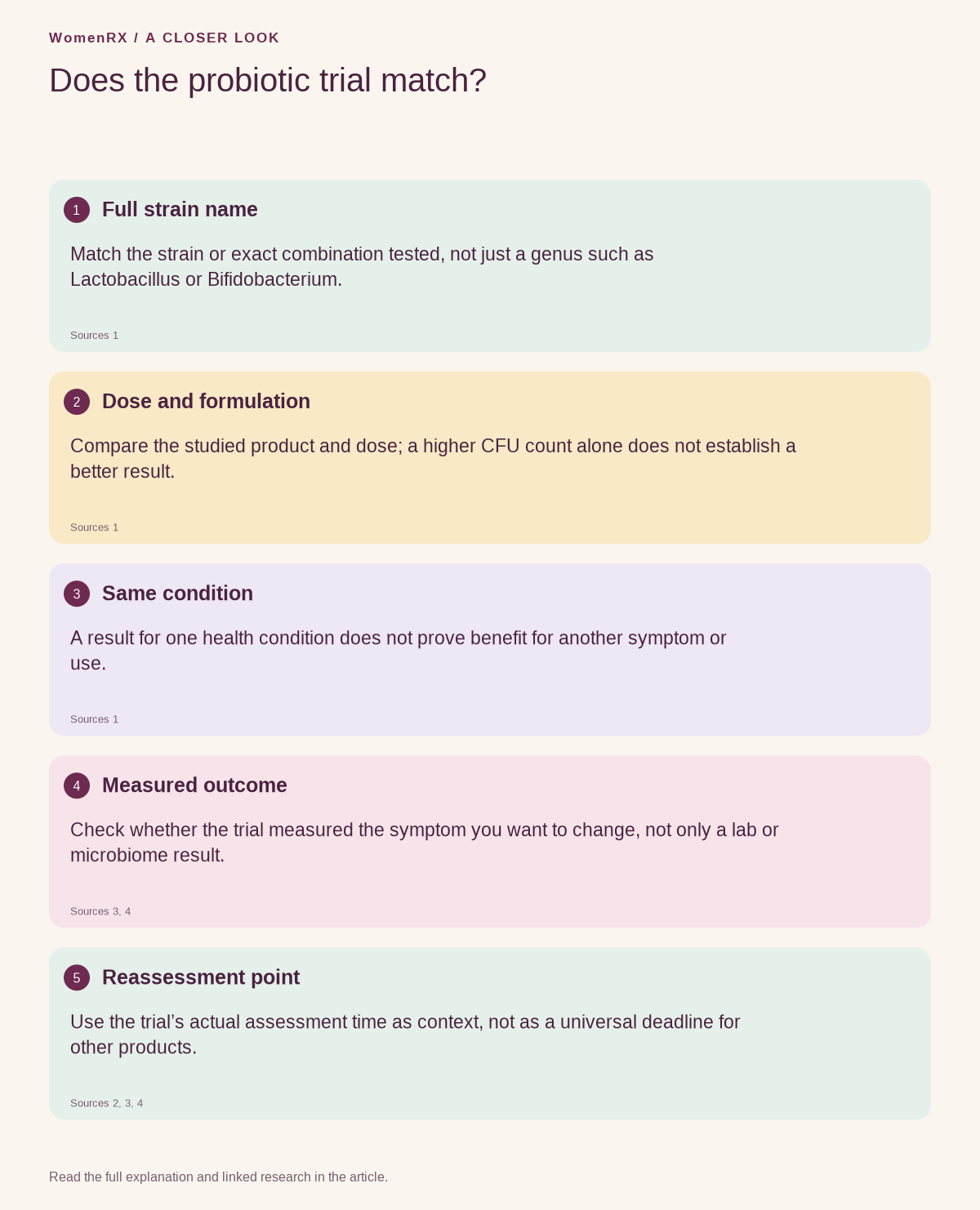
Does the probiotic trial match?
Full strain name: Match the strain or exact combination tested, not just a genus such as Lactobacillus or Bifidobacterium.1
Dose and formulation: Compare the studied product and dose; a higher CFU count alone does not establish a better result.1
Same condition: A result for one health condition does not prove benefit for another symptom or use.1
Measured outcome: Check whether the trial measured the symptom you want to change, not only a lab or microbiome result.34
Reassessment point: Use the trial’s actual assessment time as context, not as a universal deadline for other products.234
Read the figure as text
Check each part before applying a clinical result to a product or symptom.- Full strain name: Match the strain or exact combination tested, not just a genus such as Lactobacillus or Bifidobacterium.1
- Dose and formulation: Compare the studied product and dose; a higher CFU count alone does not establish a better result.1
- Same condition: A result for one health condition does not prove benefit for another symptom or use.1
- Measured outcome: Check whether the trial measured the symptom you want to change, not only a lab or microbiome result.34
- Reassessment point: Use the trial’s actual assessment time as context, not as a universal deadline for other products.234
More questions, answered
Does a higher CFU number mean a probiotic will work better?
No. CFU counts the viable microorganisms, but a higher count does not necessarily mean greater effectiveness. The strain, product, dose, and condition studied all matter. 1
Can a probiotic studied for digestion be assumed to help vaginal symptoms?
No. Evidence for one condition does not establish benefit for another. Look for research on the particular strain or formulation and a relevant vaginal-health outcome. 1
Sources you can check
- Probiotics - Health Professional Fact SheetAccessed 2026-09-25Return to first citation
- Adjunctive probiotic therapy sustains symptom relief in gastroesophageal reflux disease through gut microbiome-metabolome remodeling.Li Y, Li Q, Quan K, Xie Y, Yang N, Ma T, Zheng L, Zhou W, Li Y, Jin H, Sun Z, Chen Y, Kwok L-Y, Lu N, Zhu W, Liu W, Zhang H. · mSystems · 2026Return to first citation
- Eight weeks of treatment with probiotic Bifidobacterium breve, Bif195 lowers fatigue scores in patients with diarrhoea-predominant irritable bowel syndrome: results from a randomised, clinical trial.Grønbæk IMB, Halkjær SI, Hansen EH, Mollerup S, Paulsen SJ, Konrad CV, Engel S, Bulinska-Balas M, Wellejus A, Haaber AB, Christensen AH, Engsbro AL, Petersen AM. · Frontiers in nutrition · 2025Return to first citation
- Four-strain probiotic exerts a positive effect on irritable bowel syndrome symptoms occurring in inflammatory bowel diseases in absence of inflammation (train-IBD trial).Fennessy A, Doyle M, Boland A, Bourke R, O'Connor A. · World journal of gastrointestinal pharmacology and therapeutics · 2025Return to first citation