Probiotics: Match the Strain to the Goal
A probiotic’s evidence is tied to the exact strain, formulation, and outcome studied, not just the word “probiotic” on the bottle.
Start with the outcome you want to address, then look for a human study of that outcome using the same named strain or combination and a comparable formulation. A species name or a high CFU count alone doesn’t show that a product will help. Gut findings also don’t establish benefits for vaginal, urinary, or pregnancy outcomes, which need their own evidence.
Start with the outcome, not the category
“Gut health” can mean constipation, reflux, medication-related diarrhea, or something else. A result for one of these doesn’t automatically apply to the others. For example, a randomized trial in 113 people with functional constipation tested Weizmannia coagulans BC01 and reported improvements in several constipation-related measures after 21 days. That’s evidence about this strain in that condition, not proof that probiotics generally relieve constipation or other digestive symptoms. The trial summary doesn’t report results by sex. 5
A separate randomized study compared two nine-strain products in 100 adults with functional gastrointestinal disorders over four weeks. Some outcomes differed between the formulations: one showed more improvement in early abdominal pain, while the other showed more improvement in reflux symptoms. This doesn’t point to one product as the best choice for every digestive concern. 3
Read the label for a match
Look for the strain identifier. A label that names only a species, such as Lactiplantibacillus plantarum, is less specific than a study that names a strain code, such as K014. Probiotic effects can differ by strain, so don’t assume a study of one strain supports every product containing the same species. 4
Check the full combination. If a study tested several strains together, its findings apply to that tested blend. A product with a different mix isn’t automatically equivalent. In the four-week trial, the two products had similar nine-strain compositions but different viable counts; their reported outcomes varied by symptom and measure rather than showing a simple “more is better” pattern. 3
Compare the CFU amount and serving. CFU describes the viable microorganisms in a product, but it isn’t a measure of how well that product works for your goal. In a constipation trial, BC01 was tested at a specific daily amount; that result doesn’t set a generally effective amount for other strains or conditions. 5
Notice the form used in the study. A sachet, capsule, or other delivery format is part of the tested intervention. If the product label differs from the study in strain, blend, amount, or form, you’re making a less direct comparison. The research summarized here doesn’t establish that one format is best overall. 35
What the women-specific evidence says
One small, 12-week randomized trial studied 30 women with elevated HOMA-IR who were taking metformin. The women assigned a multi-strain probiotic reported fewer gastrointestinal symptoms than those assigned placebo. The probiotic did not add a measurable metabolic benefit. This is a specific finding about digestive side effects during metformin treatment; it doesn’t establish that a probiotic will help women with everyday digestive symptoms, or that the result applies to a different product. 2
Other gut trials summarized here don’t report results separately for women, or don’t specify participants’ sex in the available study details. That limits what you can conclude about whether effects differ by sex or life stage. And evidence about a digestive outcome doesn’t answer a separate question about vaginal or urinary health, or use during pregnancy. Those outcomes need evidence for the relevant population and purpose.
A practical evidence check
Before choosing a product, write down the symptom or outcome you’re targeting. Then compare the label with the study: the exact strain or blend, CFU amount, serving, and form. Ask whether the study measured your outcome in people like you, and whether it compared the product with a placebo or another approach. If the match is weak, the product’s general probiotic claim may be broader than the evidence behind it.
A product can match a study closely and still not guarantee the same result for you. A clinical trial estimates outcomes in a group, and its relevance depends on who took part and what was measured. The useful question isn’t “Is this a probiotic?” It’s “Was this product, or a close match, tested for the outcome I care about?” 1
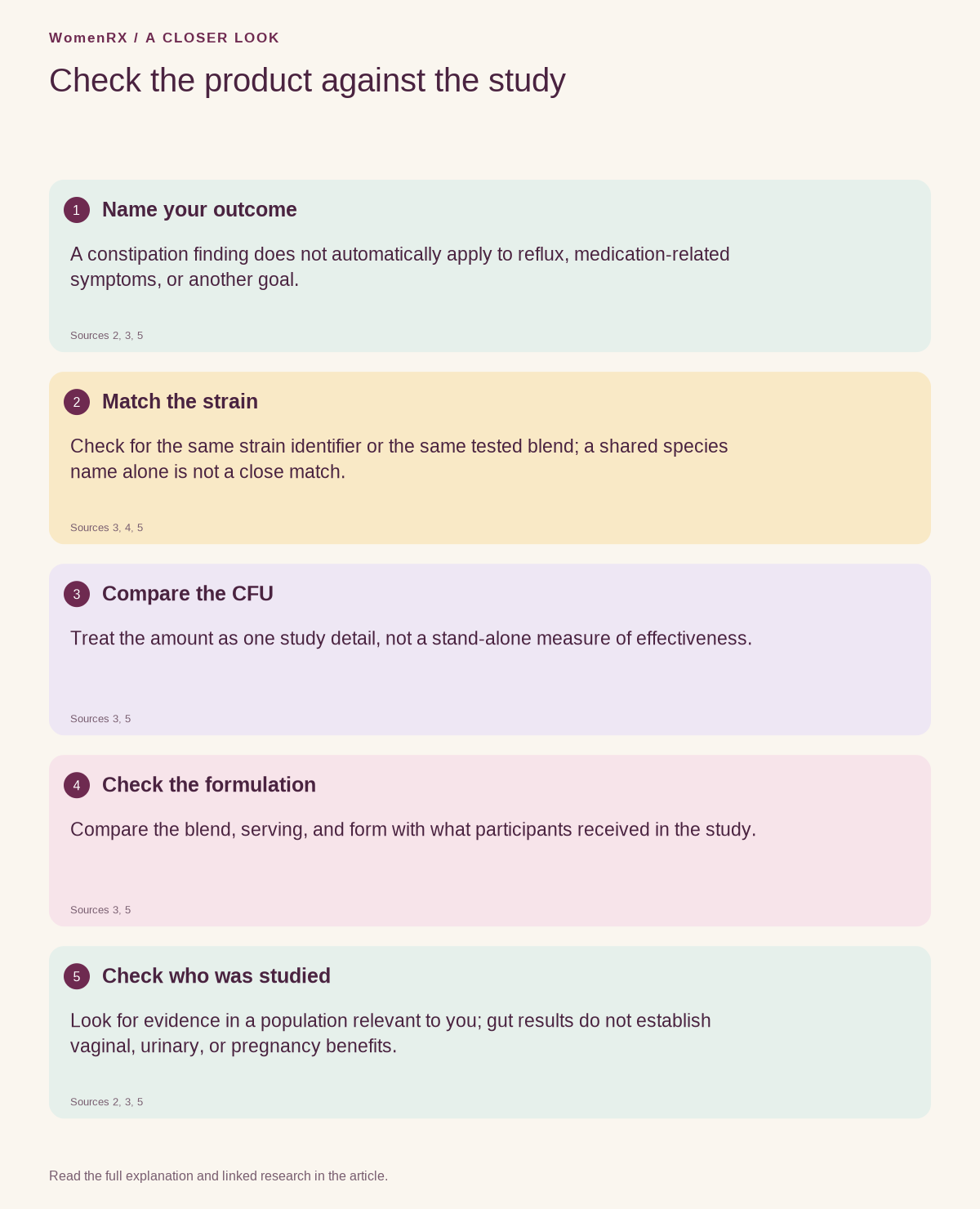
Check the product against the study
Name your outcome: A constipation finding does not automatically apply to reflux, medication-related symptoms, or another goal.235
Match the strain: Check for the same strain identifier or the same tested blend; a shared species name alone is not a close match.345
Compare the CFU: Treat the amount as one study detail, not a stand-alone measure of effectiveness.35
Check the formulation: Compare the blend, serving, and form with what participants received in the study.35
Check who was studied: Look for evidence in a population relevant to you; gut results do not establish vaginal, urinary, or pregnancy benefits.235
Read the figure as text
Compare the product details with the intervention and outcome in a human trial before treating a general probiotic claim as relevant to your goal.- Name your outcome: A constipation finding does not automatically apply to reflux, medication-related symptoms, or another goal.235
- Match the strain: Check for the same strain identifier or the same tested blend; a shared species name alone is not a close match.345
- Compare the CFU: Treat the amount as one study detail, not a stand-alone measure of effectiveness.35
- Check the formulation: Compare the blend, serving, and form with what participants received in the study.35
- Check who was studied: Look for evidence in a population relevant to you; gut results do not establish vaginal, urinary, or pregnancy benefits.235
More questions, answered
Does a higher CFU count mean a probiotic works better?
Not by itself. A trial comparing two multi-strain formulations found differences across symptoms and measures, rather than a uniform advantage for the higher-count product. CFU is one detail to compare with the study, alongside strain, blend, and outcome. 3
Can gut probiotic research support vaginal or urinary claims?
No. A result for a digestive symptom doesn’t establish an effect on vaginal or urinary outcomes. Look for studies designed around the specific outcome and population you’re considering.
Sources you can check
- Clinical Trials: MedlinePlusAccessed 2026-09-25Return to first citation
- Multi-strain probiotic reduces gastrointestinal side effects in women with elevated HOMA-IR index treated with metformin: a 12-week randomised controlled trial.Ratajczak M, Bilska A, Musialik K, Skonieczna-Żydecka K, Łoniewski I, Gogojewicz A, Karolkiewicz J. · Frontiers in endocrinology · 2026Return to first citation
- Effects of Two Compound Probiotic Formulations on Gastrointestinal Symptoms and Gut Microbiota: A 4-Week Randomized, Double-Blind Intervention Trial.Qu Z, Wu Y, Jiang Y, Fan J, Cao L, Dong Y, Fang S, Gu S. · Nutrients · 2025Return to first citation
- Safety of Lactiplantibacillus plantarum K014 in Healthy Adults: A Randomized, Double-Blind, Placebo-Controlled, Parallel-Group Trial.Goh KS, Chong CP, Tan JS, Ho RY, Ng ZJ, Abdul Latiff AZB, Sinnasamy S, Seberi MH. · Nutrients · 2026Return to first citation
- Weizmannia coagulans BC01 supplementation improved functional constipation by regulating gut microbiota: A randomized, placebo-controlled, clinical study.Xu Y, Zhang Y, Yue F, Yu X, Chen Y, Ma X. · Medicine · 2025Return to first citation