Choosing a Probiotic: Match the Strain to the Purpose
A useful probiotic choice starts with the digestive concern you want to address, because results for one strain and condition don’t automatically apply to another.
There isn’t one best probiotic for every woman or every digestive concern. Look for a product that names the strain, gives a viable CFU count through the end of its shelf life, and matches the condition and formulation studied. A higher CFU number or a “for women” label alone doesn’t show that a product will work. 1
Start with the problem, not the product
Probiotics are not interchangeable. A study of one strain for one condition doesn’t establish that a different strain, a blend, or the same product will help with another concern. Even the number of live organisms isn’t a shortcut: products with more CFUs aren’t necessarily more effective. 1
That’s why “best probiotic for women” is usually too broad to guide a choice. First define the goal, such as preventing antibiotic-associated diarrhea, then compare products against evidence for that use. A label that says “women’s gut health” doesn’t tell you which digestive outcome was studied or whether the product matches it.
What the evidence can and can’t tell you
Antibiotic-associated diarrhea is one example where research has examined particular probiotics. A review summarized by the NIH Office of Dietary Supplements found that Lactobacillus rhamnosus GG and Saccharomyces boulardii reduced risk in some analyses. Results varied by age and study: in one analysis, the reduction with L. rhamnosus GG was statistically significant for children but not when adults were assessed separately. In another analysis, S. boulardii was associated with lower risk in adults and children. These findings don’t mean every product containing a related species will work, or that probiotics are appropriate for every person taking antibiotics. 1
Broader reviews also report potential benefits for conditions such as irritable bowel syndrome, inflammatory bowel disease, and constipation, but they emphasize that outcomes vary with the strain, population, and condition. Those broad findings don’t identify a universal product or establish that a particular supplement will help your symptoms. 3
The digestive findings discussed above aren’t reported separately for women and men, so they don’t establish whether benefits differ by sex. If you’re comparing a study with a product, check who participated and whether results were analyzed by sex rather than assuming a “for women” formula has been tested specifically in women.
Pregnancy evidence needs the same close reading. Studies described in the NIH fact sheet looked at probiotic use during pregnancy and early infancy in relation to children’s eczema risk. They don’t answer whether probiotics help a pregnant person’s digestive symptoms, or establish the safety of every probiotic product during pregnancy or while trying to conceive. 1
A practical label check
Before comparing products, look for details that let you match the bottle to a specific study or intended use:
- Full strain name: Look beyond a genus or species name. Strain identification matters because effects can differ between strains. 1
- CFU through expiration: CFU means colony-forming units, an estimate of viable microorganisms. Look for the amount guaranteed at the end of shelf life, not only at manufacture. 1
- Formulation and intended use: Compare the product’s strain or strains and formulation with those studied for your specific concern. The fact sheet notes that recommendations, where available, identify a specific product, dose, and formulation. 1
- Storage directions: Probiotic organisms can die during shelf life. Check the package’s storage instructions and follow them; a large number on the front doesn’t make up for a product that hasn’t been stored as directed. 1
- A claim you can verify: Ask what exact condition and outcome support the product’s claim. “Digestive balance” or “women’s wellness” isn’t a substitute for evidence tied to your goal.
A label can help you screen products, but it can’t prove that the product has been studied or that it will suit you. The NIH fact sheet notes that effects of many commercial probiotic products haven’t been examined in research and that labeling practices are inconsistent. 1
When the decision needs more context
If you’re immunocompromised or receiving cancer treatment, safety deserves particular attention: a review of probiotics for chemotherapy-related digestive complications identifies safety concerns in immunocompromised cases. That is not a finding that every probiotic is unsafe, but it does mean results from other populations shouldn’t be assumed to apply. 2
For any product, bring the exact label and your intended use into the decision if you need help matching it to evidence. Useful questions include: Which strain is this? Was this specific strain and formulation studied for my concern? Who was studied, and were results reported by sex? What amount of viable organisms is guaranteed at the end of shelf life? These questions make it easier to compare a studied product with a broad marketing claim, without treating all probiotics as the same.
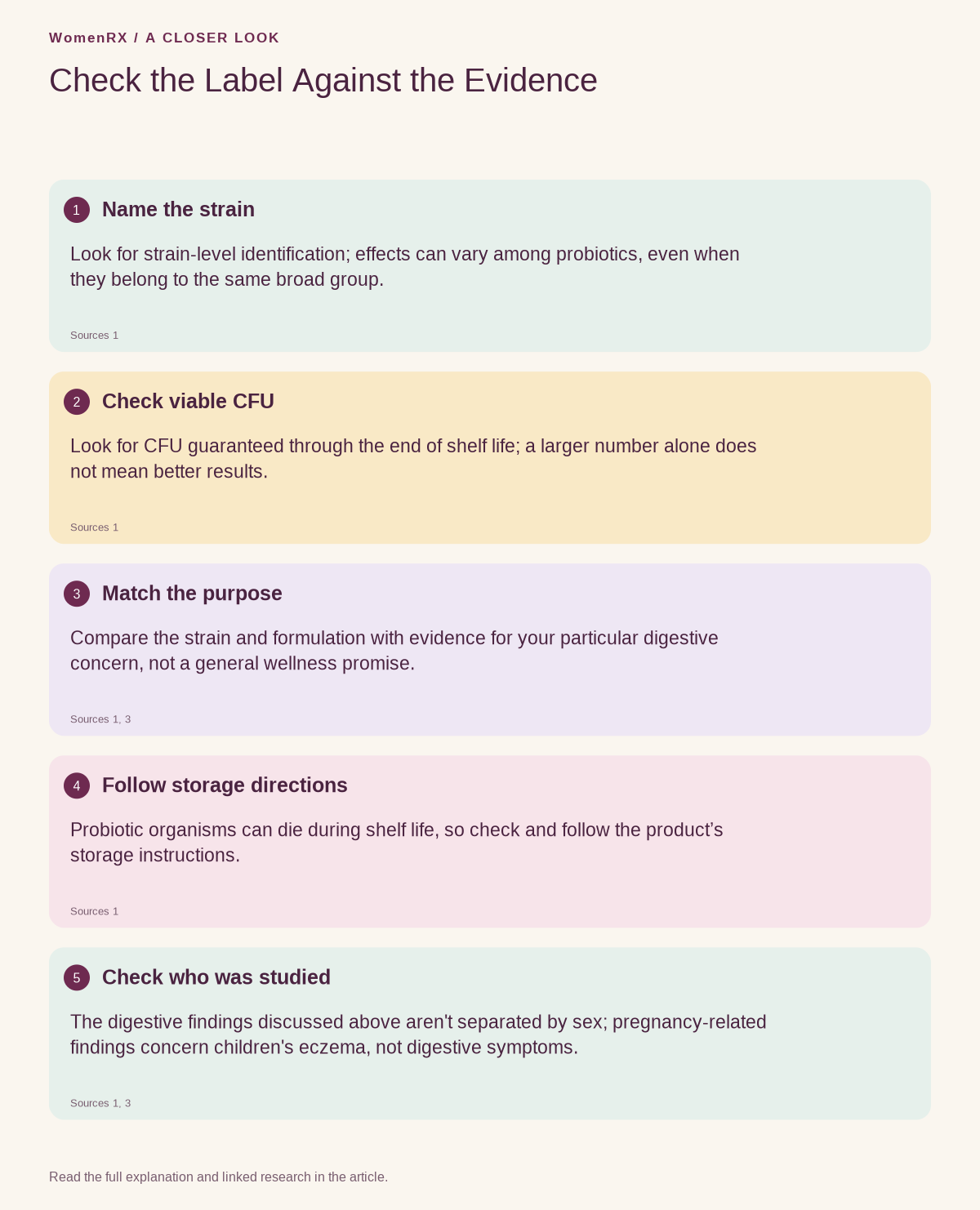
Check the Label Against the Evidence
Name the strain: Look for strain-level identification; effects can vary among probiotics, even when they belong to the same broad group.1
Check viable CFU: Look for CFU guaranteed through the end of shelf life; a larger number alone does not mean better results.1
Match the purpose: Compare the strain and formulation with evidence for your particular digestive concern, not a general wellness promise.13
Follow storage directions: Probiotic organisms can die during shelf life, so check and follow the product’s storage instructions.1
Check who was studied: The digestive findings discussed above aren't separated by sex; pregnancy-related findings concern children's eczema, not digestive symptoms.13
Read the figure as text
Use these details to compare a product with research for a specific digestive concern, rather than relying on a broad wellness claim.- Name the strain: Look for strain-level identification; effects can vary among probiotics, even when they belong to the same broad group.1
- Check viable CFU: Look for CFU guaranteed through the end of shelf life; a larger number alone does not mean better results.1
- Match the purpose: Compare the strain and formulation with evidence for your particular digestive concern, not a general wellness promise.13
- Follow storage directions: Probiotic organisms can die during shelf life, so check and follow the product’s storage instructions.1
- Check who was studied: The digestive findings discussed above aren't separated by sex; pregnancy-related findings concern children's eczema, not digestive symptoms.13
More questions, answered
Does a higher CFU count mean a probiotic is better?
No. CFU estimates viable microorganisms, but products with higher counts aren’t necessarily more effective. Check whether the strain and amount match evidence for the condition you’re considering. 1
Are probiotic results known to differ for women?
The digestive findings discussed above aren’t broken out by sex, so they don’t establish whether benefits differ between women and men. A product’s “for women” label doesn’t fill that evidence gap.
Sources you can check
- Probiotics - Health Professional Fact SheetAccessed 2026-09-25Return to first citation
- Probiotics in the Management of Chemotherapy-Induced Gastrointestinal Complications: Underlying Mechanisms and Potential Applications.Mazloom F, Mottaghizadeh-Jazi M, Sadeghi Dousari A, Farsinejad A, Khanahmad A. · Molecular nutrition & food research · 2026Return to first citation
- Efficacy and Safety of Probiotics, Prebiotics, and Synbiotics: An Umbrella Review of Systematic Reviews and Meta-Analysis of Randomized Controlled Trials.Hoang T, Kim J. · Nutrition reviews · 2026Return to first citation