How to Choose a Probiotic for the Concern You Have
A probiotic’s evidence belongs to a particular strain, health concern, and outcome, not to every product carrying the same species name.
Start with the health concern, then match the product’s full strain name to human research on that same concern and outcome. For antibiotic-associated diarrhea, evidence supports certain strains, including Lactobacillus rhamnosus GG and Saccharomyces boulardii, in some age groups; it does not make every probiotic interchangeable or establish a vaginal or urinary benefit. 1
Begin with the problem, not the product
“Probiotic” describes a broad category, not one treatment. Research findings can depend on the exact strain, the condition being studied, and who took it. A result for one strain and one outcome doesn’t automatically apply to another strain, another product, or another concern. 1
That matters when a label or ad promises broad benefits for women. A probiotic studied for antibiotic-associated diarrhea isn’t thereby shown to prevent urinary tract infections, treat vaginal symptoms, or support every kind of digestion. For a specific concern, look for evidence that matches both the product’s strain and the outcome you care about.
If you’re taking antibiotics
Antibiotics can disturb gut microbes in ways that contribute to diarrhea. But diarrhea during or after antibiotics can have different causes, and a probiotic isn’t a substitute for assessing symptoms that are severe or persistent. 13
The NIH Office of Dietary Supplements reports evidence that Lactobacillus rhamnosus GG (often shortened to LGG) or Saccharomyces boulardii may reduce the risk of antibiotic-associated diarrhea when started within two days of the first antibiotic dose in children and adults ages 18 to 64. The same summary reports no evidence of benefit in adults 65 and older. This isn’t a claim that every product containing a related species will work, or that the benefit applies equally to every antibiotic or care setting. 1
A separate randomized, placebo-controlled trial illustrates why the full strain name matters. In children ages six months to 10 years taking amoxicillin-clavulanate for ear or sinus infections, Limosilactobacillus reuteri DSM 17938 was associated with fewer cases of diarrhea than placebo during follow-up. That pediatric finding is specific to the studied strain, children, antibiotic, and setting; it shouldn’t be treated as proof for adults or for a different product. 4
The useful comparison is not “probiotic versus no probiotic” in the abstract. It’s whether a study tested the same strain for the same outcome in people reasonably like you. Evidence for one strain may be promising without establishing that a multi-strain blend, a product with a different strain, or a larger CFU number works better. The NIH summary says there’s no evidence that using more than one strain improves prevention of antibiotic-associated diarrhea compared with the supported approach. 1
Read the label for a match
Check these details before comparing products:
- Full strain identity: Find the genus, species, and strain designation, not just a familiar species name. A strain’s letter-and-number code can be the key to matching it with research. 1
- The outcome studied: Was the product evaluated for preventing antibiotic-associated diarrhea, or for a different digestive outcome? Those results aren’t interchangeable. 1
- The study population and context: Note age, antibiotic, and care setting. The evidence summarized for antibiotic-associated diarrhea varies by these factors. 1
- The product information: CFU indicates the number of viable cells listed for a supplement, but a high CFU count alone doesn’t show that the product has demonstrated a benefit for your concern. Product labeling and recommendations can be inconsistent. 1
If the label lists a species but no strain designation, you may not be able to confirm that it matches the strain in a study. A product containing several strains isn’t automatically a better match.
Keep vaginal and urinary claims separate
Gut evidence for antibiotic-associated diarrhea does not establish that an oral probiotic prevents vaginal infections or urinary tract infections. The strain-specific principle applies here too: a claim about vaginal or urinary health needs evidence for that particular concern and outcome, not an assumption based on gut results. The evidence summarized above doesn’t establish a reliable vaginal or urinary benefit. 1
That doesn’t prove no relevant research exists. It means you shouldn’t use evidence for one condition as a stand-in for evidence about another. If you’re choosing a product for vaginal or urinary symptoms, check whether the evidence actually studied that symptom or condition and the exact strain in the product.
Safety depends on the person, too
For someone who is immunocompromised, probiotic use deserves an individual safety check. An editorial reviewing probiotic research describes reports of bloodstream infections associated with probiotic use and flags safety concerns for immunocompromised people; it doesn’t quantify an individual’s risk. A pediatric trial of a different probiotic excluded children with immune deficiency, so its results don’t answer safety for that group. 54
The antibiotic-associated-diarrhea findings described here also don’t establish safety or benefit during pregnancy. If you’re pregnant, or have an immune condition, ask your clinician or pharmacist whether a specific product is appropriate for your situation rather than relying on a general product claim.
A probiotic also shouldn’t distract from diarrhea that needs attention. MedlinePlus advises adults to contact a health care provider for signs of dehydration or diarrhea lasting more than two days. 2
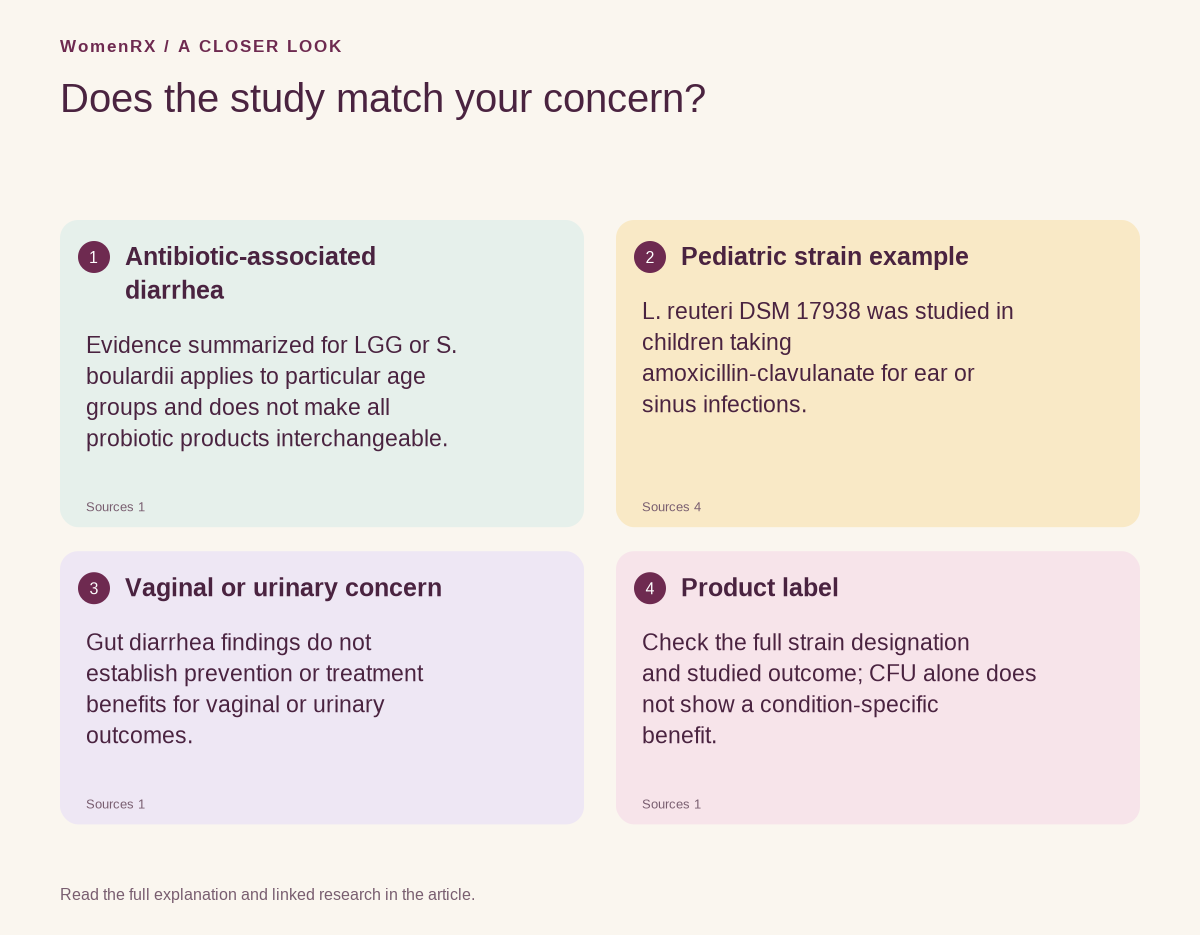
Does the study match your concern?
Antibiotic-associated diarrhea: Evidence summarized for LGG or S. boulardii applies to particular age groups and does not make all probiotic products interchangeable.1
Pediatric strain example: L. reuteri DSM 17938 was studied in children taking amoxicillin-clavulanate for ear or sinus infections.4
Vaginal or urinary concern: Gut diarrhea findings do not establish prevention or treatment benefits for vaginal or urinary outcomes.1
Product label: Check the full strain designation and studied outcome; CFU alone does not show a condition-specific benefit.1
Read the figure as text
Compare the concern, strain, and study population before treating a probiotic claim as relevant to you.- Antibiotic-associated diarrhea: Evidence summarized for LGG or S. boulardii applies to particular age groups and does not make all probiotic products interchangeable.1
- Pediatric strain example: L. reuteri DSM 17938 was studied in children taking amoxicillin-clavulanate for ear or sinus infections.4
- Vaginal or urinary concern: Gut diarrhea findings do not establish prevention or treatment benefits for vaginal or urinary outcomes.1
- Product label: Check the full strain designation and studied outcome; CFU alone does not show a condition-specific benefit.1
More questions, answered
Does a higher CFU number mean a probiotic is more effective?
Not by itself. CFU is the number of viable cells listed on the label; it doesn’t establish that a product has been shown to help with your specific concern. Match the strain and studied outcome, not just the count. 1
Should I choose a product with several strains?
More strains don’t automatically mean more benefit. For prevention of antibiotic-associated diarrhea, the NIH summary reports no evidence that using more than one strain improves the benefit. 1
Sources you can check
- Probiotics - Health Professional Fact SheetAccessed 2026-09-25Return to first citation
- Diarrhea | MedlinePlusAccessed 2026-09-25Return to first citation
- Antibiotics: MedlinePlusAccessed 2026-09-25Return to first citation
- Effect of Limosilactobacillus reuteri DSM17938 to prevent antibiotic-associated diarrhea in children: prospective, multi-center, randomized, placebo-controlled clinical trial (PEARL Study).Dinleyici EC, Ozen M, Guven S, Dalgic N, Karbuz A, Sutcu M, Turel O, Oz FN, Kirli U, Yasar Durmus S, Yazar AS, Cakin ZE, Vandenplas Y, Kara A. · European journal of pediatrics · 2025Return to first citation
- From Chaos to Clarity? The Quest for Effective Probiotics in Antibiotic-Associated Diarrhea.Rao K, Garey KW. · Open forum infectious diseases · 2024Return to first citation