Choosing a Probiotic? Start With the Condition
For vaginal health, the useful question is whether a study tested the same product, in the same situation, for the outcome you want.
Choose a probiotic by the condition and outcome studied, not a broad “women’s wellness” claim. For bacterial vaginosis (BV), some trials suggest a benefit when probiotics are added to antibiotics, but results differ by product and study. One trial of two named oral strains found no significant improvement in cure rates. Check the strains, route, length of use, and follow-up before applying a finding to a product. 2 5
First, name the job you want it to do
Are you trying to treat a current BV episode, reduce the chance it returns, or address a digestive or urinary concern? Those aren’t interchangeable goals. A study of vaginal bacteria cannot tell you whether a product relieves digestive symptoms, and a study of BV cure cannot necessarily tell you whether BV will stay away.
For any probiotic claim, compare four details: the exact strains or formula, how it was used, how long it was used, and what researchers measured and when. “Contains Lactobacillus” isn’t a close match to a study of two named strains. Neither is an oral supplement a match to a study of a vaginal product. These distinctions matter because BV trials have tested different probiotic approaches and reached different results. 2 5
For BV, an add-on may help, but the formula matters
A 2022 meta-analysis combined 14 randomized trials in nonpregnant women of childbearing age that compared antibiotics plus probiotics with antibiotics alone or with placebo. Across those trials, the probiotic add-on groups had a higher relative rate of BV cure (risk ratio 1.23; 95% confidence interval 1.05 to 1.43). That pooled result doesn’t give you the absolute chance of cure with a product on a shelf, and the trials used different approaches. 2
A specific trial shows why the pooled finding isn’t a promise about every formula. Researchers randomized 126 Chinese women with BV to metronidazole alone or metronidazole plus oral Lacticaseibacillus rhamnosus GR-1 and Limosilactobacillus reuteri RC-14. The oral strains were used for 30 days; cure was assessed at 30 and 90 days. The add-on did not significantly improve cure rates at either assessment. Those are the trial’s use and measurement periods, not a recommended course for another product. 5
The same meta-analysis included three trials comparing probiotics alone with antibiotics and found no statistically significant difference in BV cure. That does not establish that probiotics work as well as antibiotics: the estimate was uncertain. BV is usually treated with antibiotics, so a probiotic shouldn’t be used as a substitute for getting a suspected episode assessed and treated. 1 2
A better lab result isn’t necessarily a better day
Some vaginal-health studies measure a change in vaginal bacteria rather than relief of symptoms or fewer future infections. In one 12-week placebo-controlled trial, a five-strain oral formula improved Nugent scores and certain bacterial measurements. But participants had intermediate Nugent scores, not diagnosed BV, and the study doesn’t show that the formula treats a symptomatic BV episode or prevents its return. 4
This is a useful product-label test. If your goal is fewer recurrences, look for research that actually followed recurrence. If your goal is relief from discharge or odor, a change in a lab measure alone doesn’t answer that question. And if your goal is digestive or urinary relief, vaginal-outcome studies are the wrong evidence to rely on.
Pregnancy changes which evidence applies
In a small randomized trial, pregnant women whose vaginal infections had already been treated received one oral probiotic formula or placebo until delivery. Among 47 women analyzed, there was no significant difference in the rate of any vulvovaginal infection during follow-up. The women took the study product for about four months; that describes this trial, not how long someone should take a probiotic. Its combined infection outcome also cannot be read as a BV-only result. 3
If you’re pregnant and think you have BV, get assessed rather than trying to sort it out with a supplement. BV can sometimes be associated with pregnancy complications, although most pregnancies affected by BV have no problems. Some other probiotic trials excluded pregnant women and people taking immunosuppressants, so their findings don’t settle whether a particular product is suitable in those situations. If you’re immunocompromised, discuss the specific product with your care team before using it. 1 4 5
Know when the question is diagnosis, not product choice
BV may cause thin, grayish-white discharge with a fishy smell, especially after sex. It usually doesn’t cause soreness or itching, and some people have no symptoms. Other conditions can also change discharge. If you think you have BV, an assessment can confirm the cause and check for other infections. The same applies if symptoms return: recurrence is common, but you still need to know what’s causing the change before deciding what to do next. 1
If you’re comparing products for a confirmed concern, take the study description literally. Match its population, named strains, oral or vaginal route, length of use, and outcome. When one of those differs, treat the claim as a weaker fit rather than assuming all probiotics do the same job.
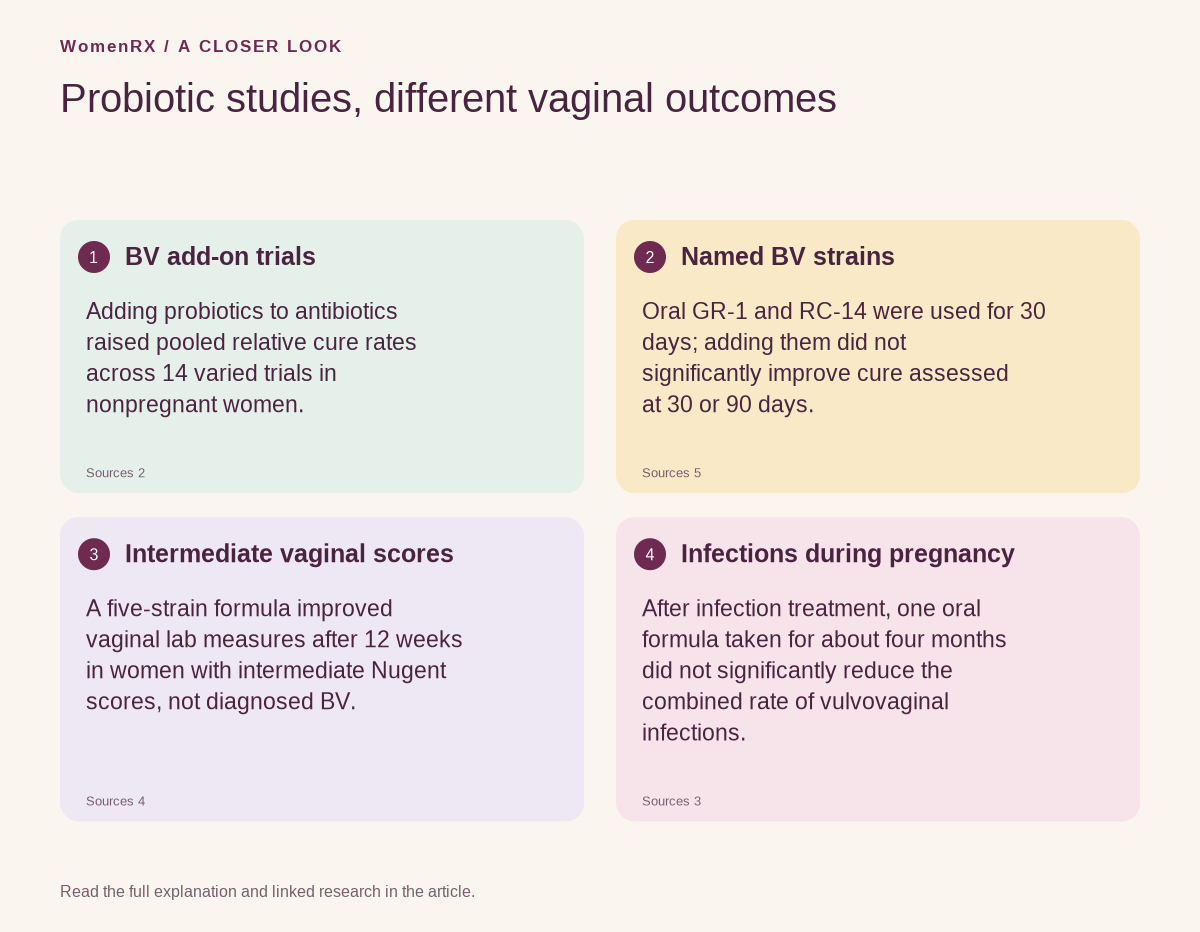
Probiotic studies, different vaginal outcomes
BV add-on trials: Adding probiotics to antibiotics raised pooled relative cure rates across 14 varied trials in nonpregnant women.2
Named BV strains: Oral GR-1 and RC-14 were used for 30 days; adding them did not significantly improve cure assessed at 30 or 90 days.5
Intermediate vaginal scores: A five-strain formula improved vaginal lab measures after 12 weeks in women with intermediate Nugent scores, not diagnosed BV.4
Infections during pregnancy: After infection treatment, one oral formula taken for about four months did not significantly reduce the combined rate of vulvovaginal infections.3
Read the figure as text
Compare who was studied, what was measured, and when. None of these findings applies automatically to a different formula.- BV add-on trials: Adding probiotics to antibiotics raised pooled relative cure rates across 14 varied trials in nonpregnant women.2
- Named BV strains: Oral GR-1 and RC-14 were used for 30 days; adding them did not significantly improve cure assessed at 30 or 90 days.5
- Intermediate vaginal scores: A five-strain formula improved vaginal lab measures after 12 weeks in women with intermediate Nugent scores, not diagnosed BV.4
- Infections during pregnancy: After infection treatment, one oral formula taken for about four months did not significantly reduce the combined rate of vulvovaginal infections.3
Sources you can check
- Bacterial vaginosis - NHSAccessed 2026-09-25Return to first citation
- Probiotics are a good choice for the treatment of bacterial vaginosis: a meta-analysis of randomized controlled trial.Chen R, Li R, Qing W, Zhang Y, Zhou Z, Hou Y, Shi Y, Zhou H, Chen M. · Reproductive health · 2022Return to first citation
- Oral Probiotics to Prevent Recurrent Vulvovaginal Infections During Pregnancy-Multicenter Double-Blind, Randomized, Placebo-Controlled Trial.Nachum Z, Suleiman A, Colodner R, Battino S, Wattad M, Kuzmin O, Yefet E. · Nutrients · 2025Return to first citation
- Efficacy and Safety of MED-01 Probiotics on Vaginal Health: A 12-Week, Multicenter, Randomized, Double-Blind, Placebo-Controlled Clinical Trial.Park SH, Lee ES, Park ST, Jeong SY, Yun Y, Kim Y, Jeong Y, Kang CH, Choi HJ. · Nutrients · 2023Return to first citation
- Probiotic Lacticaseibacillus rhamnosus GR-1 and Limosilactobacillus reuteri RC-14 as an Adjunctive Treatment for Bacterial Vaginosis Do Not Increase the Cure Rate in a Chinese Cohort: A Prospective, Parallel-Group, Randomized, Controlled Study.Zhang Y, Lyu J, Ge L, Huang L, Peng Z, Liang Y, Zhang X, Fan S. · Frontiers in cellular and infection microbiology · 2021Return to first citation