Probiotics for BV or UTIs: What Strain Studies Show
Research on Lactobacillus rhamnosus GR-1 concerns recurrence, but it doesn’t establish that every probiotic product prevents or treats BV or UTIs.
A 2021 review reports that the specific strain Lactobacillus rhamnosus GR-1 has been studied for reducing recurrence of both bacterial vaginosis (BV) and urinary tract infections (UTIs). But the review abstract doesn’t give enough trial detail to judge the size of benefit or match it to a particular product or route. Older trial findings were mixed, so probiotics aren’t an established substitute for condition-specific care. 4 5
The condition and the outcome both matter
A probiotic study about BV doesn’t answer a UTI question, and a study about preventing recurrence doesn’t show that a probiotic treats an infection that’s happening now. The most specific finding in this research is about Lactobacillus rhamnosus GR-1: a 2021 review describes research reporting reduced recurrence of both BV and UTIs. Its abstract doesn’t give the underlying trials’ methods, participant details, effect sizes, or routes of use, so it can’t tell you how much benefit to expect or whether a product you’re considering matches the research. 5
That distinction matters because probiotic effects can vary by strain. Products may contain different strains or blends, and many commercial probiotic products haven’t been studied. A label that says only “Lactobacillus” or “women’s probiotic” doesn’t establish that the product contains GR-1 or has been tested for your particular concern. 3
BV: some positive findings, not a settled treatment
A 2008 review of 11 randomized trials found mixed results. Two studies reported benefit from Lactobacillus probiotics for BV treatment; a separate trial reported 35% fewer recurrent BV episodes than placebo. Seven studies across BV and UTI found no therapeutic effect. The review concluded that limitations in strain-specific evidence prevented recommending Lactobacillus probiotics for BV treatment. These findings describe the trials the review assessed, not every study conducted since. 4
The GR-1 review’s recurrence finding is a reason to distinguish prevention research from treatment evidence, not a reason to assume a supplement will clear current symptoms. BV can cause thin, greyish-white discharge with a fishy smell, but some people have no symptoms, and other conditions can also change discharge. BV is usually treated with antibiotics when treatment is needed. If you’re pregnant and think you may have BV, seek evaluation rather than relying on a probiotic; pregnancy-related concerns call for condition-specific care. The GR-1 review does not establish a probiotic benefit in pregnancy. 2 5
UTIs: recurrence research isn’t treatment for an active infection
The GR-1 review also describes reduced UTI recurrence, but its abstract doesn’t report how large the reduction was or which route was used. The older review found UTI prevention evidence inconclusive, pointing to small studies and dosing approaches that had not been validated. Together, these reviews don’t establish a probiotic as a dependable way to prevent UTIs. 4 5
If you have symptoms that could be a UTI, such as pain or burning when you urinate, don’t rely on a probiotic in place of evaluation or treatment. UTIs may need medical treatment, and prevention is a separate question from treating an infection that has already started. 1
Why the route belongs in the comparison
An oral product and one used vaginally aren’t automatically interchangeable. To apply a study to a product, you’d want to know the full strain name, how it was taken, whether the study measured BV or UTI, and whether it tested treatment or recurrence prevention. Some probiotic organisms may be taken orally or applied locally, but that general possibility doesn’t show that either route works for a particular condition or strain. The GR-1 review abstract doesn’t provide those study details. 5 6
When comparing a product with research, look for the specific strain designation, the route used in the study, and the outcome studied. If those details aren’t clear, a broad probiotic claim doesn’t tell you whether the findings apply. For current BV or UTI symptoms, focus first on identifying the condition and getting appropriate care; any possible role in preventing recurrence is a separate decision.
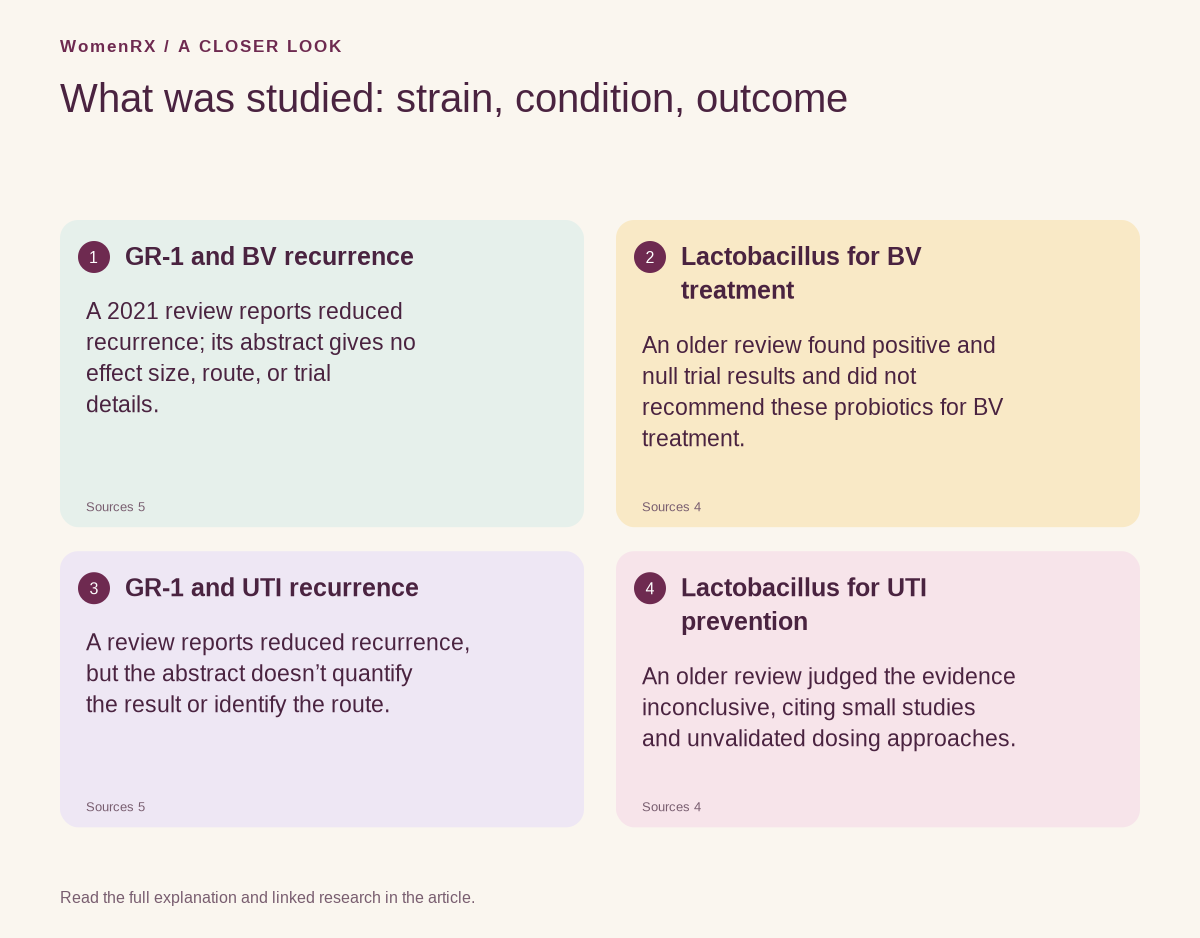
What was studied: strain, condition, outcome
GR-1 and BV recurrence: A 2021 review reports reduced recurrence; its abstract gives no effect size, route, or trial details.5
Lactobacillus for BV treatment: An older review found positive and null trial results and did not recommend these probiotics for BV treatment.4
GR-1 and UTI recurrence: A review reports reduced recurrence, but the abstract doesn’t quantify the result or identify the route.5
Lactobacillus for UTI prevention: An older review judged the evidence inconclusive, citing small studies and unvalidated dosing approaches.4
Read the figure as text
These findings concern different conditions and outcomes. A recurrence finding does not establish treatment, and a general probiotic label doesn’t show that a product matches a studied strain or route.- GR-1 and BV recurrence: A 2021 review reports reduced recurrence; its abstract gives no effect size, route, or trial details.5
- Lactobacillus for BV treatment: An older review found positive and null trial results and did not recommend these probiotics for BV treatment.4
- GR-1 and UTI recurrence: A review reports reduced recurrence, but the abstract doesn’t quantify the result or identify the route.5
- Lactobacillus for UTI prevention: An older review judged the evidence inconclusive, citing small studies and unvalidated dosing approaches.4
More questions, answered
Does a study of GR-1 apply to every Lactobacillus probiotic?
No. Probiotic effects can differ by strain, and products vary in their ingredients. Research on GR-1 doesn’t establish the same effect for another strain or a multi-strain product. 3 5
Does the GR-1 research establish a benefit during pregnancy?
No pregnancy-specific benefit is established by the GR-1 review abstract. If you’re pregnant and think you may have BV, seek evaluation rather than using a probiotic as a substitute for care. 2 5
Sources you can check
- Urinary tract infections (UTIs) - NHSAccessed 2026-09-25Return to first citation
- Bacterial vaginosis - NHSAccessed 2026-09-25Return to first citation
- Probiotics - Health Professional Fact SheetAccessed 2026-09-25Return to first citation
- Use of Lactobacillus probiotics for bacterial genitourinary infections in women: a review.Barrons R, Tassone D. · Clinical therapeutics · 2008Return to first citation
- Lacticaseibacillus rhamnosus GR-1, a.k.a. Lactobacillus rhamnosus GR-1: Past and Future Perspectives.Petrova MI, Reid G, Ter Haar JA. · Trends in microbiology · 2021Return to first citation
- Probiotics and non-intestinal infectious conditions.de Vrese M, Schrezenmeir J. · The British journal of nutrition · 2002Return to first citation