Probiotics: Which Benefits Have Human Evidence?
Probiotics aren’t one treatment: results depend on the strain, the condition, and the outcome researchers measured.
Some specific probiotics have evidence for particular outcomes, including modest improvement in some irritable bowel syndrome symptoms and reduced antibiotic-associated diarrhea in certain groups. That doesn’t mean any probiotic will work for those concerns. Research on fertility outcomes is promising but low to very low certainty, and the recurrent-UTI findings are limited. Match a product to the exact strain and outcome studied, not just the word “probiotic.” 1 2 3
Start with the outcome, not the label
“Probiotic” describes a broad group of live microorganisms, not a single treatment. A study’s result applies to the strain or combination it tested, the people who took it, and the outcome it measured. A product containing different strains, or the same species without the same strain designation, isn’t automatically equivalent. A change in gut microbes also isn’t proof of a health benefit by itself. 1
That’s why a useful question isn’t simply “Do probiotics work?” It’s “Did this specific product help with the outcome I care about, in a group like me?”
Digestive outcomes: some signals, not a universal fix
Irritable bowel syndrome
Reviews summarized by the NIH found a modest overall benefit for some IBS symptoms, including abdominal pain, bloating, or flatulence. But results varied among products and symptoms, and the quality of some studies was low. One review of 35 randomized trials in 3,406 adults found statistically significant improvement in global symptoms in 14 of 29 trials and a clinically meaningful reduction in abdominal pain in 8 of 34 trials. These are counts of trials reporting a result, not the chance that an individual will improve. 1
The studies don’t establish a single best probiotic for every person with IBS, or a reliable choice based on whether symptoms lean toward constipation or diarrhea. The adult findings also aren’t a women-specific result: the summary doesn’t report a separate women’s subgroup. 1
Diarrhea during antibiotic treatment
Evidence suggests that some strains, including Lactobacillus rhamnosus GG and Saccharomyces boulardii, may lower the risk of antibiotic-associated diarrhea in children and adults under 65. In one review of 12 randomized trials, the risk among participants taking antibiotics fell from 22.4% without the probiotic to 12.3% with L. rhamnosus GG. The difference was statistically significant in children when adults and children were analyzed separately; the adult subgroup result was not statistically significant. Another review found lower risk with S. boulardii in both adults and children. These findings don’t establish a benefit for every strain, antibiotic, or person. 1
Other digestive claims need their own evidence
For Crohn’s disease, a review found no evidence that probiotics helped induce or maintain remission. For ulcerative colitis, findings are more uncertain: some studies suggest a modest benefit in mild-to-moderate disease alongside usual treatment, but the evidence is limited and guidance does not support routine use. That’s a very different claim from easing occasional bloating, and it shouldn’t be used to replace established IBD treatment. 1
Reproductive and urinary claims: read the fine print
A 2026 review of 16 studies involving 2,339 women with infertility reported associations between oral probiotics and higher biochemical and clinical pregnancy rates and live-birth rates. It also found an association between vaginal probiotics and lower miscarriage risk among clinical pregnancies. The review included randomized and observational studies, and rated the evidence low to very low certainty. These results are not proof that probiotics improve fertility generally, and they don’t establish that a particular product will improve an individual’s chance of pregnancy. 2
Recurrent urinary tract infection (UTI) prevention is another claim, but the available review summary offers limited detail for choosing a product. It included two recurrent-UTI trials within a 12-trial review of several kinds of bacterial infections and described results as directionally favorable. The review rated certainty across its outcomes as low to moderate, in part because studies were small and varied. It doesn’t report whether the UTI findings came from a women-only population or identify a specific strain in the summary. So these results aren’t enough to treat probiotics as a proven general UTI-prevention option. 3
A practical way to assess a product claim
Before choosing a supplement, compare its label with the evidence behind the claim:
- Condition and outcome: Is the study about the same issue you want to address, and did it measure a meaningful outcome rather than only a microbiome change?
- Strain: Does the product list the same strain designation or combination that was studied? Species names alone may not be specific enough. 1
- Population: Were participants similar in age and health status? Don’t assume a mixed adult result applies specifically to women when a women’s subgroup wasn’t reported. 1
- Product information: Check whether the label identifies the strains and the number of live microorganisms through the use-by date. A higher CFU count alone doesn’t mean a product works better. 1
Many commercial probiotic products haven’t been studied in research, and inconsistent labeling can make it difficult to connect a product to a trial. A product’s general “gut health” or “women’s health” wording doesn’t establish that it has evidence for a specific symptom or diagnosis. 1
Safety depends on who’s taking it
In healthy people, common probiotic side effects are usually mild, such as temporary gas. Serious infections associated with probiotics have been reported, most often in people who are severely ill or immunocompromised. The balance may be different in those situations, so the reassuring safety picture for healthy people shouldn’t be generalized to everyone. 1
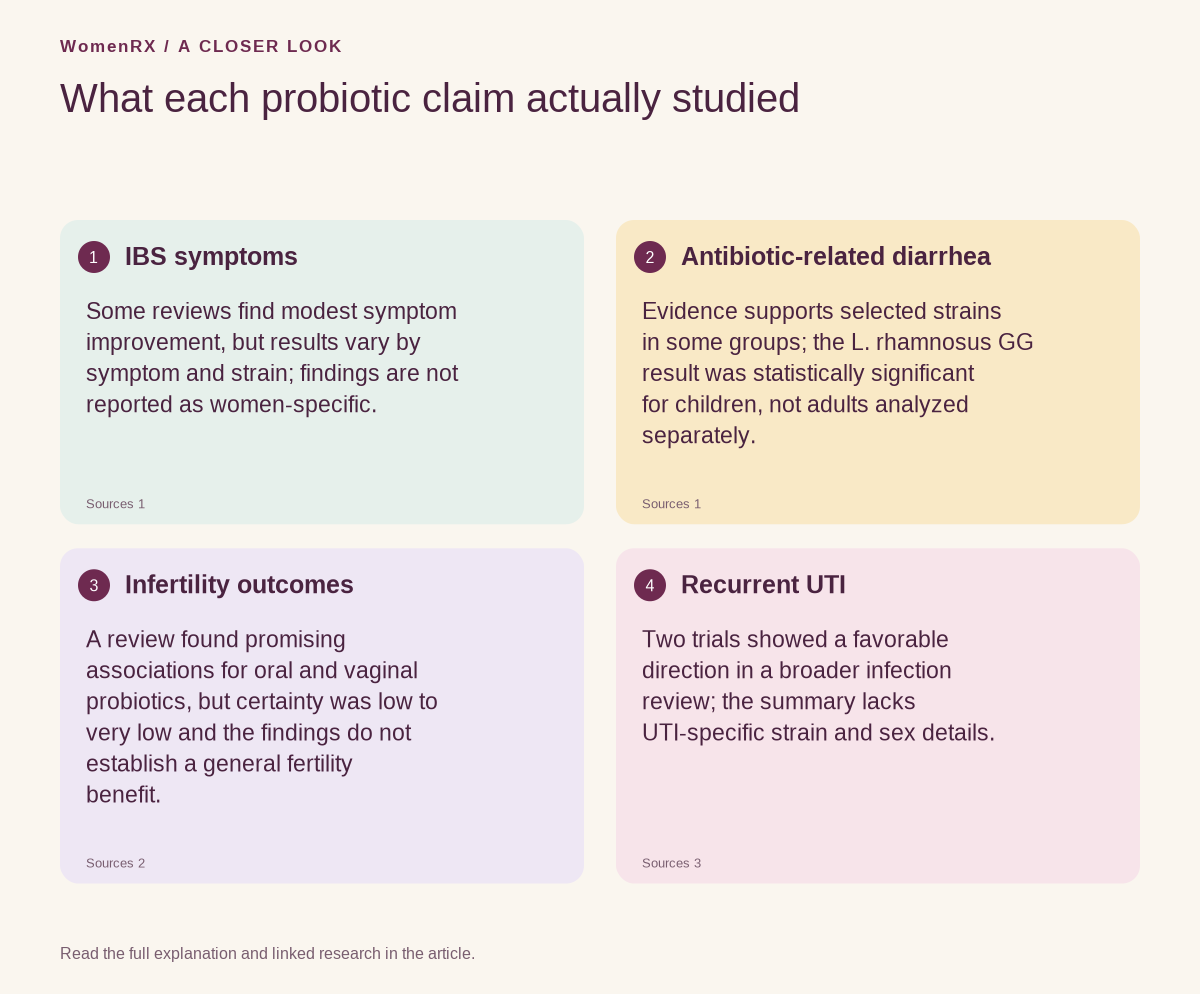
What each probiotic claim actually studied
IBS symptoms: Some reviews find modest symptom improvement, but results vary by symptom and strain; findings are not reported as women-specific.1
Antibiotic-related diarrhea: Evidence supports selected strains in some groups; the L. rhamnosus GG result was statistically significant for children, not adults analyzed separately.1
Infertility outcomes: A review found promising associations for oral and vaginal probiotics, but certainty was low to very low and the findings do not establish a general fertility benefit.2
Recurrent UTI: Two trials showed a favorable direction in a broader infection review; the summary lacks UTI-specific strain and sex details.3
Read the figure as text
Compare the outcome and evidence boundary for digestive, reproductive, and urinary claims before assuming a product applies.- IBS symptoms: Some reviews find modest symptom improvement, but results vary by symptom and strain; findings are not reported as women-specific.1
- Antibiotic-related diarrhea: Evidence supports selected strains in some groups; the L. rhamnosus GG result was statistically significant for children, not adults analyzed separately.1
- Infertility outcomes: A review found promising associations for oral and vaginal probiotics, but certainty was low to very low and the findings do not establish a general fertility benefit.2
- Recurrent UTI: Two trials showed a favorable direction in a broader infection review; the summary lacks UTI-specific strain and sex details.3
More questions, answered
Does a higher CFU number mean a probiotic will work better?
No. CFU describes the number of viable microorganisms, but a higher count alone doesn’t show that a product is more effective. Look for evidence tied to the strain and outcome you care about, and check whether the label gives the CFU through the end of shelf life. 1
Are probiotics proven to improve fertility?
No general fertility benefit is established. A review in women with infertility found promising associations for some pregnancy outcomes, but the evidence was low to very low certainty and doesn’t show that probiotics improve fertility for everyone or that any product will help. 2
Sources you can check
- Probiotics - Health Professional Fact SheetAccessed 2026-09-25Return to first citation
- Oral and Vaginal Probiotics and Pregnancy Outcomes in Women With Infertility: A Systematic Review and Meta-analysis.Moradi M, Grieger JA, Tong Y, Heilbronn LK. · Obstetrics and gynecology · 2026Return to first citation
- A systematic review evaluating efficacy of probiotics in prevention and treatment of bacterial infections.Bhagat T, Goyal A, Chatterji T. · Future microbiology · 2026Return to first citation