Vitamin D Treatment: What Follow-Up Can Show
A blood test can show whether 25-hydroxyvitamin D has changed, but it can’t by itself show that symptoms or bone health have improved.
Vitamin D supplementation can raise the blood level measured by a 25-hydroxyvitamin D test, but the size of the change depends partly on the amount taken, the starting level, and time on supplementation. 1 A rising level alone doesn’t tell you when to retest after a low result. Ask the clinician managing that result whether a repeat test is part of your plan and what it would help decide.
Three different kinds of response
When you start vitamin D after a low result, it’s natural to wonder when you’ll feel a difference. But “working” can mean three different things: the vitamin D level in your blood has risen, a symptom has changed, or bone health has improved. These aren’t interchangeable milestones, and they don’t necessarily happen together.
The main blood test is 25-hydroxyvitamin D, sometimes written as 25(OH)D. It reflects vitamin D from food, supplements, and the body’s own production. The active form, 1,25-dihydroxyvitamin D, is generally not the right test for assessing vitamin D status. 1
A higher 25(OH)D result shows a change in the blood marker. It doesn’t prove that a symptom was caused by low vitamin D, or that the symptom will improve. Vitamin D’s role in bone health is clearer than its role in many other outcomes, and the relationship between a blood level and health effects is not fully established. 1
What a repeat blood test can tell you
Vitamin D levels tend to rise when intake increases, but the response isn’t a simple, predictable climb. How much the level changes depends in part on the starting level, the amount of vitamin D taken, and how long supplementation has been used. Available lab tests also vary, which can affect results. 1
For context, National Academies guidance describes levels below 12 ng/mL as associated with deficiency risk, 12 to less than 20 ng/mL as generally inadequate for most healthy people, and 20 ng/mL or more as adequate for most. These are population-level reference points, not a promise that one number is the right treatment target for every person. The Endocrine Society has not set universal thresholds for vitamin D sufficiency, and it does not recommend routine testing in healthy people. 1
Routine testing guidance for healthy people is a different question from follow-up after a documented low result. If you have a low result, ask the clinician managing it whether a repeat test is part of your plan, what question it would answer, and how the result might affect next steps.
Absorption can complicate that discussion. Some digestive conditions limit vitamin D absorption, and guidance for people who have had bariatric surgery specifically addresses vitamin D monitoring. That does not establish a testing schedule for everyone with a low result. 1
Starting level and time on supplementation can affect how much 25(OH)D changes. Absorption and body weight can also influence vitamin D status or the blood-level response. 14
The blood marker has a circulating half-life of about 15 days, but that is not a recommended wait time for retesting or a countdown to symptom relief. 1
Symptoms and bone health are different measures
Severe vitamin D deficiency can cause osteomalacia in adults, with symptoms such as bone pain and muscle weakness. A change in 25(OH)D alone can’t establish whether those symptoms are improving. 13
Bone outcomes are assessed differently. A bone-density scan measures bone mineral density; it does not substitute for a vitamin D blood test. Trials in postmenopausal women and older men have found small increases in bone mineral density with vitamin D and calcium supplements in some settings, while evidence about fracture reduction in people living in the community is inconsistent. A blood-level rise should not be read as proof of stronger bones or fewer fractures. 12
If you’re postmenopausal and concerned about osteoporosis or fracture risk, the vitamin D result is only one part of the picture. A bone-density scan can assess bone density, and decisions about osteoporosis prevention or treatment involve more than the vitamin D number. 12
Pregnancy and breastfeeding call for separate context
Vitamin D response can vary during pregnancy. In one randomized trial of pregnant participants, researchers measured 25(OH)D at enrollment and again in the third trimester. The blood-level increase differed by BMI. That trial shows that biochemical response can vary; it does not establish a universal supplement plan, testing schedule, or benefit for pregnancy outcomes. 4
Breastfeeding raises a separate question: a mother’s blood level is not the same as an infant’s vitamin D plan. Human milk is not usually enough on its own to meet an infant’s vitamin D needs, so infant supplementation guidance is separate from decisions about testing or supplementing the breastfeeding parent. 1
A practical way to interpret “how long”
Think of follow-up in terms of the question being checked. A blood test asks whether 25(OH)D changed after supplementation; it doesn’t give a reliable countdown to feeling better. A symptom review asks whether you feel different. Bone-density testing asks about bone mineral density. None of those measures can stand in for the others. 12
If you’ve been advised to supplement for a low result, clarify whether a repeat 25(OH)D test is part of your plan, when it would answer a useful question in your situation, and what result might lead to a change. If you feel no different, that doesn’t automatically mean the blood level hasn’t changed; if the level rises, that doesn’t guarantee symptoms will resolve. Keeping those outcomes separate makes follow-up more meaningful.
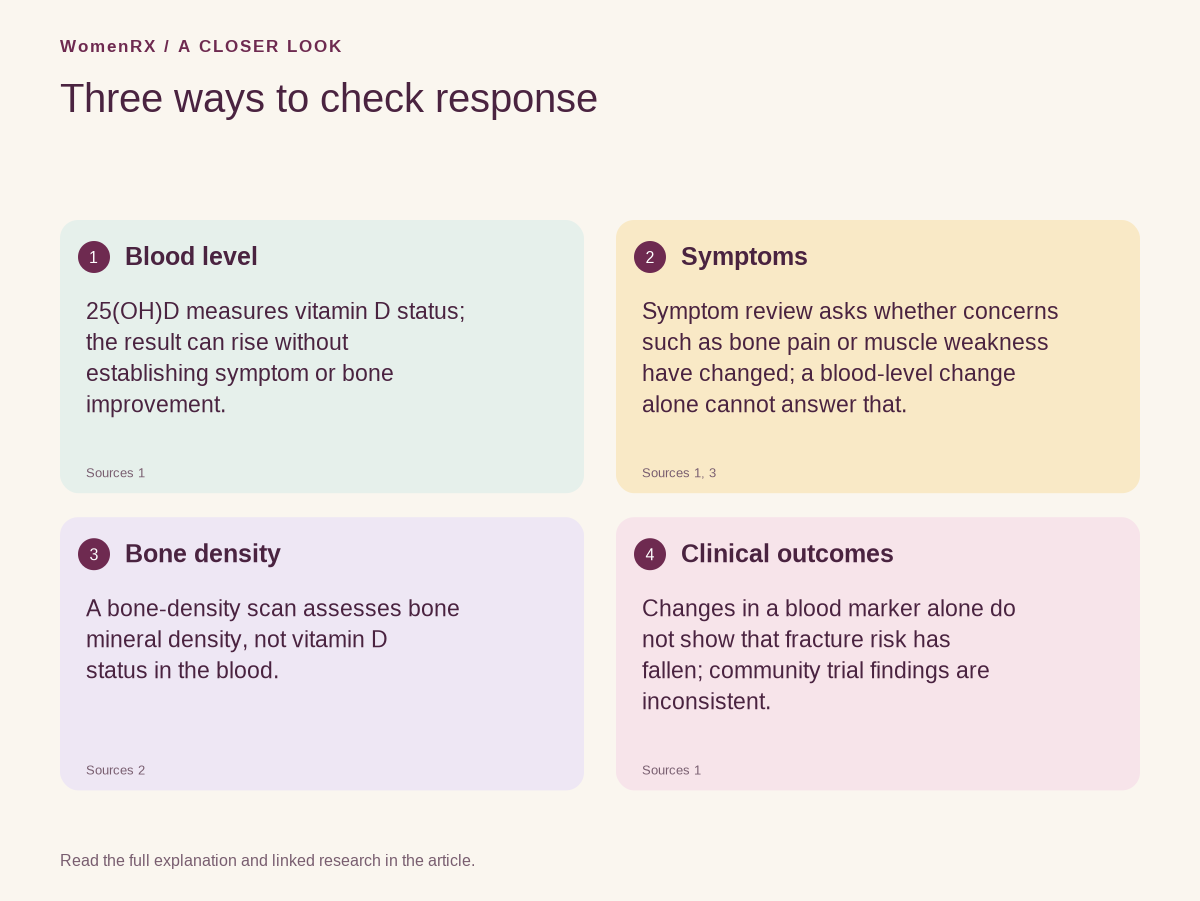
Three ways to check response
Blood level: 25(OH)D measures vitamin D status; the result can rise without establishing symptom or bone improvement.1
Symptoms: Symptom review asks whether concerns such as bone pain or muscle weakness have changed; a blood-level change alone cannot answer that.13
Bone density: A bone-density scan assesses bone mineral density, not vitamin D status in the blood.2
Clinical outcomes: Changes in a blood marker alone do not show that fracture risk has fallen; community trial findings are inconsistent.1
Read the figure as text
These measures answer different questions. A change in one does not prove a change in the others.- Blood level: 25(OH)D measures vitamin D status; the result can rise without establishing symptom or bone improvement.1
- Symptoms: Symptom review asks whether concerns such as bone pain or muscle weakness have changed; a blood-level change alone cannot answer that.13
- Bone density: A bone-density scan assesses bone mineral density, not vitamin D status in the blood.2
- Clinical outcomes: Changes in a blood marker alone do not show that fracture risk has fallen; community trial findings are inconsistent.1
More questions, answered
Which vitamin D test checks my level?
The usual test is 25-hydroxyvitamin D, or 25(OH)D. The active form, 1,25-dihydroxyvitamin D, is generally not a good measure of vitamin D status. 1
Does a higher result mean my bones are healthier?
Not by itself. A 25(OH)D test measures vitamin D status; a bone-density scan measures bone mineral density. A blood-level increase alone does not demonstrate improved bone density or fewer fractures. 12
Sources you can check
- Vitamin D - Health Professional Fact SheetAccessed 2026-09-25Return to first citation
- Bone Density | Bone Mineral Density | BMD | MedlinePlusAccessed 2026-09-25Return to first citation
- Vitamin D Deficiency: MedlinePlusAccessed 2026-09-25Return to first citation
- Higher Maternal Body Mass Index Attenuates the Response to High-Dose Vitamin D Supplementation During Pregnancy: A Secondary Analysis of the Randomized Vitamin D Antenatal Asthma Reduction Trial (VDAART).Jung C, Lu Z, Handy DE, Litonjua AA, Loscalzo J, Weiss ST, Mirzakhani H. · The Journal of nutrition · 2026Return to first citation