Trying to Conceive: Timing, Testing, and When to Get Help
A simple timing approach works for many people, but age, cycle patterns, and reproductive history can change when it makes sense to seek help.
If you’re trying through sex and your cycles are regular, having sex every two to three days is one way to cover the chance of conception without pinpointing ovulation.2 Seek an infertility evaluation after 12 months of trying if you’re under 35, or after 6 months if you’re 35 or older. Irregular periods, a known fertility-related condition, or being over 40 can warrant an earlier conversation.14
Start with a timing approach you can live with
Trying to conceive can quickly turn into a project of counting days. You don’t have to start there. For people having sex with a sperm-producing partner, sex every two to three days is a straightforward approach that doesn’t depend on identifying one particular day.2 For example, if tracking ovulation makes sex feel like a deadline, that regular pattern may be more workable.
It’s also normal for pregnancy not to happen in the first few cycles. The NHS estimates that more than 8 in 10 couples in which the woman is under 40 conceive naturally within a year when they have unprotected sex every two to three days. That describes a group over a full year, not your personal odds in any given month.2 If your route involves donor sperm or insemination rather than sex, the every-two-to-three-days approach doesn’t translate directly. Planning with a fertility service may be useful from the outset, and the evaluation thresholds used for therapeutic donor insemination are included in US professional guidance.4
Let your circumstances set the clock
The usual point to begin an infertility evaluation is 12 months of attempts if you’re under 35 and 6 months if you’re 35 or older. These are points to seek answers, not deadlines you must reach before you’re allowed to ask a question. For women over 40, professional guidance calls for more immediate evaluation. It also recommends immediate evaluation when a condition known to cause infertility is already present.14
Some histories make waiting less useful. Irregular periods are a reason to ask about assessment sooner; polycystic ovary syndrome (PCOS) is one possible cause of failure to ovulate. A history of pelvic inflammatory disease, prior fertility concerns, or a condition known to cause infertility is another reason to ask about assessment sooner.14 Prior pregnancy doesn’t rule out a new fertility problem, either. Difficulty conceiving after an earlier pregnancy is called secondary infertility.2
These distinctions matter more than finding a single rule that fits everyone. For example, someone with predictable cycles who has tried for two months is in a different position from someone whose periods are infrequent and unpredictable, even if both started trying on the same date.1
What an evaluation is looking for
An infertility evaluation isn’t one test with a pass-or-fail result. It starts with a health history and may include an examination, with testing chosen according to the situation. The main questions are whether ovulation is occurring, whether the uterus or fallopian tubes may be affecting conception, and, when sperm comes from a partner, whether a semen analysis identifies a possible sperm-related factor.14
That broader view can save time and misplaced blame. Fertility difficulties can involve either partner, both partners, or no cause that testing can clearly identify. ACOG recommends assessing a male partner from the outset in an infertility workup; semen analysis is one possible early test.14 If you’re using donor sperm, tell the care team how many insemination attempts you’ve made and whether you’ve had any evaluation already. The relevant questions about ovulation and reproductive anatomy still depend on your own history.4
Tests for the person hoping to carry a pregnancy may assess ovulatory function, ovarian reserve, and reproductive anatomy.4 If there’s reason to check whether the fallopian tubes are open, imaging options include an X-ray test called hysterosalpingography and ultrasound-based approaches. A systematic review found differences between these approaches in test agreement and discomfort, so the choice is worth discussing in the context of what information is needed and which tests are offered locally.3
Results shape the next step rather than automatically pointing to IVF. Depending on the cause, possibilities include treating an underlying condition, medication, surgery, or assisted conception such as intrauterine insemination or IVF.12 Sometimes the initial workup does not identify a cause; that finding does not mean the difficulty is imagined.4
Make the next move fit the question
If you’ve just started and have regular cycles, a sustainable pattern of sex may be enough for now. If periods are irregular, you have a history linked to fertility problems, or you’re over 40, ask about evaluation sooner. If you’ve reached the age-based time threshold, ask for an assessment that considers ovulation, reproductive anatomy, and the sperm source rather than assuming timing is the only issue.124
Trying can also be emotionally tiring, especially when each cycle brings a new decision about testing or treatment. Support or counseling can be part of the plan alongside medical assessment, not something you have to save for a crisis.1
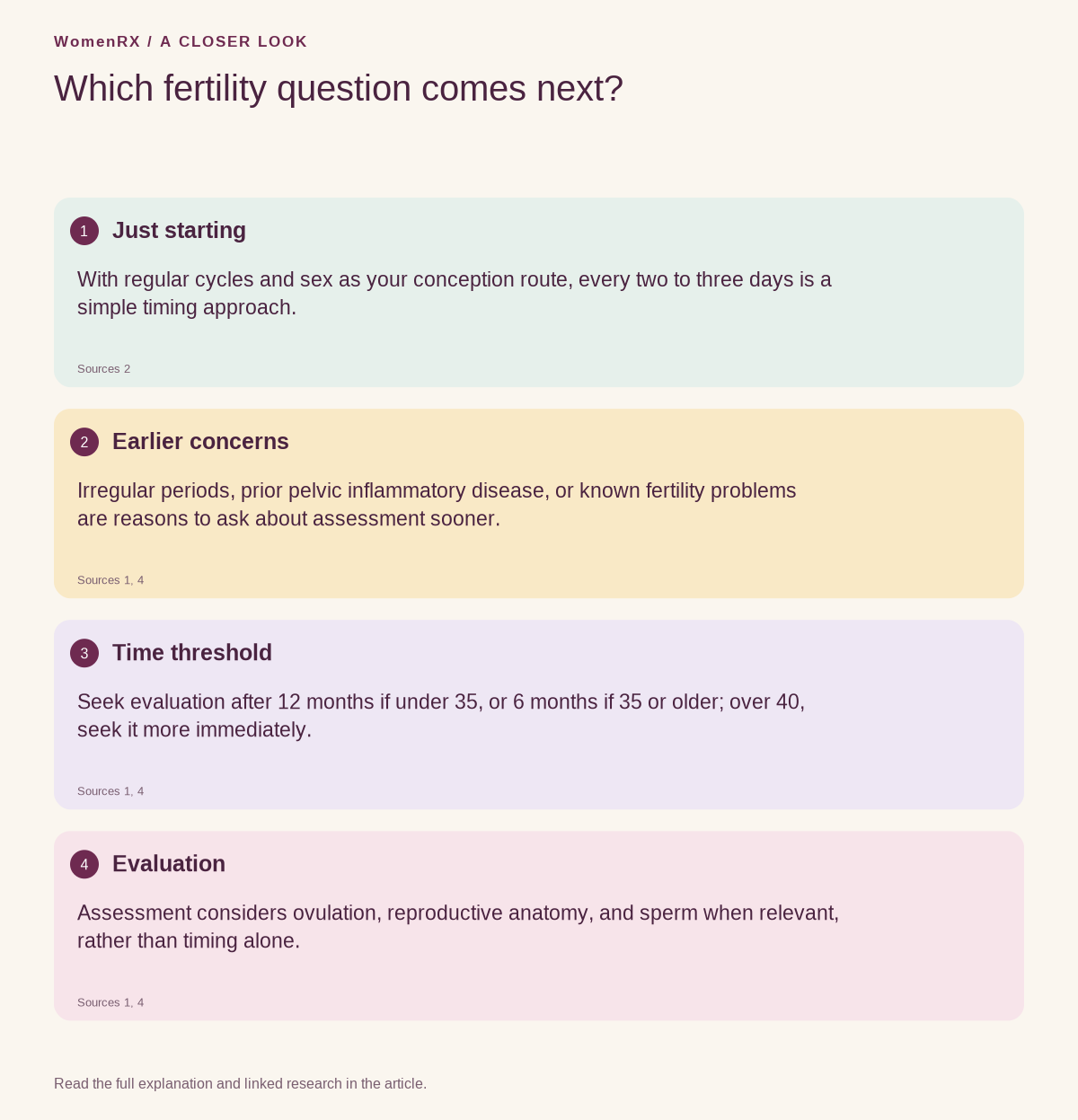
Which fertility question comes next?
Just starting: With regular cycles and sex as your conception route, every two to three days is a simple timing approach.2
Earlier concerns: Irregular periods, prior pelvic inflammatory disease, or known fertility problems are reasons to ask about assessment sooner.14
Time threshold: Seek evaluation after 12 months if under 35, or 6 months if 35 or older; over 40, seek it more immediately.14
Evaluation: Assessment considers ovulation, reproductive anatomy, and sperm when relevant, rather than timing alone.14
Read the figure as text
Follow the branch that matches your situation; a reason for earlier assessment takes priority over time spent trying.- Just starting: With regular cycles and sex as your conception route, every two to three days is a simple timing approach.2
- Earlier concerns: Irregular periods, prior pelvic inflammatory disease, or known fertility problems are reasons to ask about assessment sooner.14
- Time threshold: Seek evaluation after 12 months if under 35, or 6 months if 35 or older; over 40, seek it more immediately.14
- Evaluation: Assessment considers ovulation, reproductive anatomy, and sperm when relevant, rather than timing alone.14
More questions, answered
Does having conceived before mean I don’t need an evaluation?
No. Difficulty conceiving after a previous pregnancy is recognized as secondary infertility. Your current age, time trying, cycles, and health history still matter when deciding whether to seek an evaluation.24
Does an infertility evaluation always find a cause?
No. Some people receive a diagnosis of unexplained infertility after an evaluation that includes evidence of ovulation, open fallopian tubes, and a normal semen analysis when a male partner is involved.4
Sources you can check
- Infertility | Infertility Treatments | MedlinePlusAccessed 2026-09-25Return to first citation
- Infertility - NHSAccessed 2026-09-25Return to first citation
- Comparison of HyFoSy, HyCoSy and X-Ray Hysterosalpingography in the Assessment of Tubal Patency in Women with Infertility: A Systematic Review and Meta-Analysis.Xydias EM, Emmanouil V, Koutini M, Ntanika A, Tsakos E, Prior M, Sarris I, Thanasas I, Daponte A, Ziogas AC. · Medical sciences (Basel, Switzerland) · 2025Return to first citation
- Infertility Workup for the Women's Health Specialist: ACOG Committee Opinion, Number 781.Obstetrics and gynecology · 2019Return to first citation