PCOS and Trying to Conceive: Your Next Steps
If PCOS means your periods are irregular, you can ask about fertility evaluation sooner rather than waiting a full year.
PCOS can make ovulation irregular, but it isn’t the only possible reason conception may take longer. If your periods are irregular or you have known fertility concerns, MedlinePlus advises seeking care when you’re ready to try. It defines infertility using one year of trying if you’re under 35, or six months if you’re 35 or older; those definitions aren’t advice to wait before asking about care. A full assessment looks at both partners. 1
Start with the question of ovulation
PCOS can interfere with regular ovulation, which can make it harder to predict when conception is possible. But having PCOS doesn’t automatically mean you’ll need fertility treatment, and it doesn’t rule out other causes if pregnancy isn’t happening. Fertility can be affected by factors involving either partner, including sperm, the fallopian tubes, the uterus, or age-related changes in egg production. 1
If you’re planning a pregnancy and your periods are irregular, MedlinePlus advises seeking care when you’re ready to try. It also advises seeking care for past fertility concerns or when trying after age 40. Separately, it defines infertility as not becoming pregnant after one year of trying if under 35, or six months at age 35 or older. Those are definitions, not evaluation-timing recommendations or a reason to wait before asking about care. 1
You can start by saying, “My cycles are irregular, and I’m hoping to get pregnant. Could we assess ovulation and whether anything else might be affecting fertility?”
Ask for a full picture, not just an ovulation plan
An evaluation can help distinguish two different needs: support for releasing an egg, and investigation of other possible barriers to conception. Depending on your situation, testing may include a review of your health history, blood tests, imaging, and a semen test for your partner. The specific workup varies; the aim is to look for relevant causes rather than assume PCOS explains everything. 1
Useful questions include:
- Do my cycle pattern or test results suggest that I’m ovulating regularly?
- What other causes should we consider, including sperm or fallopian tube factors?
- Which tests would change the next step in my situation?
- If ovulation support is appropriate, how will we tell whether it’s working?
A full assessment matters because ovulation treatment addresses ovulation. It won’t, by itself, identify or treat a problem with sperm, a blocked tube, or a uterine condition. 1
If ovulation support is the next step
For people with PCOS who aren’t ovulating regularly and want to conceive, a clinician may discuss medicines that encourage ovulation. A 2026 review describes letrozole as increasingly recommended as a first-line option for ovulation induction in anovulatory PCOS, noting that research has reported better pregnancy and live-birth rates, particularly in people with clomiphene resistance. The review also describes variation in treatment protocols. 2
That doesn’t make one medicine the right choice for everyone. Ask why a particular option is being considered, what outcome the plan is aiming for, what follow-up it involves, and what the next step would be if ovulation or pregnancy doesn’t occur. Clomiphene is another medicine discussed in PCOS ovulation research, but the best choice depends on your evaluation and care plan. 2
Ovulation, pregnancy, and live birth are different outcomes. A treatment that helps trigger ovulation doesn’t guarantee conception or a live birth.
Make the plan fit your goals
You don’t have to pursue fertility treatment just because you have PCOS, and you don’t have to wait until you’ve been trying for a set number of months to ask about irregular cycles. If pregnancy is your goal, the most useful next step may be an ovulation assessment, a broader fertility workup, or a discussion of ovulation-inducing medicine. Which one fits depends on what the evaluation finds. 1
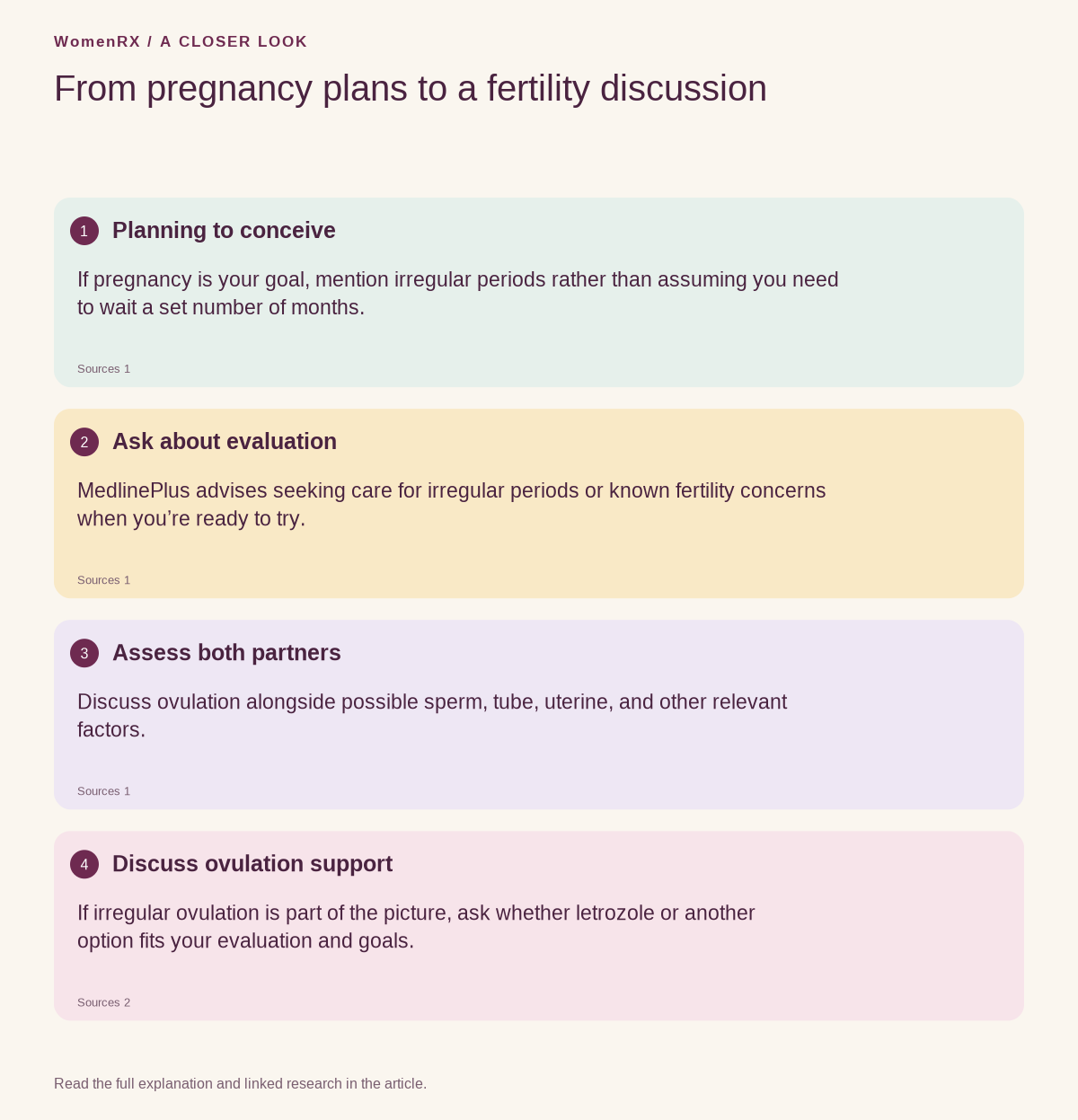
From pregnancy plans to a fertility discussion
Planning to conceive: If pregnancy is your goal, mention irregular periods rather than assuming you need to wait a set number of months.1
Ask about evaluation: MedlinePlus advises seeking care for irregular periods or known fertility concerns when you’re ready to try.1
Assess both partners: Discuss ovulation alongside possible sperm, tube, uterine, and other relevant factors.1
Discuss ovulation support: If irregular ovulation is part of the picture, ask whether letrozole or another option fits your evaluation and goals.2
Read the figure as text
A practical pathway: raise cycle concerns, consider factors beyond ovulation, then discuss treatment if the findings support it.- Planning to conceive: If pregnancy is your goal, mention irregular periods rather than assuming you need to wait a set number of months.1
- Ask about evaluation: MedlinePlus advises seeking care for irregular periods or known fertility concerns when you’re ready to try.1
- Assess both partners: Discuss ovulation alongside possible sperm, tube, uterine, and other relevant factors.1
- Discuss ovulation support: If irregular ovulation is part of the picture, ask whether letrozole or another option fits your evaluation and goals.2
More questions, answered
Should I wait a year before asking about fertility if I have PCOS?
Not necessarily. MedlinePlus advises seeking care when you’re ready to try if you have irregular periods or known fertility concerns. Its one-year and six-month timeframes define infertility; they aren’t stated as evaluation-timing recommendations. 1
Does treating ovulation address every cause of infertility?
No. Ovulation medicine is aimed at helping with ovulation. Fertility concerns can also involve sperm, fallopian tubes, the uterus, or other factors, so an evaluation may consider both partners and more than one possible cause. 1
Sources you can check
- Infertility | Infertility Treatments | MedlinePlusAccessed 2026-09-25Return to first citation
- Letrozole for Ovulation Induction in Women With Polycystic Ovary Syndrome.Li XL. · Obstetrical & gynecological survey · 2026Return to first citation