PCOS and Pregnancy: From Evaluation to Ovulation Treatment
If PCOS is making ovulation irregular, treatment may focus on helping an egg mature and release, while checking whether other fertility factors need attention too.
PCOS can affect how often you ovulate, but fertility care usually begins by clarifying your goals and looking for more than one possible barrier to pregnancy. If ovulation is irregular, letrozole is a commonly recommended first medicine to discuss; clomiphene and metformin may also come up for different reasons. The right plan depends on your health, other fertility factors, and preferences. 1 4 5
First, find out whether ovulation is the main issue
PCOS doesn't automatically mean you can't become pregnant. For some people, the main fertility challenge is that ovulation happens infrequently or not at all. In that situation, treatment may aim to prompt ovulation. But difficulty conceiving can also involve sperm, fallopian tubes, the uterus, age-related changes, or more than one factor at once. 1 3
The first conversation is about what you want now. You may be hoping to conceive soon, considering your options, or wanting to understand how PCOS could affect a future pregnancy. You don't need to pursue fertility treatment simply because you have PCOS. If pregnancy is your goal, irregular periods are a reason to ask about fertility evaluation without waiting a full year; MedlinePlus also advises earlier discussion for people over 40 or with past fertility concerns. 1
Evaluation is broader than an ovulation medicine
A clinician may ask about your cycle pattern, health history, and how long you’ve been trying. Depending on your situation, evaluation can include blood tests or imaging, and a semen test for a male partner. This broader look matters because inducing ovulation won't address a blocked tube or a sperm-related factor. 1
PCOS can also involve metabolic health, but that doesn't mean every person has insulin resistance or needs the same assessment or treatment. A review describes PCOS as having varied reproductive and metabolic features, including possible glucose and blood-pressure concerns. That makes it reasonable to ask whether any health factors relevant to pregnancy should be assessed in your case, rather than assuming that body size or a PCOS diagnosis tells the whole story. 3
Preconception assessment and fertility treatment are related, but they're not the same step. One is about understanding your health and possible barriers; the other may involve medication to encourage ovulation. Your plan can address both, or start with one, depending on what the evaluation shows.
If ovulation is the target, compare the options
Letrozole is a common first medicine to discuss for ovulation induction in PCOS-related anovulation. A 2026 review describes it as increasingly recommended as a first-line option, and a 2025 narrative review also identifies it as a leading monotherapy. These reviews support discussing it, not assuming it will work for every person or guarantee pregnancy. 4 5
Clomiphene citrate is another medicine used to encourage ovulation. The choice between it and letrozole depends on the clinical situation and treatment plan. If one approach doesn't lead to ovulation or pregnancy, that doesn't by itself explain why; the next step may depend on how you responded and whether another factor was found. 2 4
Metformin is an insulin-sensitizing medicine, not simply another name for an ovulation drug. It may be relevant when metabolic features are part of the treatment discussion, but a review notes that metformin alone may not be sufficient to induce ovulation. Ask what outcome it is intended to address in your plan and whether it is being considered alone or alongside an ovulation medicine. 5
For people who don't respond to initial medication, other options may be considered. Gonadotropins can stimulate ovulation, but they are not usually treated as a simple first step: a review notes concerns including multiple pregnancy and ovarian hyperstimulation syndrome. Options after unsuccessful treatment should be weighed against your response, risks, and preferences. 5
Questions that make the plan clearer
You might ask:
- Do my cycle pattern and evaluation suggest that I’m ovulating?
- Are there other fertility factors we should assess before focusing on ovulation?
- What is the goal of each proposed medicine: ovulation, metabolic health, or both?
- How will we know whether the treatment is working, and what would change the plan?
- What are the possible risks and tradeoffs of the next option?
The useful distinction is between getting ready for a possible pregnancy and treating a specific barrier to conception. A good plan explains both, without assuming that every person with PCOS needs weight loss, the same tests, or the same medicine.
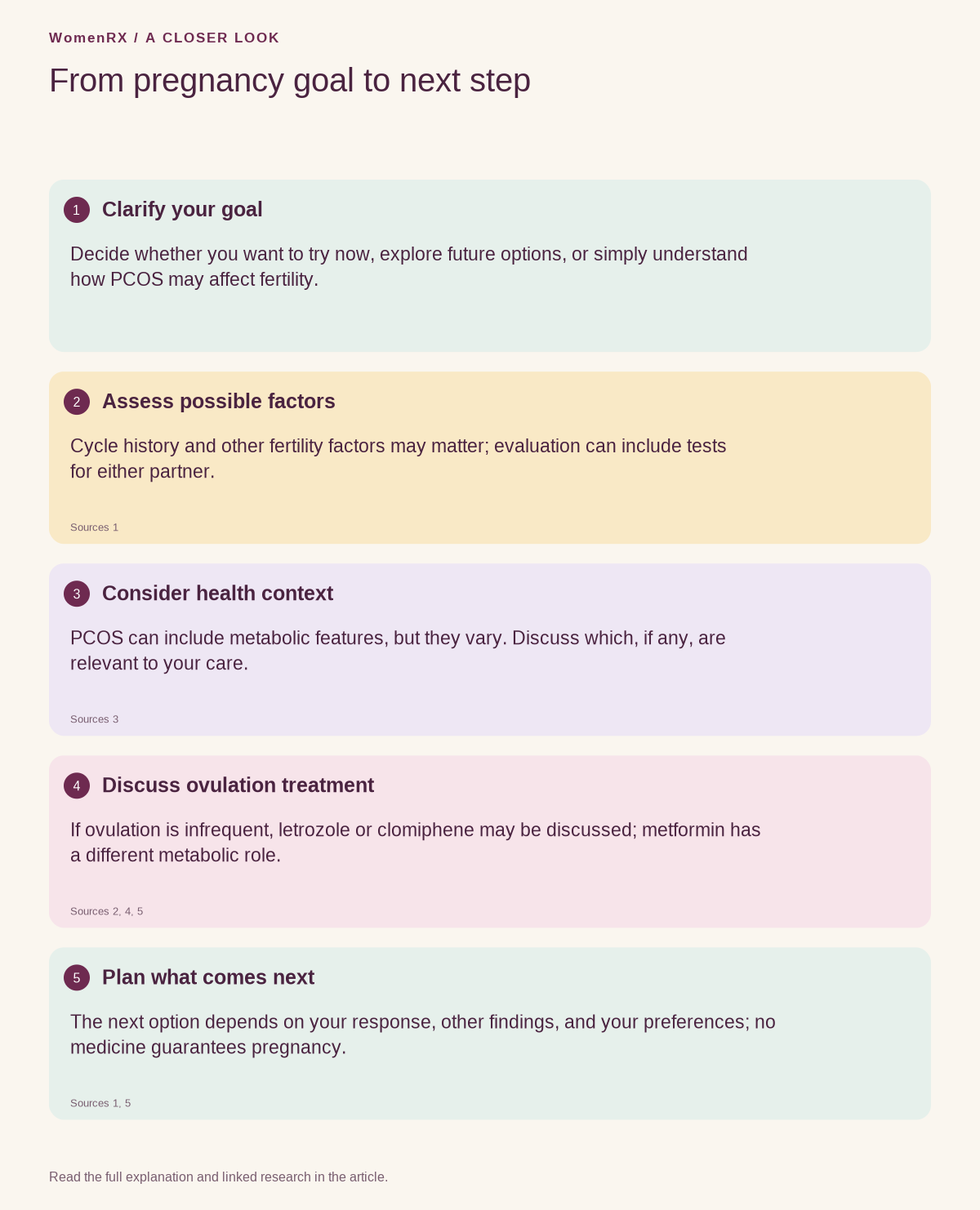
From pregnancy goal to next step
Clarify your goal: Decide whether you want to try now, explore future options, or simply understand how PCOS may affect fertility.
Assess possible factors: Cycle history and other fertility factors may matter; evaluation can include tests for either partner.1
Consider health context: PCOS can include metabolic features, but they vary. Discuss which, if any, are relevant to your care.3
Discuss ovulation treatment: If ovulation is infrequent, letrozole or clomiphene may be discussed; metformin has a different metabolic role.245
Plan what comes next: The next option depends on your response, other findings, and your preferences; no medicine guarantees pregnancy.15
Read the figure as text
A simple map of how clarifying your goal, assessing possible fertility factors, and considering ovulation treatment fit together. The steps may vary by person.- Clarify your goal: Decide whether you want to try now, explore future options, or simply understand how PCOS may affect fertility.
- Assess possible factors: Cycle history and other fertility factors may matter; evaluation can include tests for either partner.1
- Consider health context: PCOS can include metabolic features, but they vary. Discuss which, if any, are relevant to your care.3
- Discuss ovulation treatment: If ovulation is infrequent, letrozole or clomiphene may be discussed; metformin has a different metabolic role.245
- Plan what comes next: The next option depends on your response, other findings, and your preferences; no medicine guarantees pregnancy.15
More questions, answered
Should I wait a year before asking about fertility with PCOS?
Not necessarily. MedlinePlus advises seeking care sooner for irregular periods or a known fertility concern; it also gives six months of trying as a point for evaluation for people 35 and older, and advises earlier discussion for people over 40. 1
Does metformin make everyone with PCOS ovulate?
No. A review describes metformin as an insulin-sensitizing medicine and notes it may not be enough by itself to induce ovulation. Ask what specific goal it would serve in your treatment plan. 5
Sources you can check
- Infertility | Infertility Treatments | MedlinePlusAccessed 2026-09-25Return to first citation
- Treatment for infertility - NHSAccessed 2026-09-25Return to first citation
- Ovulation induction in anovulatory PCOS women.Diamanti M, La Marca A. · Minerva obstetrics and gynecology · 2025Return to first citation
- Letrozole for Ovulation Induction in Women With Polycystic Ovary Syndrome.Li XL. · Obstetrical & gynecological survey · 2026Return to first citation
- Integrative Approaches to Ovulation Induction in Polycystic Ovary Syndrome: A Narrative Review of Conventional and Complementary Therapies.Song SY. · Biomedicines · 2025Return to first citation