What Testing for Secondary Infertility May Involve
A previous pregnancy is useful history, but an evaluation still looks at ovulation, sperm, the uterus and the fallopian tubes.
Secondary infertility means having difficulty conceiving after a previous pregnancy. An evaluation may include a health and pregnancy history, a semen analysis for the sperm-producing partner, blood tests, and imaging of the uterus or fallopian tubes. The tests chosen depend on your age, menstrual pattern and history. A previous pregnancy doesn’t rule out a fertility issue now, including one involving either partner. 12
What your previous pregnancy tells the clinician
A previous pregnancy shows that conception happened before. It doesn’t establish that ovulation, sperm, the uterus and the fallopian tubes are all functioning the same way now. Secondary infertility is the term for difficulty conceiving after one or more previous pregnancies, and fertility problems can involve either partner or a combination of factors. Sometimes an evaluation finds no clear cause. 12
Expect questions about how long you’ve been trying, your age, menstrual patterns, previous pregnancies and any known health concerns. Those details help shape the evaluation rather than sending everyone through the same set of tests. For example, a change in your cycles raises a different question from a history that suggests a possible uterine or tubal problem. A health history and physical exam may be part of the assessment. 12
When should you start that conversation? For people under 35, MedlinePlus describes infertility as not becoming pregnant after a year of frequent, unprotected sex. At 35 or older, it gives six months as the timeframe for that definition. If you already know of a possible fertility problem, you don’t need to wait for a time threshold to bring it up. 12
What each test is trying to answer
Semen analysis: Is there a sperm concern? If your partner produces sperm, a semen test belongs in the conversation even if you conceived together before. Standard semen analysis assesses sperm concentration, movement and shape. Results can identify characteristics worth investigating, but normal parameters don’t guarantee fertility, and an abnormal result doesn’t by itself explain the underlying cause. 15
Menstrual history: Is ovulation a concern? Regular release of an egg is one part of conception; lack of regular ovulation is a recognized cause of infertility. Your cycle pattern can help frame that question. 2 Blood tests may also be included in an infertility evaluation, but there isn’t one blood test that establishes every possible cause. Ask what a proposed test is meant to clarify in your situation. 1
Ultrasound or other uterine imaging: Could something inside the uterus matter? Imaging may be used to assess the uterine cavity. Depending on the question, options discussed in infertility care include transvaginal ultrasound and saline infusion sonohysterography. Imaging can bring a possible cavity concern into focus, but a normal image doesn’t answer questions about sperm or ovulation. Some uterine findings may also need a closer look. 13
A tubal test: Are the fallopian tubes open? Hysterosalpingography, often called HSG, uses contrast and X-ray imaging to show whether contrast passes through the tubes and to outline the uterine cavity. It answers a different question from a semen analysis or an ovulation assessment. A result suggesting a blockage, or a result that doesn’t fit the rest of the history, may need further interpretation. HSG also may not show small abnormalities inside the uterus as clearly as direct viewing. 36
Hysteroscopy: Is a direct view of the uterine cavity needed? A clinician uses a small scope to look inside the uterus, sometimes with the option to biopsy or treat a finding. It’s more involved than initial imaging, so it isn’t automatically the next test for everyone. Evidence about routinely adding hysteroscopy when imaging looks normal comes largely from people undergoing assisted reproductive treatment and has produced differing findings. That question is distinct from whether hysteroscopy would help clarify a suspected uterine finding. 34
Put the results together, not in separate boxes
The most useful discussion is often about what remains unanswered. For example, an open-tube result doesn’t assess sperm quality; a semen analysis doesn’t show whether the tubes are open; and a normal uterine image doesn’t settle every question about the uterine cavity. These tests examine different parts of conception, so a single reassuring result isn’t a complete fertility evaluation. 1356
If a test is proposed, you can ask: What question will this answer? What would an unclear or abnormal result mean? Would the result change what we do next? That keeps the evaluation focused on decisions that matter to you and your partner, rather than on completing a fixed checklist.
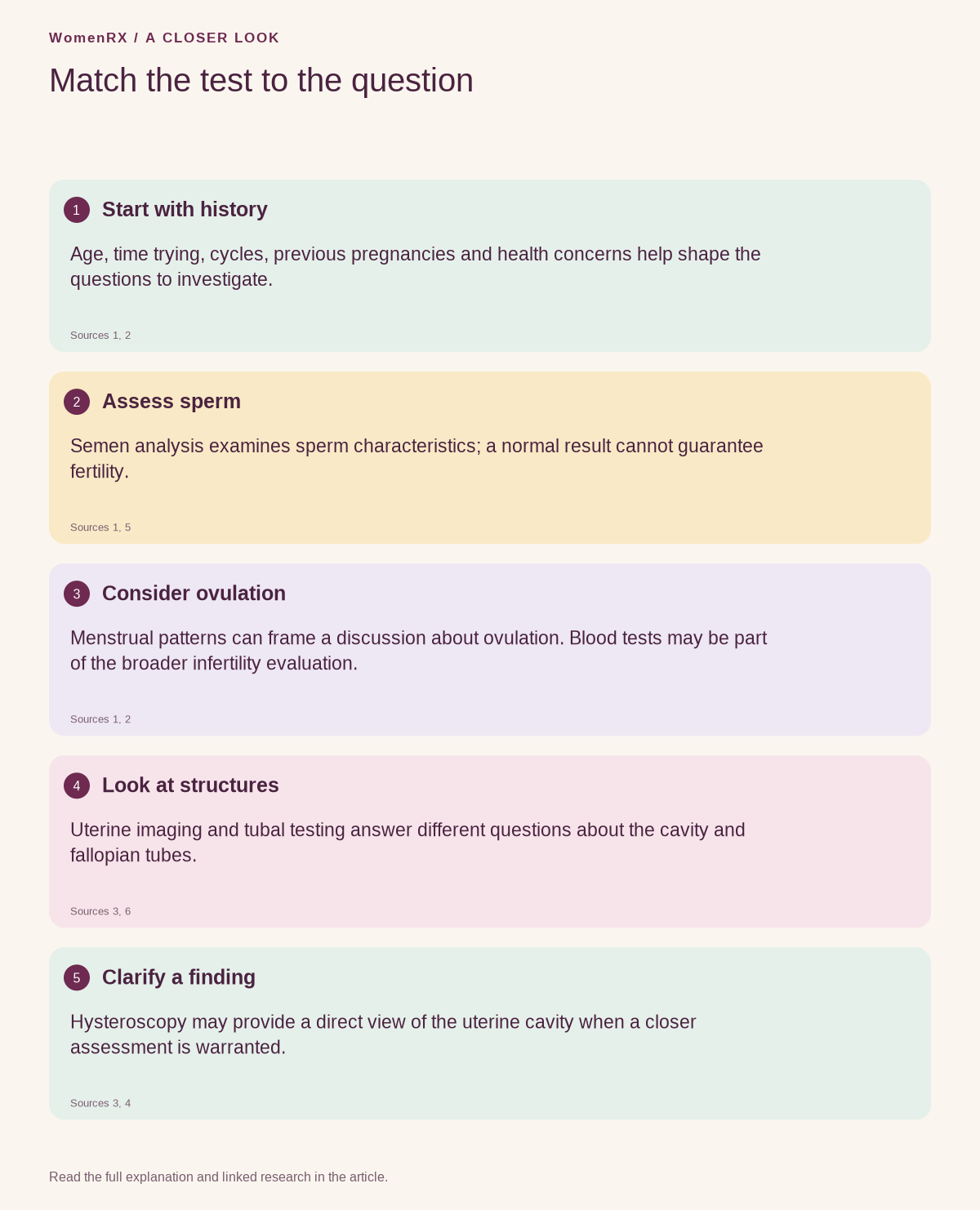
Match the test to the question
Start with history: Age, time trying, cycles, previous pregnancies and health concerns help shape the questions to investigate.12
Assess sperm: Semen analysis examines sperm characteristics; a normal result cannot guarantee fertility.15
Consider ovulation: Menstrual patterns can frame a discussion about ovulation. Blood tests may be part of the broader infertility evaluation.12
Look at structures: Uterine imaging and tubal testing answer different questions about the cavity and fallopian tubes.36
Clarify a finding: Hysteroscopy may provide a direct view of the uterine cavity when a closer assessment is warranted.34
Read the figure as text
These are possible branches of an evaluation, not required steps in a set order.- Start with history: Age, time trying, cycles, previous pregnancies and health concerns help shape the questions to investigate.12
- Assess sperm: Semen analysis examines sperm characteristics; a normal result cannot guarantee fertility.15
- Consider ovulation: Menstrual patterns can frame a discussion about ovulation. Blood tests may be part of the broader infertility evaluation.12
- Look at structures: Uterine imaging and tubal testing answer different questions about the cavity and fallopian tubes.36
- Clarify a finding: Hysteroscopy may provide a direct view of the uterine cavity when a closer assessment is warranted.34
More questions, answered
Does secondary infertility mean the issue is with the person who was pregnant?
No. A fertility issue can involve either partner, both partners or no clearly identified cause. If a partner produces sperm, a previous pregnancy isn’t a reason to leave semen assessment out of the discussion. 12
Sources you can check
- Infertility | Infertility Treatments | MedlinePlusAccessed 2026-09-25Return to first citation
- Infertility - NHSAccessed 2026-09-25Return to first citation
- Outpatient hysteroscopy impact on subsequent assisted reproductive technology: a systematic review and meta-analysis in patients with normal transvaginal sonography or hysterosalpingography images.Hou JH, Lu BJ, Huang YL, Chen CH, Chen CH. · Reproductive biology and endocrinology : RB&E · 2024Return to first citation
- Hysteroscopy as An Investigational Operative Procedure in Primary and Secondary Infertility: A Systematic Review.Genovese F, Di Guardo F, Monteleone MM, D'Urso V, Colaleo FM, Leanza V, Palumbo M. · International journal of fertility & sterility · 2021Return to first citation
- Role of Seminal microRNAs Detected by Quantitative Polymerase Chain Reaction (qPCR) in Male Infertility: A Systematic Literature Review.Shunmuga Sundaram M, Reddy S, Venkatesan V, Kalagara M, Ganesh R, G M. · Cureus · 2025Return to first citation
- Comparative Analysis of Hysterosalpingography and Diagnostic Hysteroscopy Findings in Infertility Evaluation.G M, M S. · Cureus · 2025Return to first citation