Could It Be Trichomoniasis? What Testing and Treatment Involve
Vaginal irritation or painful urination can be a reason to get tested, but symptoms alone can’t identify trichomoniasis.
Trichomoniasis can cause discharge, vaginal irritation, discomfort during sex or pain when you pee, but many people have no symptoms. A partner’s positive result is also a reason to arrange testing. A vaginal swab or urine test can help establish the diagnosis. If you test positive, treatment includes a prescribed oral antibiotic and partner care to reduce the chance of passing the infection back and forth. 157
What your symptoms can and can’t tell you
Trichomoniasis, often called trich, is a sexually transmitted infection caused by a parasite. It may cause yellow-green or gray vaginal discharge, odor, itching, soreness, discomfort during sex or pain when you pee. Many people have no symptoms at all. So if a partner has tested positive, feeling fine doesn’t rule out infection. 17
Painful urination deserves attention, but it isn’t proof of trichomoniasis. The same goes for discharge or itching: vaginal symptoms can have different causes, including bacterial vaginosis and yeast infection. In a randomized study of 276 women seeking care for vaginal symptoms, testing for those conditions alongside trichomoniasis helped clinicians choose appropriate treatment more often than usual care. That’s the practical reason to test rather than guess from the symptom that stands out most. 6
What happens at testing
Tell the clinician about your symptoms, when they began, and whether a partner has tested positive. A test for trichomoniasis may use a vaginal swab or a urine sample. Molecular tests are generally more sensitive than culture-based methods. A negative office microscope exam may not settle the question if exposure or symptoms still raise concern; ask whether additional testing is appropriate. 156
If painful urination is your main symptom, say so rather than assuming a vaginal infection explains it. You may need an assessment of that symptom as well as STI testing. For the discharge, itching or painful urination described here, arrange a clinical appointment; trichomoniasis guidance treats these as reasons for assessment, not as a diagnosis you can make at home. If you’re pregnant or planning pregnancy and think you may have trichomoniasis, arrange an assessment even if symptoms are mild or absent. 17
A positive result: treatment and partners
Trichomoniasis is treated with a prescribed antibiotic, usually oral metronidazole. Your clinician can choose the treatment plan for your circumstances, including pregnancy, rather than relying on a medicine left over from another infection. Metronidazole can cause nausea, diarrhea or a metallic taste; take a prescribed course as directed even if symptoms improve. 12
Tell the clinician if a current or recent sexual partner may need treatment. Partners can carry and pass on trichomoniasis without symptoms, and you can get it again after treatment. Treating only one person can leave the opportunity for reinfection. Avoid sex until at least a week after you and your partners have finished treatment. This is about interrupting transmission, not assigning blame. 17
If symptoms continue after treatment or you start feeling worse, contact the prescribing clinician rather than assuming the same infection is still the cause. They can consider whether further assessment or testing is needed. 4 If your throat feels tight or you struggle to swallow after taking metronidazole, seek emergency care; these can be signs of a serious allergic reaction. 3
If you’re pregnant
Mention pregnancy when arranging testing and before treatment is chosen. Trichomoniasis during pregnancy is associated with a greater likelihood of early birth and low birth weight, which makes a possible exposure worth discussing even without symptoms. A positive test calls for a conversation about treatment and partner care in your particular circumstances. 17
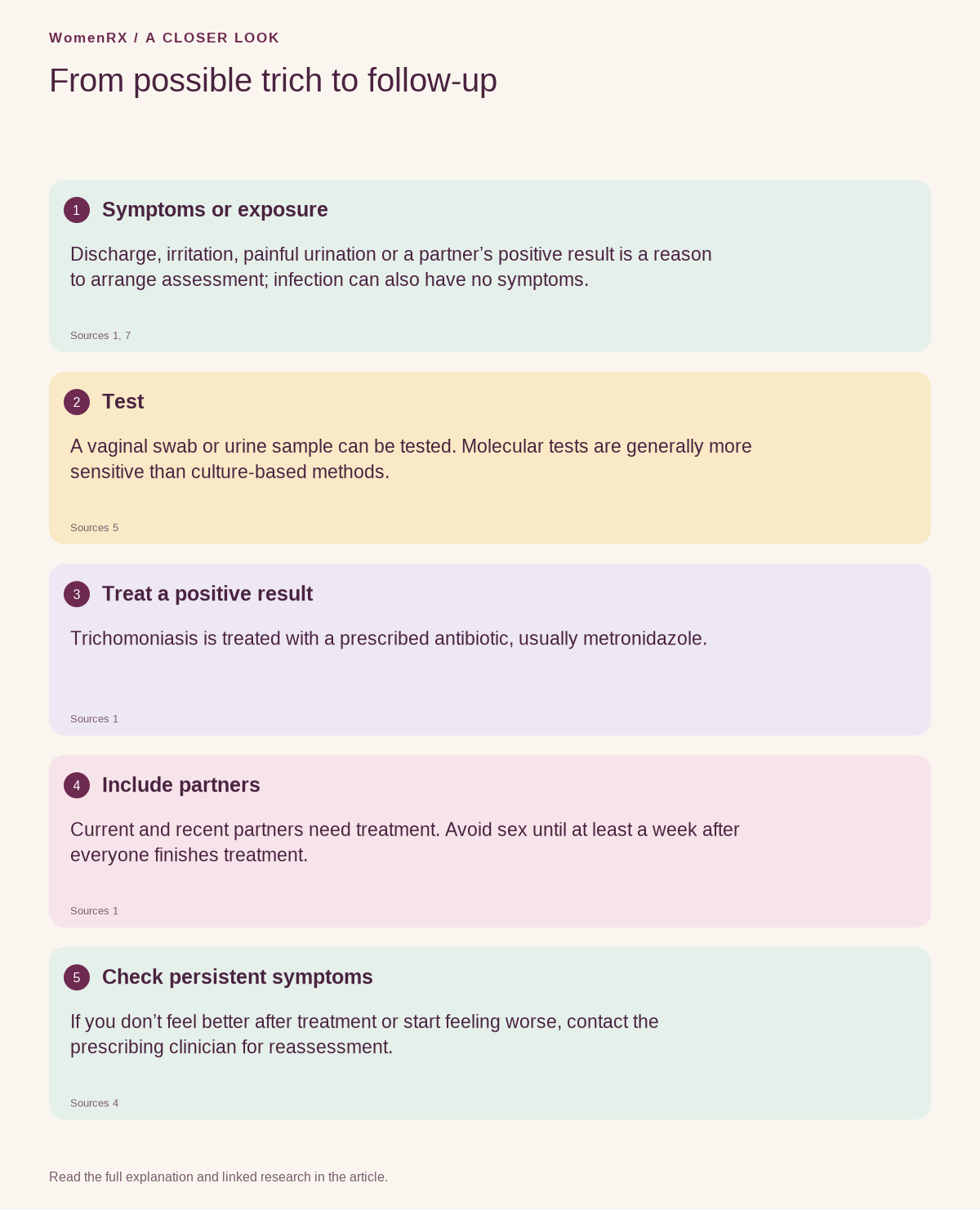
From possible trich to follow-up
Symptoms or exposure: Discharge, irritation, painful urination or a partner’s positive result is a reason to arrange assessment; infection can also have no symptoms.17
Test: A vaginal swab or urine sample can be tested. Molecular tests are generally more sensitive than culture-based methods.5
Treat a positive result: Trichomoniasis is treated with a prescribed antibiotic, usually metronidazole.1
Include partners: Current and recent partners need treatment. Avoid sex until at least a week after everyone finishes treatment.1
Check persistent symptoms: If you don’t feel better after treatment or start feeling worse, contact the prescribing clinician for reassessment.4
Read the figure as text
The next step depends on a test result, not on how distinctive the symptoms seem.- Symptoms or exposure: Discharge, irritation, painful urination or a partner’s positive result is a reason to arrange assessment; infection can also have no symptoms.17
- Test: A vaginal swab or urine sample can be tested. Molecular tests are generally more sensitive than culture-based methods.5
- Treat a positive result: Trichomoniasis is treated with a prescribed antibiotic, usually metronidazole.1
- Include partners: Current and recent partners need treatment. Avoid sex until at least a week after everyone finishes treatment.1
- Check persistent symptoms: If you don’t feel better after treatment or start feeling worse, contact the prescribing clinician for reassessment.4
More questions, answered
Can a partner have trichomoniasis without knowing it?
Yes. Many people have no symptoms, but they can still pass on the infection. If a partner tests positive, ask about testing and how both of you can be treated before resuming sex. 17
Sources you can check
- Trichomoniasis - NHSAccessed 2026-09-25Return to first citation
- About metronidazole - NHSAccessed 2026-09-25Return to first citation
- Side effects of metronidazole - NHSAccessed 2026-09-25Return to first citation
- Common questions about metronidazole - NHSAccessed 2026-09-25Return to first citation
- Molecular Diagnosis of Trichomonas vaginalis in Women and Men: A Systematic Review.Mohamadi S, Faraji R, Khoshnood S, Maleki A, Bozorgomid A, Bastaminejad S, Rashidi T, Mansouri AS, Khezri K, Seidi S, Faraji S. · Journal of tropical medicine · 2026Return to first citation
- Randomized Study of Usual Care Versus Xpert ® Xpress Multiplex Vaginal Panel at the Point-of-Care for Accurate Diagnosis and Appropriate Treatment of Vaginal Infections.Hillier SL, Macio I, Gallagher R, Meyn L, Beamer M, Zamborsky T, Campbell T, Bunge K, Wiesenfeld HC. · Sexually transmitted diseases · 2026Return to first citation
- Trichomoniasis | Trich | STD | MedlinePlusAccessed 2026-09-25Return to first citation