Starting CBT: What Sessions Might Actually Involve
CBT turns a concern into goals and practical work, but the sessions and practice depend on what you’re treating.
In CBT, you and a therapist may identify a problem, set goals, and work on ways of thinking or responding. Some CBT programs also include between-session practice; research linking that practice with outcomes comes from youth treatment studies, so it doesn’t establish what adults need. 2 What it looks like depends on your concern: a tailored anxiety program and a childbirth-fear program used different plans. 1 3 Before you begin, ask what you’ll work on, what practice involves, and how you’ll decide whether the approach is helping.
What might happen in a session?
CBT is not one conversation repeated each week. The work is meant to connect a specific concern with things you can notice and try changing. In a tailored CBT program for people with anxiety and mild-to-moderate dementia, early sessions introduced the approach and set goals. Later work addressed bodily anxiety reactions, habitual responses, ways of thinking, and interpersonal concerns. The final phase focused on consolidating what participants had learned. That’s one program’s structure, not a schedule every therapist follows. 1
Here’s a different, hypothetical example of what the work might feel like. If fear of childbirth is your concern, a session might explore a thought such as “I won’t be able to cope with labor,” what brings that fear up, and whether avoiding conversations about birth has made it harder to prepare. You and the therapist could discuss a different response to try. This is an illustration, not a report of what happened in a study session. It reflects the thinking and behavior targets described for CBT focused on childbirth fear. 3
A useful opening question is: “What would we work on first, and what would I be doing during a session?” The answer should be more specific than “we’ll work on anxiety.”
The concern shapes the plan
CBT for one problem may not look much like CBT for another. For example, a randomized trial involving pregnant women having their first baby and experiencing high fear of childbirth compared in-person CBT with internet-based CBT. Both programs involved eight sessions lasting 60 to 90 minutes. Those numbers describe that trial, not the length of a standard CBT course. 3
The distinction matters when you’re choosing a therapist or program. Ask whether the treatment is designed for your main concern and how its activities address that concern. If you’re pregnant or recently postpartum, the timing of sessions, privacy at home, sleep disruption, and what you most want help with may all affect whether a plan is workable. Caregiving or work demands can matter just as much. You don’t need a fundamentally different kind of CBT simply because you’re a woman; you need a plan that fits both the problem and your life.
Online and in-person CBT aren’t interchangeable labels
In the childbirth-fear trial, both the internet-based and in-person groups had lower fear scores than the control group. In-person CBT showed greater improvement in overall fear and some other measures, while results on other subscales were comparable. The study involved a particular group of pregnant women and a particular program, so it cannot tell you which format works best for another concern. 3
If you’re considering an online option, find out what “online” means in practice. Is there a therapist you meet with or message, or is it a self-guided program? How do you get help if you’re stuck? Ask the same practical questions about in-person care: where sessions happen, whether privacy is possible, and whether the schedule is sustainable. Convenience helps only if you can use the treatment as intended.
Between-session practice should be possible in your real life
Some CBT includes trying a skill or noticing a pattern between appointments. Before agreeing to a plan, ask what you might be asked to do, how much time it takes, and what happens if it doesn’t go as planned. If a proposed task clashes with caregiving, exhaustion, or a lack of private space, say so. That information can help shape a more workable task.
Practice is worth discussing, but it isn’t a test of whether you’re a “good” therapy client. A meta-analysis of 14 CBT studies involving 1,179 young people found an association between greater homework adherence and lower symptoms after treatment. The association varied by condition and was strongest in the obsessive-compulsive disorder studies. These findings do not establish how much practice any individual adult needs or prove that homework alone caused the improvement. 2
Decide how you’ll tell whether it’s helping
Before you start, name a change you would notice outside therapy. For example, you might want to spend less time avoiding a specific situation or feel more able to respond when worry shows up. Ask when you and the therapist will revisit that goal and what could change if the current approach isn’t useful. These are questions to settle together, not a required CBT sequence.
You can bring four questions to a first conversation:
- What will we focus on first, and why?
- What might I do in sessions and between them?
- How does this format fit my concern and my available time and privacy?
- When will we review progress, and what are the options if I’m not improving?
A clear answer gives you something more useful than a promise that CBT works: a sense of what you’ll actually be trying and how you’ll judge the fit.
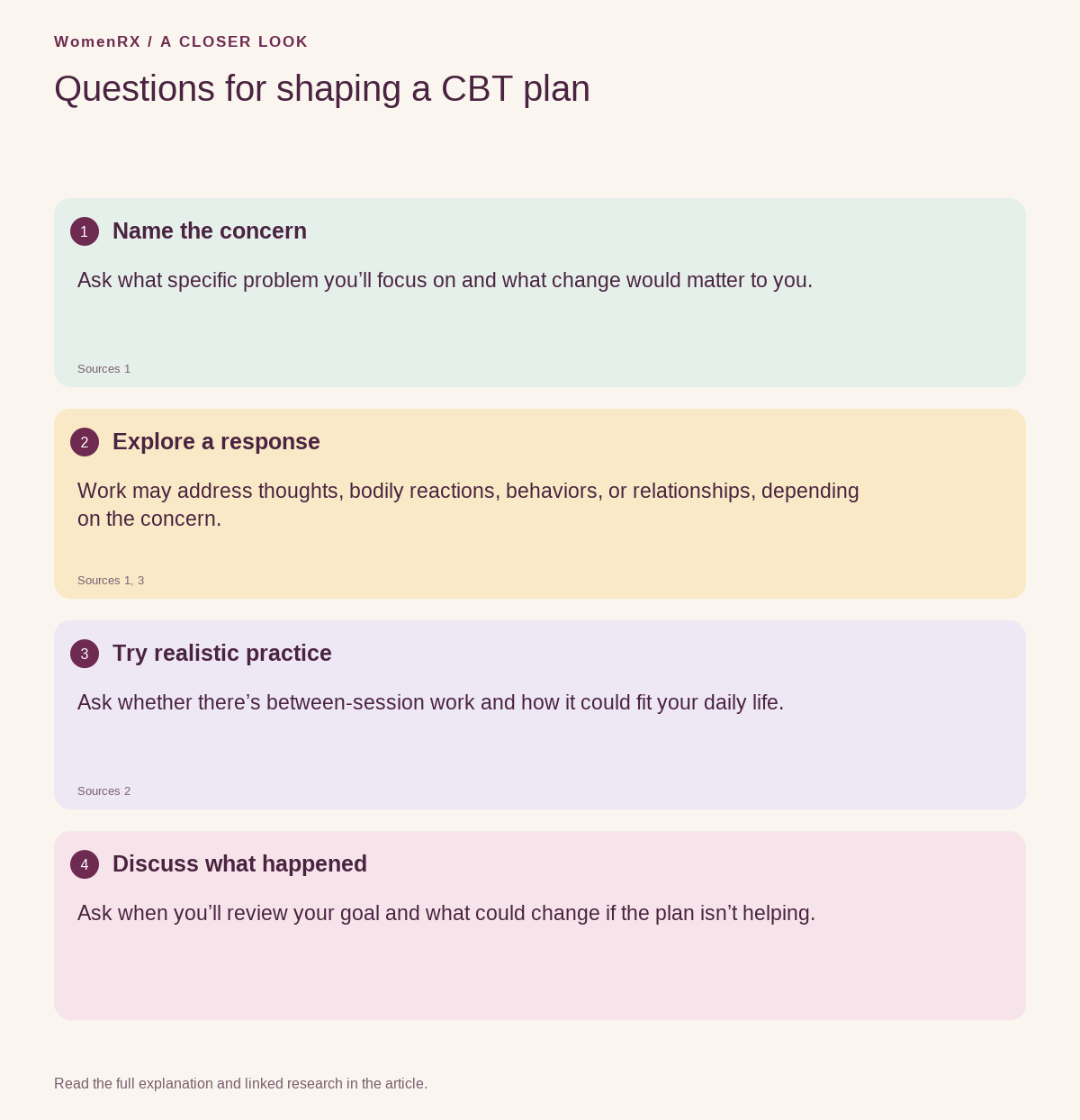
Questions for shaping a CBT plan
Name the concern: Ask what specific problem you’ll focus on and what change would matter to you.1
Explore a response: Work may address thoughts, bodily reactions, behaviors, or relationships, depending on the concern.13
Try realistic practice: Ask whether there’s between-session work and how it could fit your daily life.2
Discuss what happened: Ask when you’ll review your goal and what could change if the plan isn’t helping.
Read the figure as text
Use this flow to picture how a concern can become practical work and a plan you can discuss with a therapist. It is not a required sequence.- Name the concern: Ask what specific problem you’ll focus on and what change would matter to you.1
- Explore a response: Work may address thoughts, bodily reactions, behaviors, or relationships, depending on the concern.13
- Try realistic practice: Ask whether there’s between-session work and how it could fit your daily life.2
- Discuss what happened: Ask when you’ll review your goal and what could change if the plan isn’t helping.
Sources you can check
- Cognitive behavior therapy for anxiety in people with dementia: a clinician guideline for a person-centered approach.Charlesworth G, Sadek S, Schepers A, Spector A. · Behavior modification · 2015Return to first citation
- Therapeutic Homework and Treatment Outcomes in Youth Cognitive-Behavioral Therapy for Internalizing Disorders: A Meta-Analysis.Pine AE, Gum MA, Liu MM, McGuire JF. · Clinical child and family psychology review · 2026Return to first citation
- Comparison of the effect of internet-based and in-person cognitive behavioral therapy on the fear of childbirth in primiparous pregnant women: a randomized controlled trial.Piri K, Gholamzadeh Jofreh M, Haghighizadeh MH, Afshari P, Makvandi S. · BMC psychology · 2026Return to first citation