After Starting the Pill, What Changes Might Happen and When?
Pregnancy protection depends on which pill you started and when, while bleeding and symptom changes may take longer to judge.
Birth control pills contain either estrogen and progestin or progestin alone, and their starting instructions aren’t interchangeable.467 Check whether your start date calls for backup contraception rather than using bleeding as a sign of protection. Spotting can happen with extended or continuous combined-pill use. If pain isn’t improving enough or side effects are troublesome, ask for a review rather than waiting for a fixed deadline.617

First, separate protection from changes in your period
You may have started the pill to prevent pregnancy, ease painful periods, change your bleeding pattern, or more than one of those. They’re different outcomes. The instructions that determine when you need backup contraception depend on the pill and its start date. Whether your next period is lighter, late or absent doesn’t answer that protection question.67
The distinction on your pack matters: a combined pill contains estrogen and progestin; a progestin-only pill does not. Among progestin-only pills, drospirenone has different starting instructions from norethindrone or norgestrel.47
The first days: check your pill’s backup instructions
For someone starting a norethindrone or norgestrel progestin-only pill, CDC guidance says no backup is needed if it’s started within the first five days of menstrual bleeding. If it’s started later, the guidance calls for two days of abstinence or a barrier method such as condoms. For a drospirenone progestin-only pill, no backup is needed when it’s started on the first day of bleeding; a later start calls for seven days of backup.7
For combined pills, CDC guidance calls for seven days of backup in certain postpartum circumstances and some switches from an IUD. Those examples aren’t a general starting rule for every combined pill. Check the instructions for your pill and how you switched rather than borrowing a friend’s start-date rule.6
Correct use matters after the starting window, too. Missed pills can change the advice about backup, and that advice differs by pill type and by how many pills were missed. If you’ve missed pills or had prolonged vomiting or diarrhea, use the instructions for your specific pill instead of relying on whether you’ve started bleeding.67
Over the next cycles: judge the change you wanted
If you take a combined pill on an extended or continuous schedule, spotting or bleeding is common during the first three to six months and generally decreases with continued use. It can still be bothersome. That timeframe describes bleeding with those schedules, not a promise that every pill or every symptom will settle by a particular date.6
If painful periods were your reason for starting, compare the pain with what your cycles were like before. In a randomized trial of 211 women in Japan with regular cycles and painful periods, one flexible extended combined-pill regimen reduced a menstrual-pain score more than placebo through day 84. That result supports a possible benefit, but it doesn’t say which day relief should begin for you or predict the effect of a different pill.1
Bleeding isn’t the only change worth noticing. Intermenstrual bleeding and nausea were among the most frequent adverse events in that pain trial. Evidence about hormonal contraception and mood is mixed, so a mood change deserves attention without assuming the pill is necessarily its cause.12 A useful question is whether the pill is helping with the reason you chose it and whether its downsides are manageable. If period pain isn’t improving enough to make the pill worthwhile after you’ve compared subsequent cycles, or nausea, mood changes or bleeding are hard to live with, ask the prescriber to reassess your choice. You don’t need to wait three to six months to raise a troublesome change.1267
When bleeding deserves a closer look
Spotting after starting a pill cannot tell you whether pregnancy protection is in place. Check your pill’s start and missed-pill instructions to assess whether you need backup contraception. It also shouldn’t explain away every new bleeding pattern: bleeding between periods can have other causes, including infections, polyps and fibroids. Get bleeding between periods, after sex or other unusual bleeding checked by a GP or sexual health clinic, even if it isn’t persistent or troubling.56
If you’ve missed a period and have unusual bleeding with abdominal or pelvic pain, seek urgent medical assessment. That combination can signal an ectopic pregnancy.5 If pregnancy is possible because of a start-date or missed-pill problem, assess that possibility separately from whether your bleeding seems typical.
Postpartum or breastfeeding? Your baseline may be different
After childbirth, especially while breastfeeding, periods and ovulation may return unpredictably. That makes the date of your last period a less useful way to interpret a new bleeding pattern or choose starting instructions.3 CDC guidance has separate postpartum backup instructions for combined and progestin-only pills, and its medical eligibility guidance treats combined pills differently from progestin-only pills in the early postpartum period.678
If you’re breastfeeding, also bring up any concern about milk supply when discussing your pill. Randomized evidence has not clearly established how hormonal contraception affects milk quality or quantity during lactation.3 An absent period on its own isn’t a verdict on how well the pill is working, particularly when your cycles hadn’t returned before you started it.367
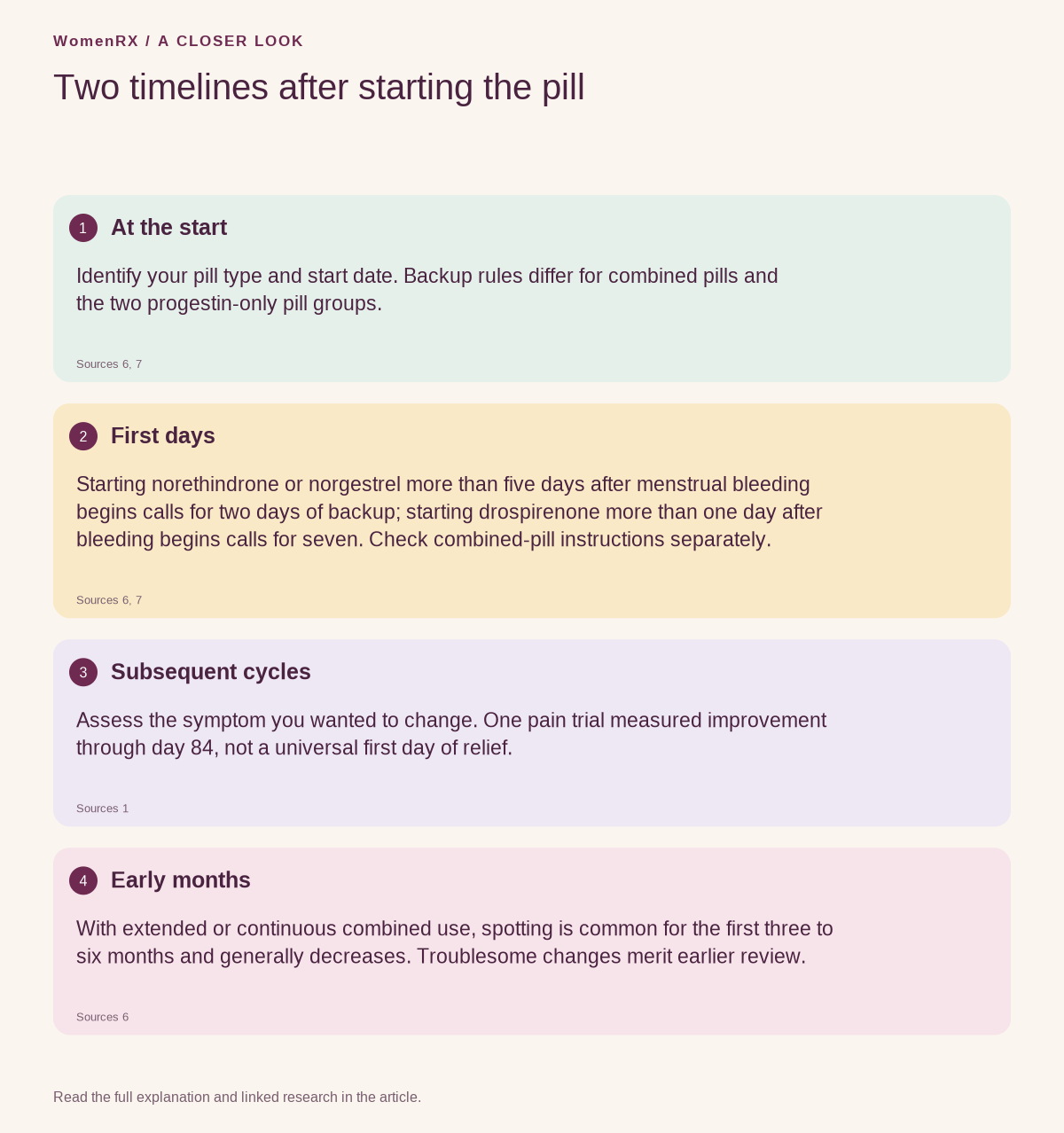
Two timelines after starting the pill
At the start: Identify your pill type and start date. Backup rules differ for combined pills and the two progestin-only pill groups.67
First days: Starting norethindrone or norgestrel more than five days after menstrual bleeding begins calls for two days of backup; starting drospirenone more than one day after bleeding begins calls for seven. Check combined-pill instructions separately.67
Subsequent cycles: Assess the symptom you wanted to change. One pain trial measured improvement through day 84, not a universal first day of relief.1
Early months: With extended or continuous combined use, spotting is common for the first three to six months and generally decreases. Troublesome changes merit earlier review.6
Read the figure as text
The early protection decision is separate from changes you may observe over later cycles.- At the start: Identify your pill type and start date. Backup rules differ for combined pills and the two progestin-only pill groups.67
- First days: Starting norethindrone or norgestrel more than five days after menstrual bleeding begins calls for two days of backup; starting drospirenone more than one day after bleeding begins calls for seven. Check combined-pill instructions separately.67
- Subsequent cycles: Assess the symptom you wanted to change. One pain trial measured improvement through day 84, not a universal first day of relief.1
- Early months: With extended or continuous combined use, spotting is common for the first three to six months and generally decreases. Troublesome changes merit earlier review.6
More questions, answered
Does spotting mean my pill isn’t preventing pregnancy?
Spotting alone cannot tell you whether pregnancy protection is in place. It is common early in extended or continuous combined-pill use. Check your pill’s start and missed-pill instructions to assess whether you need backup contraception.67
Sources you can check
- Efficacy and safety of desogestrel/ethinylestradiol 150/20 flexible extended regimen (FREEDOM 150/20) in dysmenorrhea: phase 3 study in Japan.Koga K, Colaci D, Grigg M, Goto D, Yu T, Momoeda M. · F&S reports · 2026Return to first citation
- Hormonal contraception and mental health: a narrative review of screening, monitoring, and patient-centered care for family physicians.Zaidi ARZ, Elhassan H, Syed AM, Waseem N, Muhammed A, Fida L, Fathima S, Taha I, Tannous G, Irshad S, Alghalyini B. · Frontiers in psychiatry · 2026Return to first citation
- Combined hormonal versus nonhormonal versus progestin-only contraception in lactation.Truitt ST, Fraser AB, Grimes DA, Gallo MF, Schulz KF. · The Cochrane database of systematic reviews · 2003Return to first citation
- Birth Control | Contraception | Contraceptives | MedlinePlusAccessed 2026-09-25Return to first citation
- Vaginal bleeding between periods or after sex - NHSAccessed 2026-09-25Return to first citation
- Combined Hormonal Contraceptives | Contraception | CDCAccessed 2026-09-25Return to first citation
- Progestin-Only Pills | Contraception | CDCAccessed 2026-09-25Return to first citation
- Appendix A: Summary of Classifications for U.S. Medical Eligibility Criteria for Contraceptive Use, 2024 | Contraception | CDCAccessed 2026-09-25Return to first citation