Mood Changes After Starting Birth Control
A change after starting contraception is worth paying attention to, but timing alone can’t prove the method caused it.
If your mood changed after starting birth control, note when symptoms began, how they affect daily life, and how they relate to your method and menstrual cycle. Studies find mixed average results, so your experience matters even when research can’t establish the cause. Ask for a review if symptoms persist, worsen, or interfere with daily life. If you cannot stay safe, call 911; for suicidal thoughts or crisis support, call or text 988. 3 4 6
Start with the pattern, not a verdict
Feeling more low, irritable, anxious, or emotionally unlike yourself after starting contraception can be unsettling. The timing is useful information, but it doesn’t settle the cause. Mood can be affected by several things, and research on hormonal contraception and depression has found mixed results. An individual reaction can still be real even when studies don’t show the same effect for everyone. 3 5
A 2026 meta-analysis of 14 studies, including more than 2.4 million participants, found that oral contraceptive use was associated with more depression diagnoses and antidepressant use than non-use. In studies measuring symptom scores, the average difference was statistically significant but clinically small. The diagnosis results varied substantially between studies, and the analysis was about association, not proof that the pills caused depression. Its findings also applied to women without pre-existing psychological or gynecological conditions, so they don’t answer every question about someone with a mental health history. 4
Other findings point in a different direction. In a Finnish registry study of women ages 15 to 49, use of certain combined pills was associated with lower odds of a depression diagnosis than non-use. Current use of the systemic progestogen-only preparations studied, containing norethisterone, levonorgestrel, or desogestrel, was not associated with depression. That finding shouldn’t be extended to every progestin-only method. Registry studies can identify patterns across large populations, but they can’t show what caused an individual’s symptoms. Differences in populations, methods, and study design help explain why there isn’t one simple answer. 3 5
Make a short, useful record
A brief log can help you describe what changed without turning every mood shift into a verdict about your contraception. It isn’t a diagnostic test, and there’s no validated tracking schedule established by these studies. You might jot down:
- Method and start or change date: Include the type of contraception and, if you know it, the product name.
- What you noticed: For example, sadness, irritability, anxiety, loss of interest, or changes in sleep. Note whether it’s occasional or affecting work, relationships, or everyday tasks.
- When it happens: Record whether symptoms seem to cluster around bleeding or another part of your cycle. If you’re postpartum, note that context too.
- What else changed: A new medicine, a major stressor, or a change in an existing mental health condition may also matter. Depression can have biological, psychological, and environmental contributors. 2
Bring the notes to a conversation with the clinician who prescribed your method, an OB-GYN, or another clinician who can review your contraception and mood. You don’t need a perfect log or a particular number of weeks of data to raise a concern.
When a review makes sense
Ask for a review if the symptoms are getting worse, aren’t easing, or are making ordinary life harder. You don’t need to wait two weeks to raise a concern. Symptoms that affect daily activities and last at least two weeks are relevant to an assessment for major depression, but that duration isn’t a rule for when you may ask for help. A clinician may also consider other contributors, including a medicine or medical condition, rather than assuming contraception is the explanation. 2
Tell them if you’ve had depression or another mental health condition before. Individual vulnerability, including prior mental ill-health, may affect how mood symptoms relate to contraception, but research hasn’t produced a reliable way to predict who will have a mood change. Also mention if the change began during pregnancy or postpartum: those are distinct life stages in which mood concerns can arise, and the timing deserves attention without automatically assigning blame to birth control. 2 3 After childbirth, sadness or anxiety that is severe or lasts longer than two weeks could be postpartum depression, which can begin anytime in the first year. That calls for a review of your mood, not just your contraceptive method. 7
A useful discussion can compare the mood change with the benefits and tradeoffs of your current method, and consider whether another option fits better. There are hormonal and nonhormonal methods, as well as methods with different delivery routes. Changing methods may or may not help your mood. If you’re thinking of stopping or switching, ask how to maintain pregnancy prevention during the change. Whether you need backup protection depends on the methods involved. 1 5 8 9
Getting help for severe symptoms
If you have thoughts of death or suicide, seek help promptly instead of waiting to collect more notes or for a routine contraception review. Call or text 988 for the Suicide and Crisis Lifeline. If you’re in immediate danger or cannot stay safe, call 911. These steps matter whether or not birth control is involved. 6 If you’ve recently given birth and have thoughts of harming yourself or your baby, get help right away; confusion or seeing or hearing things that aren’t there after childbirth calls for emergency care. 7
A simple next-step path
Use severity to guide the next move, not to decide on your own whether contraception is the cause. A log can make a routine review more specific, but safety comes first.
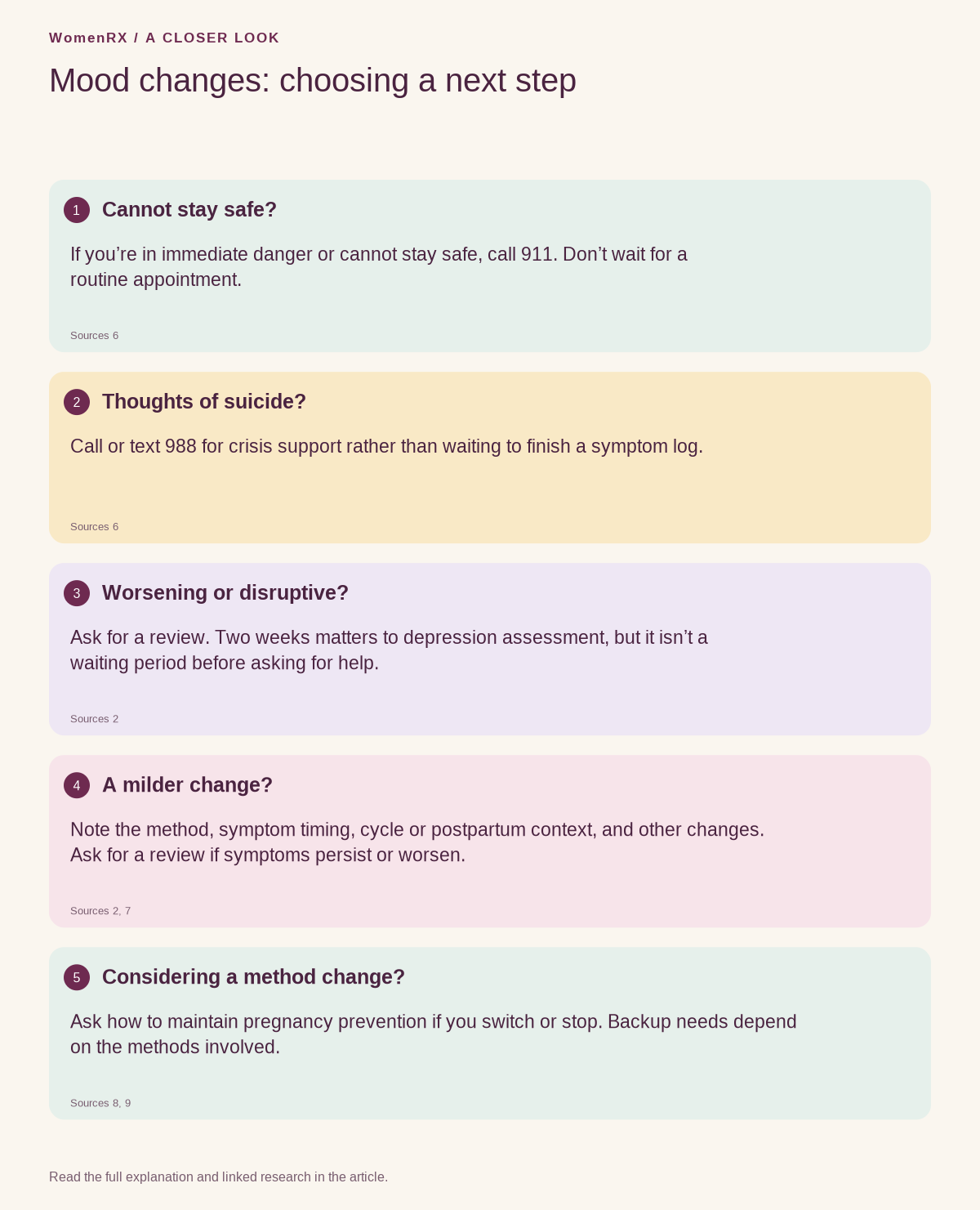
Mood changes: choosing a next step
Cannot stay safe?: If you’re in immediate danger or cannot stay safe, call 911. Don’t wait for a routine appointment.6
Thoughts of suicide?: Call or text 988 for crisis support rather than waiting to finish a symptom log.6
Worsening or disruptive?: Ask for a review. Two weeks matters to depression assessment, but it isn’t a waiting period before asking for help.2
A milder change?: Note the method, symptom timing, cycle or postpartum context, and other changes. Ask for a review if symptoms persist or worsen.27
Considering a method change?: Ask how to maintain pregnancy prevention if you switch or stop. Backup needs depend on the methods involved.89
Read the figure as text
Start with safety, then consider how much the symptoms affect your life. You don’t need a completed log to ask for help.- Cannot stay safe?: If you’re in immediate danger or cannot stay safe, call 911. Don’t wait for a routine appointment.6
- Thoughts of suicide?: Call or text 988 for crisis support rather than waiting to finish a symptom log.6
- Worsening or disruptive?: Ask for a review. Two weeks matters to depression assessment, but it isn’t a waiting period before asking for help.2
- A milder change?: Note the method, symptom timing, cycle or postpartum context, and other changes. Ask for a review if symptoms persist or worsen.27
- Considering a method change?: Ask how to maintain pregnancy prevention if you switch or stop. Backup needs depend on the methods involved.89
More questions, answered
Does a history of depression mean I can’t use hormonal birth control?
The research here doesn’t establish that a history of depression rules out hormonal contraception. Prior mental health may be relevant to an individual’s experience, but evidence doesn’t reliably predict how a particular method will affect one person. Include your history when discussing options and any mood change. 3 5
If I switch methods, will my mood improve?
A change may or may not help. A review can weigh your symptoms and contraception needs together. If you’re thinking of switching or stopping, ask how to maintain pregnancy prevention during the change; backup needs vary by method. 5 8 9
Sources you can check
- Birth Control | Contraception | Contraceptives | MedlinePlusAccessed 2026-09-25Return to first citation
- Depression: MedlinePlusAccessed 2026-09-25Return to first citation
- Use of systemic hormonal contraception and risk of depression: a registry-based study from Finland.Toffol E, Partonen T, Heikinheimo O, But A, Latvala A, Haukka J. · European journal of epidemiology · 2025Return to first citation
- Association of oral contraceptives with depression symptoms, diagnosis, and treatment in healthy women: A meta-analysis.Kellock MD, Potts HWW, Pinho G, Chilanga F, Farič N. · European journal of obstetrics, gynecology, and reproductive biology · 2026Return to first citation
- Hormonal contraception and mental health: a narrative review of screening, monitoring, and patient-centered care for family physicians.Zaidi ARZ, Elhassan H, Syed AM, Waseem N, Muhammed A, Fida L, Fathima S, Taha I, Tannous G, Irshad S, Alghalyini B. · Frontiers in psychiatry · 2026Return to first citation
- Depression in Women: 4 Things to Know - National Institute of Mental Health (NIMH)Accessed 2026-09-25Return to first citation
- Postpartum Depression: MedlinePlusAccessed 2026-09-25Return to first citation
- Progestin-Only Pills | Contraception | CDCAccessed 2026-09-25Return to first citation
- Combined Hormonal Contraceptives | Contraception | CDCAccessed 2026-09-25Return to first citation