Can Starting or Stopping Birth Control Affect Hair?
The timing of shedding is worth noting, but your contraceptive method and other symptoms matter too.
Shedding after you start, switch, or stop hormonal contraception is worth discussing, but the sequence alone doesn’t show what caused it. Note your exact method and when the change happened. Also mention irregular periods, acne, or increased facial or body hair, which can point toward another explanation for scalp hair loss. If you rely on contraception, make a pregnancy-prevention plan before stopping. 1 2 4
A change in timing is a clue, not a verdict
If shedding began after a contraceptive change, that sequence is worth mentioning when you discuss it with a clinician. But a change followed by shedding doesn’t establish cause and effect. In one study of contraceptive use, women reported symptoms every six months, so it cannot tell you precisely how soon shedding might begin after a change. 3
A review of hormonal therapies and hair noted both a lack of data and disagreement in the literature about how specific hormone-related treatments affect hair. 2
A study of 608 women compared those using a particular oral contraceptive with a reduced pill-free interval or depot medroxyprogesterone acetate with women not using hormonal contraception. Participants reported symptoms before initiation and every six months for two years. The oral-pill group had lower odds of reporting hair loss (odds ratio 0.6); that finding doesn’t show that the pill treated hair loss, and it can’t predict what will happen with other pills or methods. 3
The method matters, and so do the other clues
“Birth control” covers methods with different hormones and different ways of delivering them. Pills may contain progestin alone or both progestin and estrogen; other hormonal options include patches, rings, injections, implants, and hormonal IUDs. Copper IUDs are a nonhormonal option. 1
That variety is one reason not to assume a finding about one pill applies to an injection, implant, or IUD. The study doesn’t compare the full range of methods or establish that one is better for hair than another. 2 3
Look beyond the date on the prescription, too. Polycystic ovary syndrome (PCOS) can involve male-pattern scalp hair loss alongside acne, increased facial or body hair, and infrequent or irregular periods. If those features were present before your contraceptive change, or you used contraception to manage irregular cycles, they’re useful context. They don’t diagnose PCOS on their own. 4
Put the events in context
Write down the exact method you used, when you started, changed, or stopped it, and when you first noticed hair loss. Describe what you mean by it: for example, more hair coming out when you wash it, or a change in where your scalp shows through. Those descriptions give a clinician more to work with than the word “shedding” alone.
If you recently gave birth and changed contraception around the same time, include both dates. Their overlap cannot, by itself, tell you which event matters more. Likewise, if pregnancy is possible, raise that separately rather than assuming the contraceptive change explains the hair loss.
If you’re thinking about stopping, consider whether you still need pregnancy prevention before making the change. Contraception includes methods that work in different ways, so that need can be part of the conversation about what to do next. 1
A useful question is: “Could this particular method be related to what I’m seeing, and do my other symptoms suggest something else?” Bring the method name, the sequence of events, and any cycle or skin changes you’ve noticed.
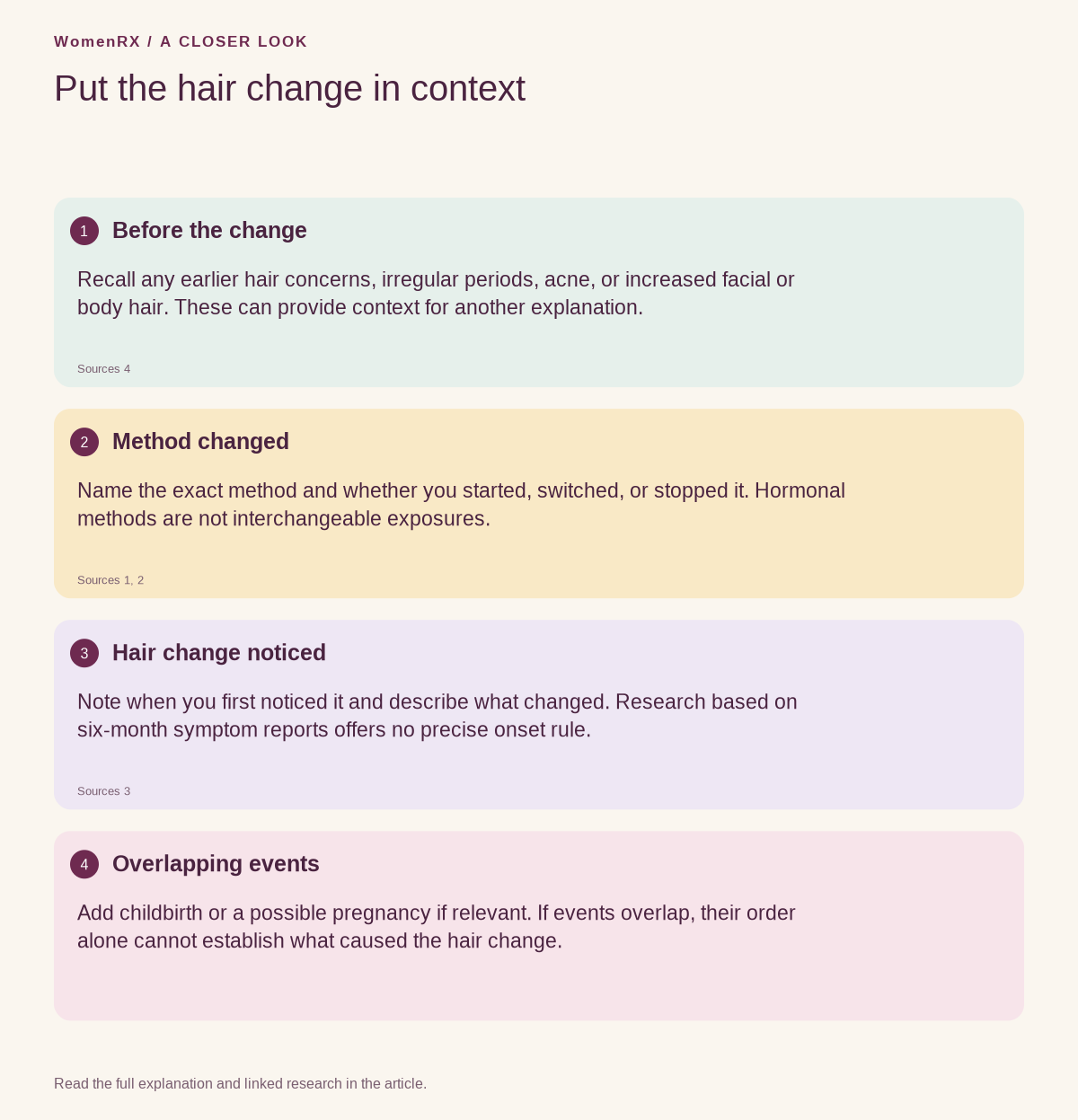
Put the hair change in context
Before the change: Recall any earlier hair concerns, irregular periods, acne, or increased facial or body hair. These can provide context for another explanation.4
Method changed: Name the exact method and whether you started, switched, or stopped it. Hormonal methods are not interchangeable exposures.12
Hair change noticed: Note when you first noticed it and describe what changed. Research based on six-month symptom reports offers no precise onset rule.3
Overlapping events: Add childbirth or a possible pregnancy if relevant. If events overlap, their order alone cannot establish what caused the hair change.
Read the figure as text
Use the sequence to organize what happened, then add clues the dates alone cannot provide.- Before the change: Recall any earlier hair concerns, irregular periods, acne, or increased facial or body hair. These can provide context for another explanation.4
- Method changed: Name the exact method and whether you started, switched, or stopped it. Hormonal methods are not interchangeable exposures.12
- Hair change noticed: Note when you first noticed it and describe what changed. Research based on six-month symptom reports offers no precise onset rule.3
- Overlapping events: Add childbirth or a possible pregnancy if relevant. If events overlap, their order alone cannot establish what caused the hair change.
More questions, answered
Should I stop birth control if I notice shedding?
You don’t have to decide based on timing alone. If you rely on your method to prevent pregnancy, make a plan for continued protection before stopping or switching. Birth control methods differ, and a contraceptive-care provider can help you weigh the options. 1
Does the evidence show that one contraceptive is best for hair?
No. A study of one oral-pill regimen found lower odds of reported hair loss, but it didn’t establish a hair benefit or compare all contraceptive methods. That result cannot rank methods for hair. 2 3
Sources you can check
- Birth Control | Contraception | Contraceptives | MedlinePlusAccessed 2026-09-25Return to first citation
- Understanding Hormonal Therapies: Overview for the Dermatologist Focused on Hair.Desai K, Almeida B, Miteva M. · Dermatology (Basel, Switzerland) · 2021Return to first citation
- Physiologic and psychologic symptoms associated with use of injectable contraception and 20 microg oral contraceptive pills.Berenson AB, Odom SD, Breitkopf CR, Rahman M. · American journal of obstetrics and gynecology · 2008Return to first citation
- Comprehensive clinical management of polycystic ovary syndrome.Setji TL, Brown AJ. · Minerva medica · 2007Return to first citation