Starting or Stopping the Pill: What Might Change?
Bleeding, cramps, and acne may change on the pill, but no before-and-after story can predict your experience.
The pill’s intended change is pregnancy prevention. Depending on the pill and why you take it, you may also notice changes in bleeding, cramps, or acne. Those outcomes aren’t equally predictable, and combined pills and progestin-only pills differ. Pregnancy can occur after stopping, but a small study of women who stopped to conceive doesn’t provide a personal timetable.256710
Start with the reason you’re taking it
A useful before-and-after comparison starts with your goal. If it’s contraception, that’s the pill’s primary job. Oral contraceptives contain either progestin alone or both estrogen and progestin; they aren’t one interchangeable treatment for every symptom.2
If you’re hoping for easier periods or clearer skin, ask a more specific question: Which change has evidence for a pill like mine, and which change am I simply hoping will happen? Your starting point matters too. A regular cycle with mild cramps leaves less room for a noticeable change than a cycle marked by painful periods. Irregular periods may have causes other than contraception, including thyroid problems or polycystic ovary syndrome (PCOS).38
Bleeding: look at the pattern, not just the calendar
Bleeding while taking a pill doesn’t necessarily tell you what your natural cycle would look like without it. For example, a combined pill can produce more predictable withdrawal bleeding for women with PCOS, even though PCOS itself may cause irregular periods. That finding is useful if you have PCOS; it isn’t a promise that everyone with irregular periods will have the same result.58
Nor is a tidier calendar the only possible change. In a review of studies of combined pills for menstrual pain in Chinese patients, abnormal menstrual bleeding was the most commonly reported adverse event. The studies used different regimens and comparisons, so that finding can’t predict whether you will have spotting or how long it might last.7 Progestin-only pills can also be associated with irregular bleeding; evidence comparing bleeding patterns in women with PCOS should not be treated as a forecast for all users.58
When you stop, pay attention to your own pattern rather than expecting your periods to match someone else’s timeline. Cycles vary naturally, and pregnancy, the years approaching menopause, PCOS, and thyroid problems can also affect regularity.18 If bleeding is very heavy, pain is severe, or your usual pattern changes substantially, it’s worth getting the cause assessed rather than attributing it all to the pill.3
Cramps: improvement is possible, not automatic
Combined pills can reduce menstrual pain. A systematic review of 28 clinical studies involving 3,409 Chinese patients found improvement in both primary and secondary dysmenorrhea. Many studies used treatments other than placebo as comparators, so the review doesn’t give one reliable amount of relief to expect from starting a pill.7
That distinction between types of pain matters. If your cramps were severe before the pill, or become severe after you stop, the question isn’t just whether to restart it. It’s also whether something causing the pain needs attention.37
Acne: a possible benefit of combined pills
Combined oral contraceptives are an established acne treatment option, and a dermatology review found generally similar acne effectiveness across combined-pill brands.6 That doesn’t mean every pill has the same evidence for skin changes. In a 12-week trial of women with PCOS, acne severity was comparable between an estetrol/drospirenone combined pill and a drospirenone-only pill. A short study in women with PCOS can’t predict any one person’s before-and-after photos.5
If acne was part of your life before starting, it’s reasonable to notice whether it changes while taking the pill or after stopping. Don’t use someone else’s weight or mood story as a forecast of your own result; those outcomes aren’t established by the bleeding, pain, acne, and fertility findings discussed here.
Stopping: fertility has no personal countdown
If you stop because you want to become pregnant, the pill shouldn’t be assumed to cause a lasting delay. In one follow-up of women who left a continuous combined-pill trial because they wanted pregnancy, 18 of the 21 women included in the pregnancy analysis conceived within 13 months. That’s encouraging, but it’s a very small, selected group, not a timetable for everyone stopping an oral contraceptive.10
A larger US insurance-claims study recorded fewer pregnancies after discontinuation of a 91-day levonorgestrel-containing combined pill than after a 28-day version. Its authors noted that differences in days supplied and unmeasured factors could explain the finding; recorded pregnancies cannot, by themselves, establish that one regimen caused lasting difficulty conceiving.9 If you don’t want pregnancy after stopping, plan what contraception you’ll use next rather than waiting to see when your periods settle.210
Finally, a first period isn’t a test of fertility. Menstrual bleeding and ovulation are related parts of a natural cycle, but their timing varies.1 If your periods were irregular before the pill, a familiar pattern may be more informative than a comparison with someone else’s ‘after’ photo. After childbirth or while breastfeeding, periods may change for reasons unrelated to starting or stopping a pill; bleeding during postpartum recovery also shouldn’t be mistaken for a clear picture of your usual cycle.34
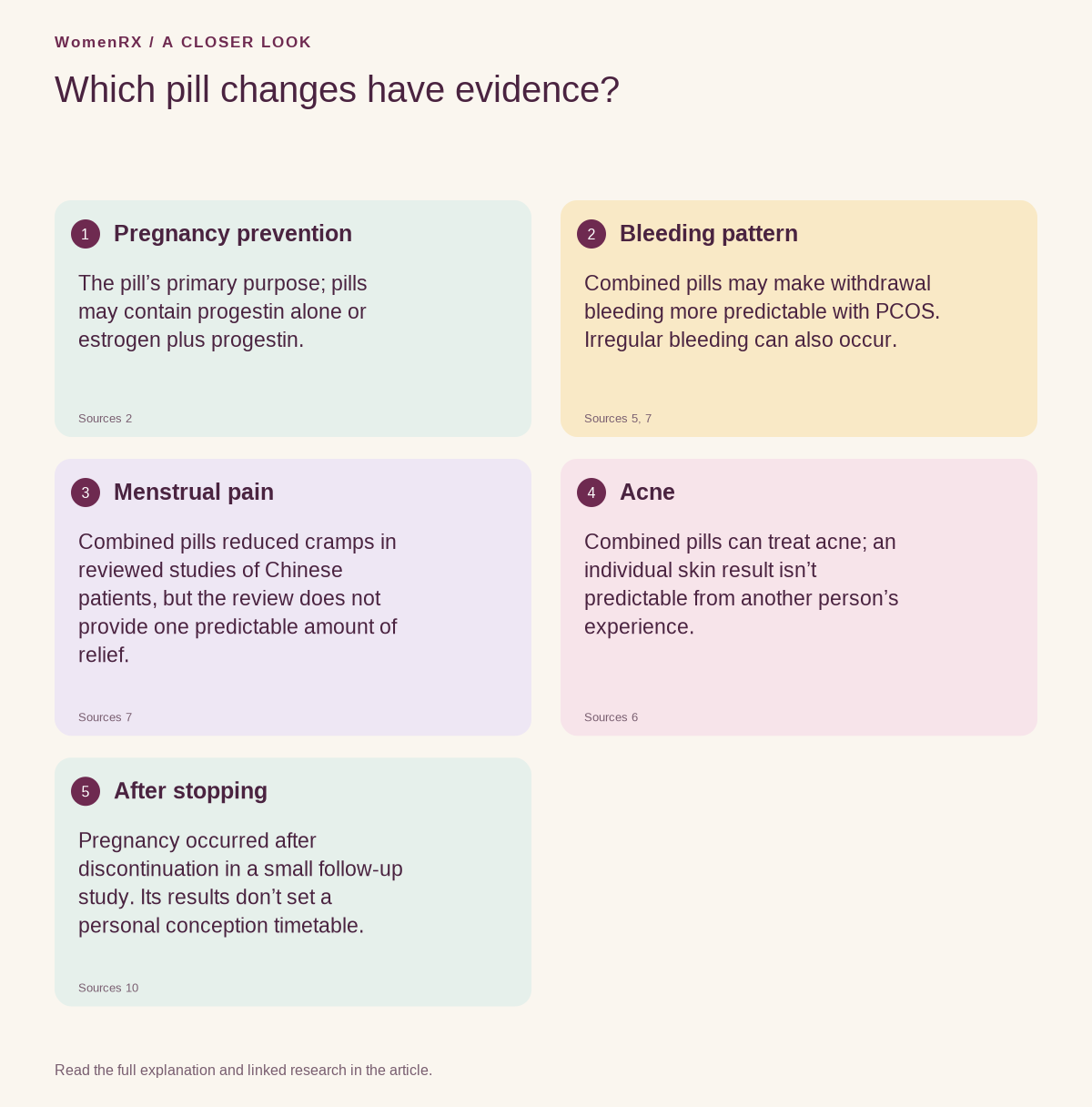
Which pill changes have evidence?
Pregnancy prevention: The pill’s primary purpose; pills may contain progestin alone or estrogen plus progestin.2
Bleeding pattern: Combined pills may make withdrawal bleeding more predictable with PCOS. Irregular bleeding can also occur.57
Menstrual pain: Combined pills reduced cramps in reviewed studies of Chinese patients, but the review does not provide one predictable amount of relief.7
Acne: Combined pills can treat acne; an individual skin result isn’t predictable from another person’s experience.6
After stopping: Pregnancy occurred after discontinuation in a small follow-up study. Its results don’t set a personal conception timetable.10
Read the figure as text
Compare the pill’s purpose with symptom outcomes studied in specific groups and the less predictable question of pregnancy after stopping.- Pregnancy prevention: The pill’s primary purpose; pills may contain progestin alone or estrogen plus progestin.2
- Bleeding pattern: Combined pills may make withdrawal bleeding more predictable with PCOS. Irregular bleeding can also occur.57
- Menstrual pain: Combined pills reduced cramps in reviewed studies of Chinese patients, but the review does not provide one predictable amount of relief.7
- Acne: Combined pills can treat acne; an individual skin result isn’t predictable from another person’s experience.6
- After stopping: Pregnancy occurred after discontinuation in a small follow-up study. Its results don’t set a personal conception timetable.10
Sources you can check
- Periods and fertility in the menstrual cycle - NHSAccessed 2026-09-25Return to first citation
- Birth Control | Contraception | Contraceptives | MedlinePlusAccessed 2026-09-25Return to first citation
- Menstruation | Period | MedlinePlusAccessed 2026-09-25Return to first citation
- Postpartum Care: MedlinePlusAccessed 2026-09-25Return to first citation
- Effects of estetrol/drospirenone vs drospirenone-only on thrombin generation in women with polycystic ovary syndrome: a randomized, double-blind, controlled trial.Chantrapanichkul P, Wiwatboworn P, Rattanachaiyanont M, Tanmahasamut P, Wongwananuruk T, Surasang W, Ruchutrakool T, Chinthammitr Y, Suwanawiboon B, Rungjirajittranon T. · Research and practice in thrombosis and haemostasis · 2026Return to first citation
- Hormonal Therapies for Acne: A Comprehensive Update for Dermatologists.Smith CA, Gosnell E, Karatas TB, Deitelzweig C, Collins EMB, Yeung H. · Dermatology and therapy · 2025Return to first citation
- Controlled Clinical Studies of Combined Oral Contraceptives for Dysmenorrhea in China: A Systematic Literature Review.Zhang Y, Chen S, Wei C, Qi M, Zhang S, Yang Y, Xu H. · Women's health reports (New Rochelle, N.Y.) · 2025Return to first citation
- Irregular periods - NHSAccessed 2026-09-25Return to first citation
- Delayed pregnancy detection and return to fertility with extended levonorgestrel-containing oral contraceptives: A real world setting cohort study.Kaplan S, Bertoia ML, Lass A, Wang FT, Evans A, Dhanda S, Roy D, Seeger JD. · Pharmacoepidemiology and drug safety · 2023Return to first citation
- Return to fertility after cessation of a continuous oral contraceptive.Barnhart K, Mirkin S, Grubb G, Constantine G. · Fertility and sterility · 2009Return to first citation