Birth Control and Acne: Which Options Help?
Combined birth control pills can improve acne, but pregnancy-prevention needs and medical suitability should shape the choice.
If you want contraception and acne treatment, a combined oral contraceptive is worth discussing: trials in women found that several estrogen-and-progestin pills improved facial acne compared with placebo. The evidence doesn’t establish one pill as best, and it doesn’t show that every birth control method helps skin. Whether a combined pill suits your health history is a separate question. If contraception isn’t a goal, a topical retinoid combined with benzoyl peroxide is a studied option for mild-to-moderate acne. 54
Start with two questions, not one
Do you want to prevent pregnancy, treat acne, or both? A birth control method needs to work for your life even if your skin doesn’t change. And acne deserves attention even if you don’t want hormonal contraception. That distinction matters when you’re comparing a daily pill with a method you won’t have to think about each day. Contraceptive choices differ in effectiveness, convenience, side effects, personal control and reversibility. 12
What the acne trials actually show
The clearest contraceptive evidence is for combined oral contraceptives, which contain estrogen and a progestin. A Cochrane review of randomized trials in women found that the combined pills studied against placebo reduced facial acne lesions and improved acne assessments. The review included trials of pills containing norgestimate and drospirenone, among other progestins. It found few consistent, important differences between combined-pill types, so the ingredient name alone doesn’t identify a best pill for acne. 5
There’s a useful qualification. A broader review comparing many acne treatments found that oral treatments, including hormonal contraceptives, did not appear effective for mild-to-moderate acne after the researchers adjusted for study bias. That analysis had uncertainty and assessed treatments differently from the combined-pill-versus-placebo review. Taken together, the findings support considering a combined pill when you also want contraception, but not treating it as the automatic first choice for acne alone. 45
How other contraceptive choices fit
A progestin-only pill is a different type of oral contraceptive from the combined pills in the acne trials. The pill results shouldn’t be carried over to it. Likewise, a patch, vaginal ring, implant, injection or hormonal IUD may meet a pregnancy-prevention need, but the combined-pill review doesn’t establish an acne benefit for those methods or for a copper IUD. That doesn’t mean no studies of other methods exist; it means the combined-pill findings can’t answer what will happen to your skin with another method. 15
Pregnancy prevention may point you toward a different choice. The CDC lists typical-use failure rates of 7% for combined and progestin-only pills, the patch and the ring; 4% for the injection; 0.1% for the implant; 0.1-0.4% for hormonal IUDs; 0.8% for the copper IUD; and 13% for external condoms. These figures describe pregnancy prevention with typical use, not acne outcomes. 2
Medical suitability can change the shortlist. The CDC’s 2024 eligibility guidance treats migraine with aura as an unacceptable health risk for combined hormonal contraception, which includes the combined pill, patch and ring. It also flags certain blood-clot histories and high blood pressure; for someone who smokes at age 35 or older, the assessment depends in part on how much they smoke. These aren’t reasons to guess whether a method is safe for yourself. They’re concrete reasons to bring your migraine history, blood pressure, smoking and any past clots into the choice. The CDC classifies some alternatives differently for these conditions, so an acne benefit doesn’t have to determine your contraceptive options. 7
Condoms belong in the comparison for a separate reason: external latex condoms can also help protect against HIV and other sexually transmitted infections, while most contraceptive methods do not. If infection prevention matters to you, acne outcomes shouldn’t crowd it out of the decision. 2
If acne is the main problem
Acne can begin or continue in adulthood, and some women notice flares before a period. Hormone changes can contribute, but acne also involves blocked follicles, excess oil and inflammation. More washing won’t clear a blockage beneath the skin and may irritate it. 36
For example, if you have mild-to-moderate acne but don’t want a daily contraceptive pill, a topical retinoid combined with benzoyl peroxide is one skin-directed option to discuss. A systematic review found it effective for mild-to-moderate acne, though the quality of the included trials varied. Painful deep nodules or cysts warrant a treatment discussion sooner because they can scar. 43
Pregnancy and postpartum change the conversation
Acne may flare during pregnancy. That’s an acne-treatment question, not a reason to start contraception for the current pregnancy. 36
After birth, pregnancy prevention may become a separate question again. The timing matters: CDC guidance classifies combined hormonal contraception as an unacceptable health risk during the first 21 days postpartum, whether or not you’re breastfeeding. Later eligibility depends on factors including breastfeeding and blood-clot risk. An acne benefit shouldn’t override that assessment. 7
If you’re breastfeeding, don’t assume breastfeeding alone provides reliable contraception: the CDC describes it as a temporary method only when you have had no period since birth, are fully or nearly fully breastfeeding, and are under six months postpartum. If any condition no longer applies, another method is needed. Your skin and pregnancy-prevention goals can still be addressed separately. 2
The practical comparison is this: choose a contraceptive for its pregnancy-prevention fit first, then count acne improvement as a potential added benefit where it has been studied. If a combined pill isn’t a good fit or you don’t want one, that doesn’t leave you without an acne plan. 145
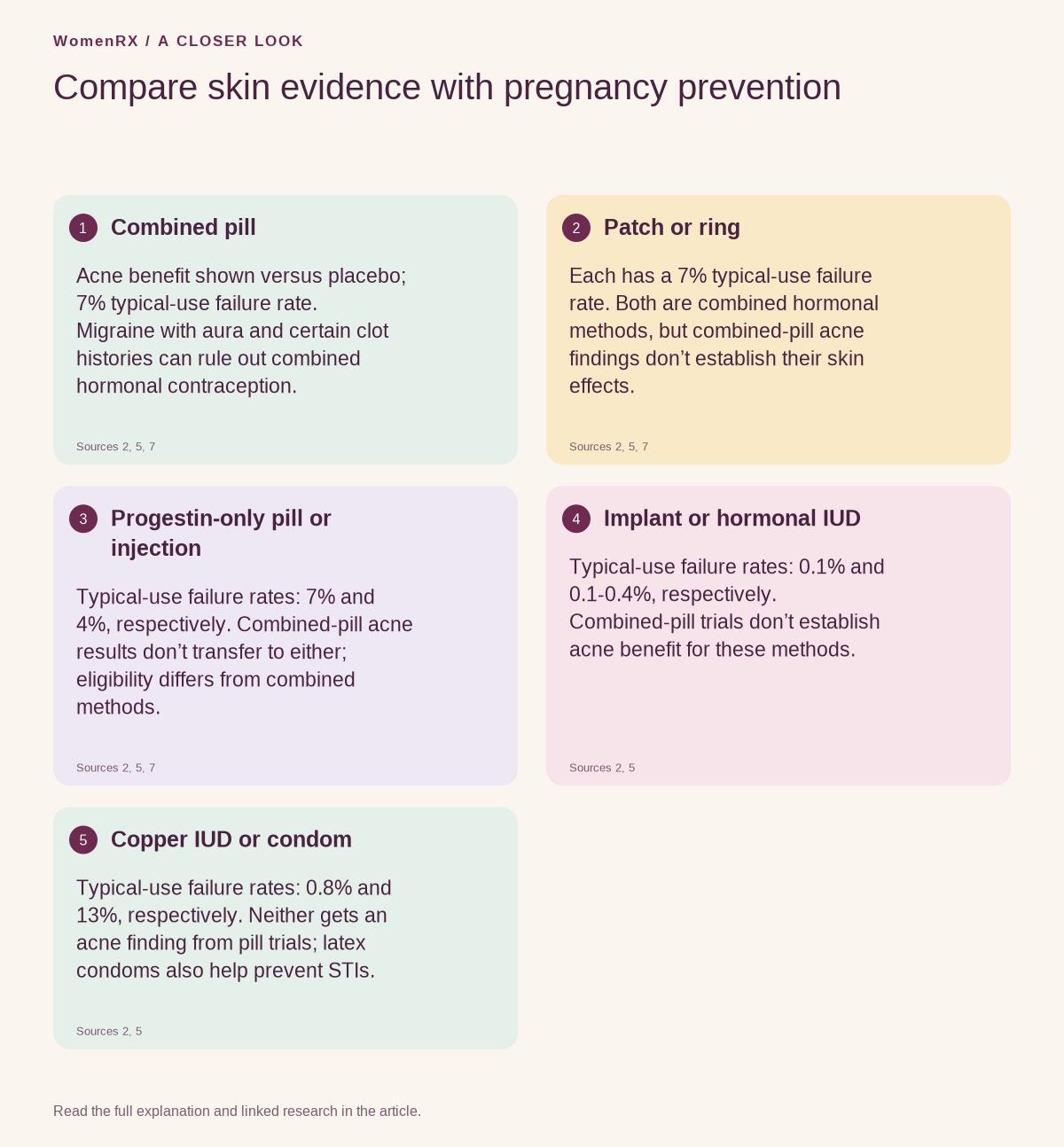
Compare skin evidence with pregnancy prevention
Combined pill: Acne benefit shown versus placebo; 7% typical-use failure rate. Migraine with aura and certain clot histories can rule out combined hormonal contraception.257
Patch or ring: Each has a 7% typical-use failure rate. Both are combined hormonal methods, but combined-pill acne findings don’t establish their skin effects.257
Progestin-only pill or injection: Typical-use failure rates: 7% and 4%, respectively. Combined-pill acne results don’t transfer to either; eligibility differs from combined methods.257
Implant or hormonal IUD: Typical-use failure rates: 0.1% and 0.1-0.4%, respectively. Combined-pill trials don’t establish acne benefit for these methods.25
Copper IUD or condom: Typical-use failure rates: 0.8% and 13%, respectively. Neither gets an acne finding from pill trials; latex condoms also help prevent STIs.25
Read the figure as text
The acne trial finding applies to studied combined pills, not automatically to the other methods below. CDC percentages are typical-use pregnancy failure rates; health history can change which options suit you. 257- Combined pill: Acne benefit shown versus placebo; 7% typical-use failure rate. Migraine with aura and certain clot histories can rule out combined hormonal contraception.257
- Patch or ring: Each has a 7% typical-use failure rate. Both are combined hormonal methods, but combined-pill acne findings don’t establish their skin effects.257
- Progestin-only pill or injection: Typical-use failure rates: 7% and 4%, respectively. Combined-pill acne results don’t transfer to either; eligibility differs from combined methods.257
- Implant or hormonal IUD: Typical-use failure rates: 0.1% and 0.1-0.4%, respectively. Combined-pill trials don’t establish acne benefit for these methods.25
- Copper IUD or condom: Typical-use failure rates: 0.8% and 13%, respectively. Neither gets an acne finding from pill trials; latex condoms also help prevent STIs.25
More questions, answered
Is drospirenone better than norgestimate for acne?
One review noted a possible advantage in some comparisons, but the evidence for differences between specific combined pills was limited and inconsistent. It did not establish a clear best pill. 5
Should I choose birth control just to treat acne?
Not necessarily. Combined pills have evidence of acne benefit, but a topical retinoid combined with benzoyl peroxide is a studied option for mild-to-moderate acne. Your need for pregnancy prevention and whether a combined pill suits your health history are separate parts of the choice. 1457
Sources you can check
- Birth Control | Contraception | Contraceptives | MedlinePlusAccessed 2026-09-25Return to first citation
- CDC: Birth control methods, barrier methods, fertility awareness and breastfeedingAccessed 2026-09-25Return to first citation
- Acne - NHSAccessed 2026-09-25Return to first citation
- A systematic review and network meta-analysis of topical pharmacological, oral pharmacological, physical and combined treatments for acne vulgaris.Mavranezouli I, Daly CH, Welton NJ, Deshpande S, Berg L, Bromham N, Arnold S, Phillippo DM, Wilcock J, Xu J, Ravenscroft JC, Wood D, Rafiq M, Fou L, Dworzynski K, Healy E. · The British journal of dermatology · 2022Return to first citation
- Combined oral contraceptive pills for treatment of acne.Arowojolu AO, Gallo MF, Lopez LM, Grimes DA. · The Cochrane database of systematic reviews · 2012Return to first citation
- Acne - Causes - NHSAccessed 2026-09-25Return to first citation
- Appendix A: Summary of Classifications for U.S. Medical Eligibility Criteria for Contraceptive Use, 2024 | Contraception | CDCAccessed 2026-09-25Return to first citation