Sprintec: How It Works and What to Consider
Sprintec offers a daily contraception routine, but its estrogen-related risks and your plans for breastfeeding can change whether it fits.
Sprintec is a combined pill containing norgestimate and ethinyl estradiol. It prevents pregnancy primarily by stopping ovulation. Its pack has 21 active pills followed by seven inactive pills, and it depends on taking a pill every day. Before starting, the key questions are whether estrogen is safe for you, whether the routine suits you, and whether you’ve recently given birth or are breastfeeding.23
What the daily routine involves
Sprintec’s 28-pill pack contains 21 blue active pills and seven white inactive pills. The pack is taken in order, with a pill at the same time each day; the next pack begins after the last inactive pill. Sprintec’s labeling gives both a first-day-of-period start and a Sunday start. With a Sunday start, it calls for additional nonhormonal contraception during the first seven days of the first pack.2
The distinction between active and inactive pills matters if you miss one. Sprintec works primarily by suppressing ovulation, and missed active pills can reduce contraceptive protection. Missing pills beside the inactive-pill week is a particular concern because it extends the time without active hormones. The action to take depends on how many active pills were missed and where you are in the pack, so use Sprintec’s missed-pill instructions rather than treating every late pill the same way. Severe vomiting or diarrhea can also interfere with absorption; the label treats vomiting or diarrhea within three to four hours of an active pill as a missed pill.23
That daily commitment is a real part of choosing the method. If remembering a pill at the same time every day sounds difficult, a method that doesn’t require a daily action may fit your life better. CDC guidance specifically suggests exploring other methods when combined-pill doses are frequently missed.23
Bleeding, acne, and other trade-offs
A scheduled bleed may happen during the inactive-pill week, but Sprintec doesn’t guarantee perfectly predictable bleeding. Spotting or bleeding between scheduled bleeds can occur, especially during the first three months, and may decrease over time. If bleeding persists or starts after previously regular cycles, it needs assessment for other causes rather than an assumption that it’s simply the pill.2
If acne is part of your decision, keep the expectation modest. A study designed to assess acne and bleeding with a norgestimate-and-ethinyl-estradiol pill describes planned measurements, not results showing how much acne improves. Acne also appears among reports after norgestimate-and-ethinyl-estradiol use. Neither point predicts what will happen to your skin on Sprintec.12
In Sprintec contraception trials, commonly reported adverse reactions included headache or migraine, stomach or gastrointestinal pain, breast symptoms, and mood changes. A new headache that’s recurrent, persistent, or severe, or a substantial change in migraine, calls for assessment. The more serious trade-off is that combined oral contraceptives increase the risk of blood clots and can increase the risk of stroke or heart attack, particularly when other risk factors are present.2
When estrogen changes the choice
A blood pressure measurement belongs before starting a combined hormonal contraceptive. A pelvic exam isn’t required just to determine whether it can be used safely. What matters more for this decision is a review of conditions that can make estrogen-containing contraception unsafe or less suitable.3
Sprintec’s labeling rules it out for people who smoke and are over 35, have migraine with aura, have a current or past deep vein thrombosis or pulmonary embolism, or have uncontrolled high blood pressure. Current or past breast cancer and certain liver conditions are also listed as contraindications. These aren’t reasons to guess whether your risk is “probably low”; they’re reasons to choose contraception with your actual health history in view. Taking a hepatitis C drug combination containing ombitasvir, paritaprevir, and ritonavir, with or without dasabuvir, is another labeled reason not to use Sprintec.2
After childbirth, the timing is different
Sprintec’s label says not to start it until at least four weeks after delivery because of clot risk. CDC guidance for combined hormonal contraceptives also distinguishes between breastfeeding and not breastfeeding, and considers other clot-risk factors. Neither group should use a combined hormonal method in the first 21 days after delivery.23
If you’re breastfeeding, CDC generally advises against a combined hormonal method from day 21 to before day 30. From day 30 through day 42, CDC generally considers one an option without other clot-risk factors, but generally advises against one with those factors. After day 42, CDC generally considers combined hormonal methods usable while breastfeeding.3
If you’re not breastfeeding, CDC generally considers a combined hormonal method an option from day 21 through day 42 without other clot-risk factors, but generally advises against one with those factors. After day 42, postpartum status alone places no restriction on its use. Sprintec’s own four-week minimum still applies, even where CDC’s broader guidance would allow a combined method earlier.23
That CDC eligibility guidance doesn’t erase a separate Sprintec consideration: its label says Sprintec is not recommended while breastfeeding because combined hormonal contraceptives can reduce milk production, though this is less likely once breastfeeding is well established. If you want contraception while nursing, a non-estrogen method is worth comparing rather than assuming that reaching a certain postpartum day settles the choice.23
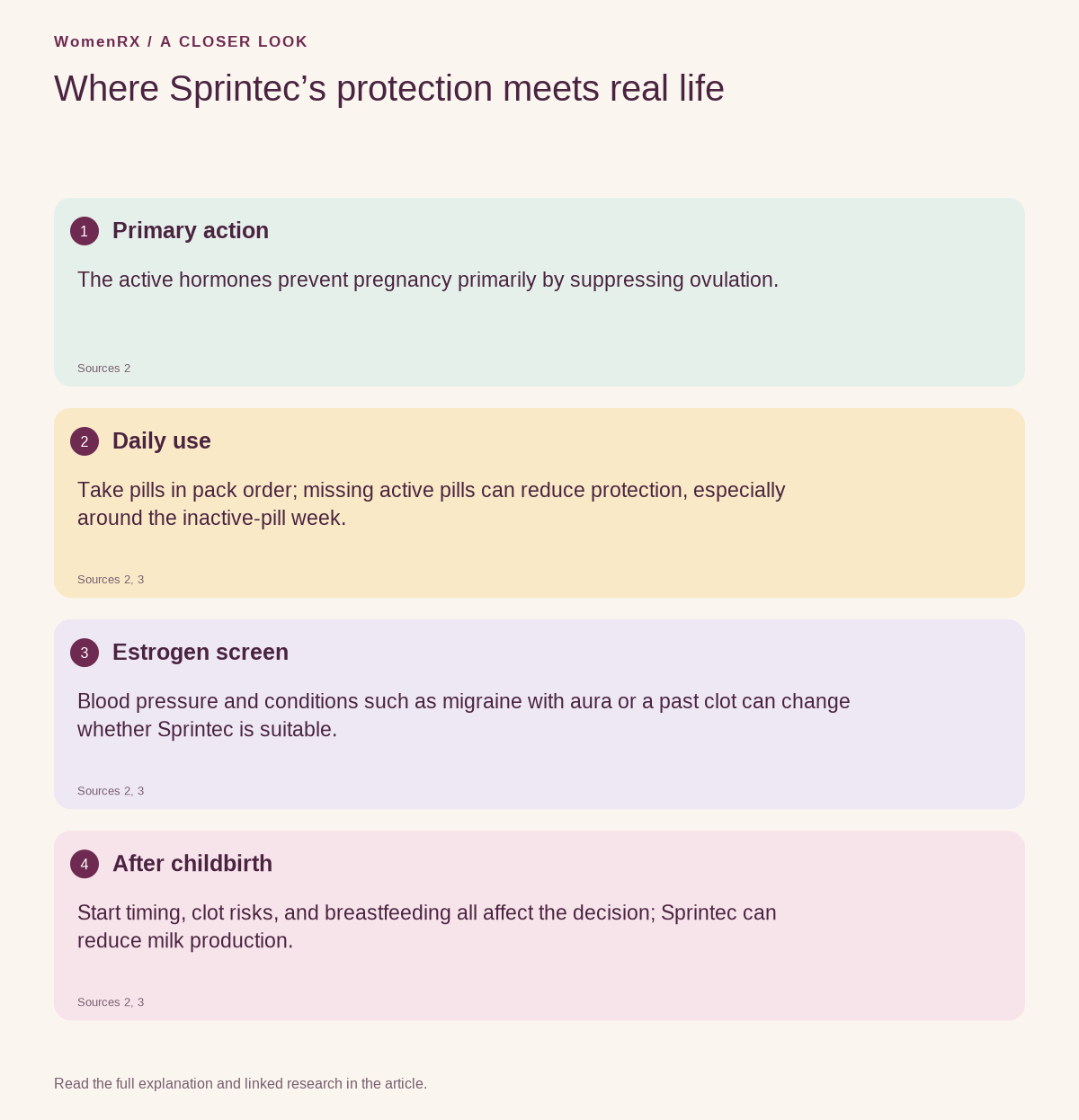
Where Sprintec’s protection meets real life
Primary action: The active hormones prevent pregnancy primarily by suppressing ovulation.2
Daily use: Take pills in pack order; missing active pills can reduce protection, especially around the inactive-pill week.23
Estrogen screen: Blood pressure and conditions such as migraine with aura or a past clot can change whether Sprintec is suitable.23
After childbirth: Start timing, clot risks, and breastfeeding all affect the decision; Sprintec can reduce milk production.23
Read the figure as text
The pill’s mechanism is only one part of the decision; daily use and estrogen-related health factors matter too.- Primary action: The active hormones prevent pregnancy primarily by suppressing ovulation.2
- Daily use: Take pills in pack order; missing active pills can reduce protection, especially around the inactive-pill week.23
- Estrogen screen: Blood pressure and conditions such as migraine with aura or a past clot can change whether Sprintec is suitable.23
- After childbirth: Start timing, clot risks, and breastfeeding all affect the decision; Sprintec can reduce milk production.23
More questions, answered
Does Sprintec protect against sexually transmitted infections?
No. Hormonal contraception doesn’t protect against sexually transmitted infections. Condoms can reduce STI risk when used consistently and correctly.4
Sources you can check
- Effects of a Monophasic Hormonal Contraceptive With Norgestimate+Ethinyl Estradiol on Menstrual Bleeding: Protocol and Design of a Multicenter, Prospective, Open-Label, Noncomparative Study in Italy.Cagnacci A, Grandi G, Capobianco G, Fulghesu AM, Morgante G, Biondelli V, Piccolo E, Casolati E, Mangrella M. · JMIR research protocols · 2025Return to first citation
- SPRINTEC norgestimate and ethinyl estradiol, TevaAccessed 2026-09-25Return to first citation
- Combined Hormonal Contraceptives | Contraception | CDCAccessed 2026-09-25Return to first citation
- Appendix A: Summary of Classifications for U.S. Medical Eligibility Criteria for Contraceptive Use, 2024 | Contraception | CDCAccessed 2026-09-25Return to first citation