Does Yaz Affect Weight? What the Evidence Shows
Weight changes are reported by some Yaz users, but a change on the scale alone can’t show whether the pill caused it.
Yaz may coincide with a weight change, but its prescribing information doesn’t establish how much weight it causes people to gain or lose. In trials involving women taking Yaz for premenstrual dysphoric disorder (PMDD), 2.5% reported increased weight as an adverse reaction over up to three cycles. That’s a report of an experience, not a measured average effect or a prediction of yours.2
What the Yaz trials tell you
Yaz contains drospirenone and ethinyl estradiol. Its prescribing information lists “weight changes” among possible side effects. It also reports that 2.5% of 285 women who took Yaz in PMDD trials reported increased weight as an adverse reaction during up to three cycles.2
That number deserves a careful reading. It describes reports in a particular group of women, not the average number of pounds gained. It doesn’t tell you whether the change lasted or whether Yaz, rather than something else happening at the same time, caused it. The label reports adverse reactions from contraception and acne trials separately from those in the PMDD trials because the studies differed in design and setting. You can’t use the PMDD percentage as the expected rate for everyone taking Yaz for birth control.2
A small randomized trial offers another piece of context, but not a direct answer about Yaz. It studied 46 adolescents with PCOS and overweight or obesity for six months. Neither the group assigned a drospirenone/ethinyl estradiol pill nor the group assigned rosiglitazone had a change in weight or BMI. The pill in that study contained a different amount of ethinyl estradiol from Yaz, and the participants had a specific health condition. Its result cannot establish what an adult Yaz user should expect.42
A scale change isn’t necessarily body-fat change
Your weight includes water, muscle, bone and fat. Sleep, stress, activity and eating patterns can also affect it. So even when a change begins soon after a new pill, the timing is a clue worth taking seriously, not proof of its cause.1
This distinction matters especially if what you’ve noticed is bloating. Drospirenone has anti-mineralocorticoid activity, which relates to how the body handles salt and water. But that property doesn’t establish that Yaz produces weight loss. Yaz’s patient information lists bloating or fluid retention and weight changes as possible experiences with birth control pills.2 Feeling less bloated, seeing a different scale reading and having a lasting change in body fat are three different things.
If the timing feels connected
You don’t have to prove Yaz caused a change before bringing it up. A useful comparison is what was happening before you started it and what has changed since: your weight if you have earlier measurements, whether the concern is a steady change or fluctuating bloating, and any changes in medicines, sleep, activity or health. This isn’t a test that can assign blame. It helps separate a persistent concern from a single reading and gives you a clearer basis for deciding whether Yaz still suits you.13
If you’re considering Yaz, the CDC says a baseline weight can be useful for discussing later changes, though weight measurement isn’t required to determine eligibility for combined hormonal contraception. Blood pressure does need to be assessed before starting one. If you already take Yaz, you can raise a weight concern or ask about changing methods without waiting for a scheduled follow-up visit.3
The most useful question about an alternative is not “Which pill guarantees no weight change?” These findings don’t offer that guarantee. Ask what you need from contraception, what else you use Yaz for, and which options fit your health history. For example, if you take it partly for PMDD or acne, a change of method may involve a tradeoff beyond weight. Blood pressure and other health factors matter when choosing a combined hormonal method.23
If weight is changing suddenly or without an apparent reason, it’s worth having that change assessed rather than assuming the pill explains it. Unexpected weight gain or loss can sometimes signal a health problem.1
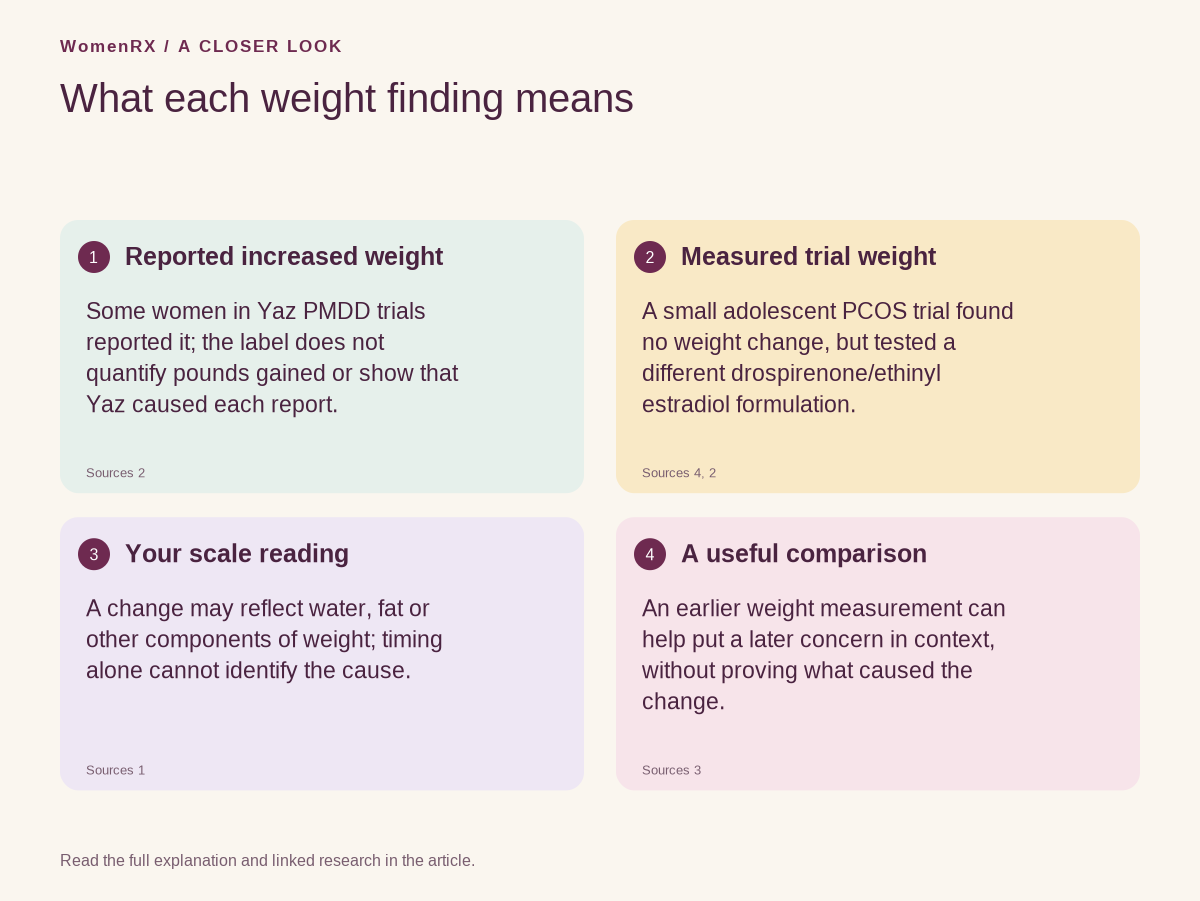
What each weight finding means
Reported increased weight: Some women in Yaz PMDD trials reported it; the label does not quantify pounds gained or show that Yaz caused each report.2
Measured trial weight: A small adolescent PCOS trial found no weight change, but tested a different drospirenone/ethinyl estradiol formulation.42
Your scale reading: A change may reflect water, fat or other components of weight; timing alone cannot identify the cause.1
A useful comparison: An earlier weight measurement can help put a later concern in context, without proving what caused the change.3
Read the figure as text
These findings answer different questions and shouldn’t be read as interchangeable estimates of Yaz’s effect.- Reported increased weight: Some women in Yaz PMDD trials reported it; the label does not quantify pounds gained or show that Yaz caused each report.2
- Measured trial weight: A small adolescent PCOS trial found no weight change, but tested a different drospirenone/ethinyl estradiol formulation.42
- Your scale reading: A change may reflect water, fat or other components of weight; timing alone cannot identify the cause.1
- A useful comparison: An earlier weight measurement can help put a later concern in context, without proving what caused the change.3
More questions, answered
Does drospirenone make Yaz a weight-loss pill?
No weight-loss effect is established by drospirenone’s anti-mineralocorticoid activity. That property concerns salt and water handling; it shouldn’t be treated as evidence of lasting body-fat loss.2
Does the 2.5% figure mean my chance of gaining weight is 2.5%?
No. It’s the proportion who reported increased weight as an adverse reaction among 285 women taking Yaz in PMDD trials lasting up to three cycles. It isn’t a measured average weight change or an individual risk estimate.2
Sources you can check
- Body Weight: MedlinePlusAccessed 2026-09-25Return to first citation
- YAZ drospirenone and ethinyl estradiol, BayerAccessed 2026-09-25Return to first citation
- Combined Hormonal Contraceptives | Contraception | CDCAccessed 2026-09-25Return to first citation
- Drospirenone/ethinyl estradiol versus rosiglitazone treatment in overweight adolescents with polycystic ovary syndrome: comparison of metabolic, hormonal, and cardiovascular risk factors.Tfayli H, Ulnach JW, Lee S, Sutton-Tyrrell K, Arslanian S. · The Journal of clinical endocrinology and metabolism · 2011Return to first citation