Does the Twirla Patch Affect Weight?
Increased weight was reported in a Twirla trial, but that finding can’t tell you whether the patch caused an individual change.
Yes, increased weight is a reported adverse reaction with Twirla: it was recorded for 2.0% of 2,031 users in a 12-month trial. Because the trial had no comparison group and the label doesn’t report an average weight change, that figure can’t tell you how much weight users typically gained or whether Twirla caused a change you’ve noticed. A starting weight and the timing of the change can help you discuss it. 43
What the Twirla weight figure actually means
Twirla is a contraceptive patch containing levonorgestrel and ethinyl estradiol. Its prescribing information lists “weight increased” among adverse reactions in a 12-month trial: 2.0% of the 2,031 women who used the patch had that finding recorded. The trial was single-arm, meaning everyone received Twirla rather than some participants receiving a comparison method. 4
That 2.0% is not an average amount gained. The reported adverse-reaction table doesn’t say how much weight changed, when it changed, or whether the change was body fat. Without a comparison group, it also can’t show how often similar changes would have happened without Twirla. At the same time, the finding is a reason to take your own experience seriously, not to dismiss it. 4
A separate trial comparing two oral contraceptives containing levonorgestrel and ethinyl estradiol found no significant difference between those pill groups in reported weight increase or decrease over six months. That comparison cannot answer what happens with Twirla, which is a patch, or establish that Twirla keeps weight stable. 2
If the scale changes after you start
The timing is useful, but it isn’t proof of a cause. Body weight includes water, muscle, bone, and fat. Diet, activity, stress, and sleep can also affect it. A higher number on one day therefore doesn’t tell you whether you’ve gained body fat, and a change after starting the patch doesn’t, by itself, identify the patch as the reason. 1
If you want a clearer picture, note your weight near the time you start Twirla and compare later readings taken under similar conditions. Jot down when the change began, whether it has continued, and whether anything else changed around the same time, such as sleep, activity, another medicine, or your postpartum routine. This is context for a conversation, not a test that can prove or rule out a Twirla effect. The CDC says a baseline weight can be useful for discussing weight concerns during combined hormonal contraceptive use. 31
An unexpected or continuing change is worth bringing up with your clinician, especially if it’s affecting how you feel about using the patch. A sudden, unexplained gain or loss deserves assessment rather than an assumption that contraception is responsible. 1 You can ask: “What else might explain this change, and would another contraceptive method make sense for me?”
Weight and BMI are different questions for Twirla
There’s a product-specific distinction here. The weight finding in the trial concerns a possible adverse reaction. BMI affects whether Twirla is an appropriate contraceptive choice. Twirla’s labeling says to consider its reduced effectiveness at a BMI of 25 to less than 30, and says it should not be used at a BMI of 30 or higher because effectiveness is reduced and the risk of blood clots may be higher. 4
If you use Twirla and think your BMI may have reached 30, raise that with your prescriber so you can review a contraceptive option that fits your current situation. This Twirla-specific restriction should not be mistaken for a rule about every combined hormonal contraceptive: CDC guidance says people with obesity generally can use combined hormonal contraceptives, while noting that individual methods and health conditions matter. 43
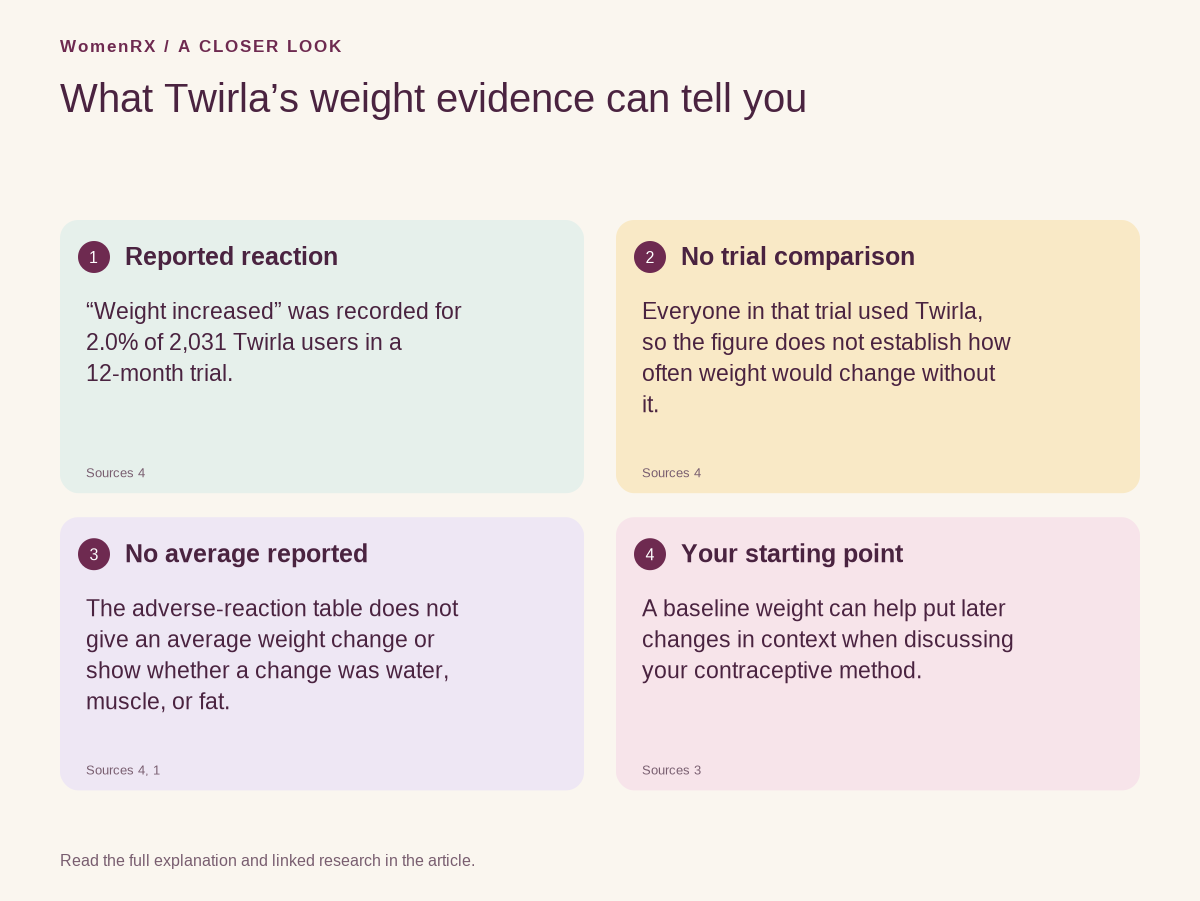
What Twirla’s weight evidence can tell you
Reported reaction: “Weight increased” was recorded for 2.0% of 2,031 Twirla users in a 12-month trial.4
No trial comparison: Everyone in that trial used Twirla, so the figure does not establish how often weight would change without it.4
No average reported: The adverse-reaction table does not give an average weight change or show whether a change was water, muscle, or fat.41
Your starting point: A baseline weight can help put later changes in context when discussing your contraceptive method.3
Read the figure as text
The same scale change can raise two different questions: what the trial recorded and what your own change means.- Reported reaction: “Weight increased” was recorded for 2.0% of 2,031 Twirla users in a 12-month trial.4
- No trial comparison: Everyone in that trial used Twirla, so the figure does not establish how often weight would change without it.4
- No average reported: The adverse-reaction table does not give an average weight change or show whether a change was water, muscle, or fat.41
- Your starting point: A baseline weight can help put later changes in context when discussing your contraceptive method.3
More questions, answered
Does the 2.0% figure mean only 2.0% of users gained any weight?
No. It’s the percentage with “weight increased” recorded as an adverse reaction in one Twirla trial, not a count of every participant whose weight rose on a scale. The label’s adverse-reaction table doesn’t give an average weight change or a comparison with nonusers. 4
Sources you can check
- Body Weight: MedlinePlusAccessed 2026-09-25Return to first citation
- A comparison between monophasic levonorgestrel-ethinyl estradiol 150/30 and triphasic levonorgestrel-ethinyl estradiol 50-75-125/30-40-30 contraceptive pills for side effects and patient satisfaction: a study in Iran.Kashanian M, Shahpourian F, Zare O. · European journal of obstetrics, gynecology, and reproductive biology · 2010Return to first citation
- Combined Hormonal Contraceptives | Contraception | CDCAccessed 2026-09-25Return to first citation
- TWIRLA levonorgestrel/ethinyl estradiol patchAccessed 2026-09-25Return to first citation