Considering Twirla? The Weekly Routine and Key Tradeoffs
Twirla replaces a daily pill with weekly patch changes, but BMI, health history, and what happens between changes all matter.
Twirla is a contraceptive patch containing levonorgestrel and ethinyl estradiol. You wear a new patch each week for three weeks, then go one week without one.6 It may appeal if you’d rather not take a daily pill, but BMI and estrogen-related health risks affect suitability. A detached patch and a late weekly change have different backup rules, so the details matter.6
A weekly routine, not a daily one
Twirla delivers two contraceptive hormones, levonorgestrel and ethinyl estradiol, through the skin. You apply a new patch on the same day each week for three weeks, then spend the fourth week without a patch. The patch-free interval should never exceed seven days. If remembering a pill every day is difficult, a weekly change may sound appealing. It still calls for a reliable change day and attention to whether the patch stays in place.6
Apply it to clean, dry, intact skin on your abdomen, buttock, or upper torso, but not your breasts. Keep lotions and oils off the application site, and check that the patch is attached each day and after prolonged time in water. These details matter because a patch that comes loose may not deliver enough hormone.6
A separate trial compared adherence to the Twirla patch with adherence to a combination pill. After six cycles, 10.0% of patch users and 21.2% of pill users reported not following their assigned routine. Laboratory checks, however, found evidence of nonadherence in 10% to 14% of participants in both groups. That makes the practical takeaway modest: fewer scheduled changes may suit you better, but a patch isn't something you can forget about once it's on.3
What the pregnancy numbers mean
The main Twirla trial enrolled 2,032 sexually active women in the United States and followed use for up to 13 cycles. Its primary pregnancy analysis focused on women ages 18 to 35 and excluded cycles without intercourse or when another contraceptive method was used. The reported Pearl Index was 5.8 pregnancies per 100 woman-years of use. That measure describes pregnancies relative to the amount of use observed in the study; it isn't a promise about any one person's chance of pregnancy.2
BMI made a meaningful difference. In that analysis, the Pearl Index was 4.3 pregnancies per 100 woman-years among women with a BMI below 30, compared with 8.6 among women with a BMI of 30 or above. Twirla’s current labeling says to consider reduced effectiveness even at a BMI of 25 to under 30, and says not to use Twirla at a BMI of 30 or above. If your BMI is near either threshold, compare methods using information specific to this patch: general eligibility guidance for combined hormonal contraception does not erase Twirla’s product-specific restrictions.265
Side effects and the clot-risk question
In Twirla’s 12-month safety trial of 2,031 women, the most commonly reported adverse reactions included application-site problems in 6.2%, nausea in 4.1%, and headache in 3.6%. About 11% stopped using the patch because of an adverse reaction. Four participants had venous clots, including deep vein thrombosis or pulmonary embolism; all four had a BMI above 30. Those events matter, but the trial alone cannot give you a precise personal clot-risk estimate.6
Twirla is a combined hormonal contraceptive, so clot risk deserves a closer look than the convenience of the schedule alone. Combined hormonal contraception increases the risk of a clot in a vein. Twirla’s labeling says not to use it with a current or past deep vein thrombosis or pulmonary embolism, migraine with aura, or certain other conditions that raise clot risk. It also says not to use it if you smoke and are over 35. High blood pressure can change eligibility, and blood pressure should be measured before starting a combined hormonal method.164
If a patch comes loose or a change is late
If it lifts or comes off: Press down a lifted edge and smooth it into place. If it won’t stick completely, use a new patch; don’t tape it on. If the patch has been partly or completely off for less than 24 hours, reapply it if it still sticks completely, or put on a new one. Keep your usual change day; no backup contraception is needed. If it has been off for 24 hours or more, or you don’t know how long, put on a new patch, start a new four-week cycle with a new change day, and use nonhormonal backup contraception for seven days.6
If you forget a scheduled change: A late patch at the start of a new cycle means applying a patch when you remember, making that your new change day, and using nonhormonal backup for seven days. For a change due in Week 2 or 3, a delay of less than 48 hours means applying a new patch and keeping the usual change day, without backup. At 48 hours or more, start a new cycle and change day with a new patch and use nonhormonal backup for seven days. If you simply forgot to remove the Week 3 patch at the start of the patch-free week, remove it when you remember and start the next cycle on your usual day; no backup is needed.6
The distinction is easy to miss: Twirla’s cutoff for a detached patch is 24 hours, while its cutoff for a late Week 2 or 3 change is 48 hours. General CDC patch guidance groups delayed application and detachment differently, so use Twirla’s product instructions for your patch. If the patch-free interval ran longer than seven days and you had sex during that gap, pregnancy is possible; raise that promptly when discussing whether emergency contraception or pregnancy testing is needed.64
Switching methods needs its own plan, too. Twirla’s instructions give different starting points depending on whether you’re switching from a pill, another patch, a ring, an injection, an intrauterine system, an implant, or a progestin-only pill. When switching from an IUD, the timing of sex and removal can create an additional pregnancy concern. Resolve the transition before stopping your current method rather than assuming your first Twirla patch provides immediate protection.64
Bring your medicines and supplements into that decision. CDC eligibility guidance flags combined hormonal contraception for review alongside rifampin or rifabutin; certain seizure medicines, including carbamazepine, phenytoin, topiramate, and oxcarbazepine; lamotrigine; and St. John’s wort. The implications aren't identical for every drug, so check your actual combination rather than assuming that all antibiotics or all seizure medicines behave alike.5
If you've recently given birth
Recent birth changes the estrogen decision even if you feel ready for a weekly routine. U.S. guidance classifies combined hormonal contraception as unsuitable during the first 21 days postpartum, whether or not you're breastfeeding. Twirla’s own instructions say that someone who isn’t breastfeeding should not start it sooner than four weeks after childbirth because of clot risk. After the early postpartum period, suitability still depends on breastfeeding status, time since birth, and other clot-risk factors. If your period hasn’t returned, the possibility of pregnancy and the need for backup protection also need attention.56
The clearest tradeoff is convenience versus the attention this particular method still needs. Twirla removes daily dosing, but its weekly routine, BMI-related effectiveness finding, and your personal eligibility all need to fit. Like other hormonal contraceptives, the patch does not protect against sexually transmitted infections; condoms can help reduce that risk.5
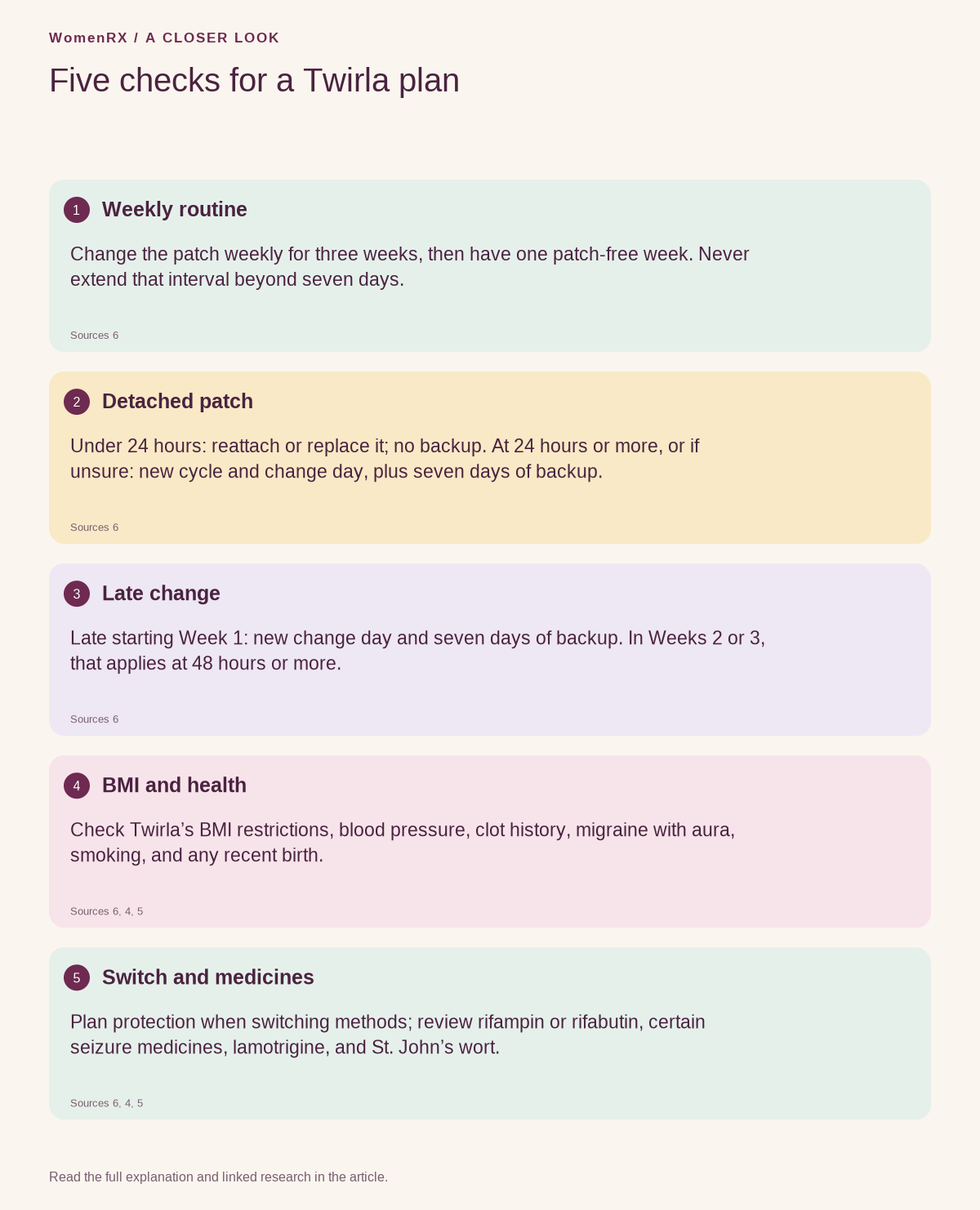
Five checks for a Twirla plan
Weekly routine: Change the patch weekly for three weeks, then have one patch-free week. Never extend that interval beyond seven days.6
Detached patch: Under 24 hours: reattach or replace it; no backup. At 24 hours or more, or if unsure: new cycle and change day, plus seven days of backup.6
Late change: Late starting Week 1: new change day and seven days of backup. In Weeks 2 or 3, that applies at 48 hours or more.6
BMI and health: Check Twirla’s BMI restrictions, blood pressure, clot history, migraine with aura, smoking, and any recent birth.645
Switch and medicines: Plan protection when switching methods; review rifampin or rifabutin, certain seizure medicines, lamotrigine, and St. John’s wort.645
Read the figure as text
The actions differ depending on whether a patch detaches or a scheduled change is late.- Weekly routine: Change the patch weekly for three weeks, then have one patch-free week. Never extend that interval beyond seven days.6
- Detached patch: Under 24 hours: reattach or replace it; no backup. At 24 hours or more, or if unsure: new cycle and change day, plus seven days of backup.6
- Late change: Late starting Week 1: new change day and seven days of backup. In Weeks 2 or 3, that applies at 48 hours or more.6
- BMI and health: Check Twirla’s BMI restrictions, blood pressure, clot history, migraine with aura, smoking, and any recent birth.645
- Switch and medicines: Plan protection when switching methods; review rifampin or rifabutin, certain seizure medicines, lamotrigine, and St. John’s wort.645
Sources you can check
- Venous Thromboembolism Issues in Women.Linnemann B, Rott H, Zotz R, Hart C. · Hamostaseologie · 2022Return to first citation
- Efficacy, safety, and tolerability of a levonorgestrel/ethinyl estradiol transdermal delivery system: Phase 3 clinical trial results.Nelson AL, Kaunitz AM, Kroll R, Simon JA, Poindexter AN, Castaño PM, Ackerman RT, Flood L, Chiodo JA, Garner EI, SECURE Investigators. · Contraception · 2021Return to first citation
- Self-reported and verified compliance in a phase 3 clinical trial of a novel low-dose contraceptive patch and pill.Kaunitz AM, Portman D, Westhoff CL, Archer DF, Mishell DR, Foegh M. · Contraception · 2015Return to first citation
- Combined Hormonal Contraceptives | Contraception | CDCAccessed 2026-09-25Return to first citation
- Appendix A: Summary of Classifications for U.S. Medical Eligibility Criteria for Contraceptive Use, 2024 | Contraception | CDCAccessed 2026-09-25Return to first citation
- TWIRLA levonorgestrel/ethinyl estradiol patchAccessed 2026-09-25Return to first citation