Birth Control After 40: Compare Your Options
Pregnancy is still possible during perimenopause, so the useful comparison is how well a method prevents pregnancy, how it affects bleeding, and whether it fits your health history.
Turning 40 isn’t a reason to stop contraception. IUDs and the implant have lower typical-use failure rates than pills, patches, rings, or condoms, but effectiveness is only part of the choice.4 Bleeding preferences and estrogen-related risks matter too.56 After age 45, 12 consecutive months without a natural period can establish menopause, but that marker cannot set a stopping date if contraception changes your bleeding. In that case, check current U.S. guidance for your age and method before stopping or switching.3
First, separate age from health history
Turning 40 alone doesn’t establish menopause or rule out a contraceptive method. The CDC’s 2024 U.S. Medical Eligibility Criteria treats age 40 or older differently from specific conditions that can change a method’s safety. Those conditions matter more than the birthday itself.5
The first useful distinction is estrogen-containing versus estrogen-free contraception. Combined pills, patches and rings contain estrogen and a progestin. Progestin-only pills, the implant and levonorgestrel IUDs do not contain estrogen; a copper IUD contains no hormones.4 For example, NuvaRing is a combined ring containing etonogestrel and ethinyl estradiol. Its prescribing information warns against combined hormonal contraception for women who smoke and are over 35.1
Migraine and blood pressure deserve a more precise look than a simple yes-or-no question. Under the CDC criteria, combined hormonal contraception is not an appropriate choice with migraine with aura or blood pressure at or above 160/100 mm Hg. Even adequately controlled high blood pressure changes its eligibility. Migraine without aura has a different classification, so the distinction matters. Aura can include flashing lights or zigzag lines.52 A history of blood clots or several cardiovascular risk factors together also changes the comparison; the CDC assesses those histories by method rather than applying one rule to every contraceptive.5
That doesn’t mean everyone over 40 needs to avoid estrogen, or that every estrogen-free option fits everyone. It means settling the relevant health-history questions before choosing the most convenient routine.5
Compare pregnancy prevention and bleeding together
The CDC’s typical-use failure rate estimates reflect pregnancies when methods are used as people ordinarily use them, rather than perfectly. Lower figures mean fewer pregnancies in that comparison. They aren’t a prediction of your individual chance of pregnancy, and the CDC does not present these estimates specifically for women over 40.4
| Method | CDC typical-use failure rate | Bleeding and practical tradeoff |
|---|---|---|
| Levonorgestrel IUD | 0.1%-0.4%, depending on the device.4 | A clinician places it; there’s no daily task. Spotting or light bleeding is expected in the first 3-6 months. Bleeding generally decreases over time, and many users have light periods or none.6 |
| Copper IUD | 0.8%.4 | A clinician places it, and it has no hormones. Spotting or heavier or longer bleeding is common in the first 3-6 months and generally decreases with continued use. That initial bleeding tradeoff may matter if periods are already difficult.6 |
| Implant | 0.1%.4 | A progestin-releasing rod is placed in the upper arm, avoiding a daily task. |
| Progestin-only pill | 7%.4 | It avoids estrogen but requires a daily routine. Its effect on bleeding shouldn’t be used to determine whether menopause has happened.43 |
| Combined pill, patch or ring | 7% for each method.4 | These offer daily, weekly or ring-based routines, but all contain estrogen and need the same kind of health-history check. Bleeding while using them isn’t a reliable menopause signal.453 |
| External condom | 13%.4 | Used during sex, without an ongoing hormonal method. Latex condoms also help protect against HIV and other sexually transmitted infections, which IUDs and hormonal methods do not do.4 |
The IUD bleeding comparison is especially useful if you’re weighing hormone-free contraception against the possibility of lighter periods. Neither IUD guarantees a particular pattern, but the expected directions differ: copper IUD use can initially bring heavier or longer bleeding, while bleeding with a levonorgestrel IUD generally decreases over time.6 If bleeding is unexplained and potentially concerning, that’s a reason to have it evaluated before assuming it’s simply perimenopause or choosing an IUD to manage it.5
If you want a method used only during sex, remember that effectiveness varies across those choices. The CDC lists a 17% typical-use failure rate for the diaphragm and 21% for the internal condom. Fertility-awareness methods have a wider range, 2%-23%, across methods. These estimates can help you decide how much pregnancy prevention you want from a method that depends on action at or around sex.4
Permanent contraception is a different decision. Tubal surgery and vasectomy are intended to be permanent, rather than a way to cover only the years until menopause. The CDC lists typical-use failure rates of 0.5% for tubal surgery and 0.15% for vasectomy; contraception is still needed after a vasectomy until a sperm check confirms it has worked.4
Know what a missed period can and cannot tell you
In a typical situation after age 45, menopause is recognized retrospectively after 12 consecutive months without a period. But that rule is harder to apply when contraception changes or stops bleeding. A missed period while using a combined or progestin-only pill, an implant, or a levonorgestrel IUD cannot, by itself, establish that contraception is no longer needed. A menopause-diagnosis guideline also advises against relying on hormone tests or pelvic ultrasound to make that stopping decision while using those methods.3
If you’re over 45 and can identify your last natural period, 12 consecutive months without another period is the clinical marker of menopause.3 If contraception has masked your periods, that marker cannot give you a stopping date: removal of a method or a skipped pill does not prove pregnancy is no longer possible. Ask your clinician to check current U.S. guidance for your age and specific method before stopping or switching, and plan how to maintain contraception while pregnancy remains possible. A menopause-diagnosis guideline describes stopping or removing a hormonal method and observing whether periods return, but does not establish a U.S. age-based stopping schedule.3
Menopausal hormone therapy isn’t a substitute for birth control. If you’re considering it for symptoms while pregnancy is still possible, contraception remains a separate question.7
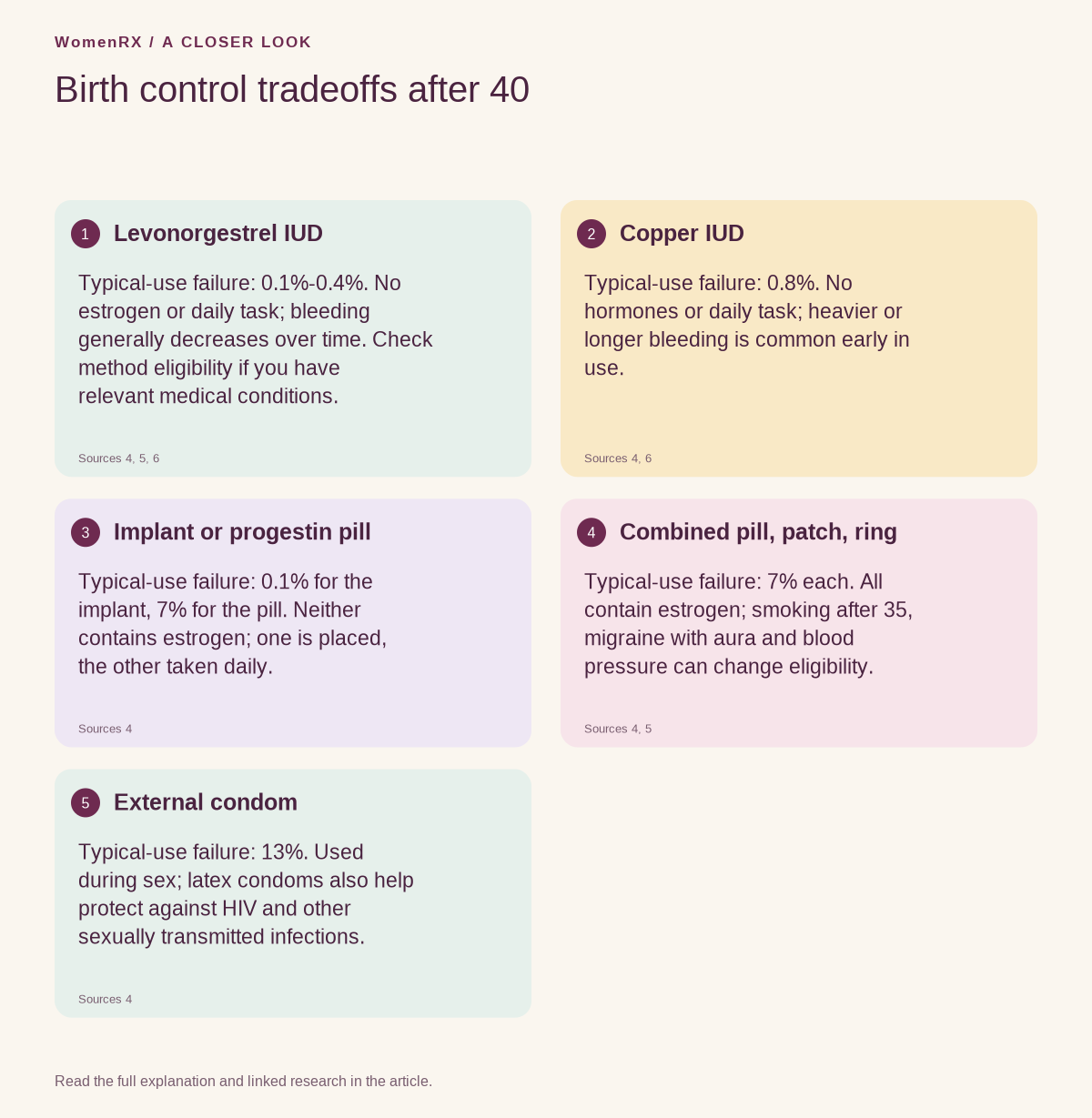
Birth control tradeoffs after 40
Levonorgestrel IUD: Typical-use failure: 0.1%-0.4%. No estrogen or daily task; bleeding generally decreases over time. Check method eligibility if you have relevant medical conditions.456
Copper IUD: Typical-use failure: 0.8%. No hormones or daily task; heavier or longer bleeding is common early in use.46
Implant or progestin pill: Typical-use failure: 0.1% for the implant, 7% for the pill. Neither contains estrogen; one is placed, the other taken daily.4
Combined pill, patch, ring: Typical-use failure: 7% each. All contain estrogen; smoking after 35, migraine with aura and blood pressure can change eligibility.45
External condom: Typical-use failure: 13%. Used during sex; latex condoms also help protect against HIV and other sexually transmitted infections.4
Read the figure as text
Start with pregnancy prevention and health-history considerations. Bleeding effects are compared only for the two IUDs.- Levonorgestrel IUD: Typical-use failure: 0.1%-0.4%. No estrogen or daily task; bleeding generally decreases over time. Check method eligibility if you have relevant medical conditions.456
- Copper IUD: Typical-use failure: 0.8%. No hormones or daily task; heavier or longer bleeding is common early in use.46
- Implant or progestin pill: Typical-use failure: 0.1% for the implant, 7% for the pill. Neither contains estrogen; one is placed, the other taken daily.4
- Combined pill, patch, ring: Typical-use failure: 7% each. All contain estrogen; smoking after 35, migraine with aura and blood pressure can change eligibility.45
- External condom: Typical-use failure: 13%. Used during sex; latex condoms also help protect against HIV and other sexually transmitted infections.4
More questions, answered
Does a vaginal ring avoid the estrogen-related concerns of a pill?
Not if it’s a combined hormonal ring. NuvaRing contains etonogestrel and ethinyl estradiol, and its U.S. labeling carries a warning about combined hormonal contraception for women who smoke and are over 35. The CDC assesses combined pills, patches and rings together for conditions such as migraine with aura and high blood pressure.15
Sources you can check
- NUVARING (ETONOGESTREL AND ETHINYL ESTRADIOL) INSERT, EXTENDED RELEASE [ORGANON LLC] | US prescribing information and patient instructionsAccessed 2026-09-25Return to first citation
- Migraine | MedlinePlusAccessed 2026-09-25Return to first citation
- [How to diagnose menopause? Postmenopausal women management: CNGOF and GEMVi clinical practice guidelines].Rousset-Jablonski C. · Gynecologie, obstetrique, fertilite & senologie · 2021Return to first citation
- CDC: Birth control methods, barrier methods, fertility awareness and breastfeedingAccessed 2026-09-25Return to first citation
- Appendix A: Summary of Classifications for U.S. Medical Eligibility Criteria for Contraceptive Use, 2024 | Contraception | CDCAccessed 2026-09-25Return to first citation
- CDC: Intrauterine contraception and copper IUD bleedingAccessed 2026-09-25Return to first citation
- Pregnancy, breastfeeding and fertility while taking or using oestrogen tablets, patches, gel and spray - NHSAccessed 2026-09-25Return to first citation