When the Birth Control Pill Needs a Closer Safety Review
The right safety questions depend on which pill you mean, your health history, your medicines, and how recently you gave birth.
“The pill” can mean a combined pill with estrogen and progestin or a progestin-only pill. Their safety considerations differ. 1 Migraine with aura, certain blood-pressure or clotting histories, recent delivery, and some medicines can make a combined pill unsuitable or call for closer review. A progestin-only pill may be an option in some of those situations, but it has its own eligibility and interaction questions. 34

A useful pill-safety conversation starts with one distinction: Which pill are you considering? Combined oral contraceptives contain estrogen and progestin; progestin-only pills contain progestin. A health issue that rules out a combined pill shouldn’t automatically be treated as a verdict on every contraceptive pill. 13
The histories that can change a combined-pill decision
For combined pills, US contraceptive guidance distinguishes conditions where the method generally shouldn’t be used from those where it shouldn’t be used. The distinction matters: neither category means you have to give up on contraception. It means the formulation needs to match your circumstances. 35
- Migraine: Say whether you have migraine with aura, not just whether you get headaches. The CDC classifies combined hormonal contraception as a method that shouldn’t be used with migraine with aura. Migraine without aura has a different classification, and progestin-only pills are classified differently from combined pills for both types. 34
- Blood pressure: Have your blood pressure measured before starting a combined pill, or share a reading taken elsewhere. Combined hormonal contraception generally shouldn’t be used with adequately controlled hypertension or a properly measured reading of 140-159/90-99 mm Hg; it shouldn’t be used at 160/100 mm Hg or higher, or with vascular disease. One reading alone isn’t enough to classify someone as having hypertension. 54
- Clots, heart disease, and smoking: Mention a past deep-vein clot or pulmonary embolism, a known clotting disorder, stroke or heart disease, and whether you smoke. The combined-pill classification for a past clot depends partly on recurrence risk and anticoagulant treatment. At age 35 or older, smoking also changes the classification, with the number of cigarettes affecting it. Don’t assume that a family history of clots carries the same classification as a clot you’ve had yourself. 3
- Other diagnoses and surgery: Mention diabetes with complications, current or past breast cancer, significant liver disease, and any planned major surgery that will involve prolonged immobility. These details can change eligibility; for example, combined hormonal contraception shouldn’t be used with major surgery involving prolonged immobility or current breast cancer. Current breast cancer also makes a progestin-only pill unsuitable under CDC guidance. 35
A study of combined-pill users at one obstetrics and gynecology clinic found several of these concerns when it applied WHO eligibility criteria. Its classifications are useful context, but current US eligibility decisions should use US guidance and your specific history. 23
After delivery, the date and breastfeeding status both matter
If you’ve recently given birth, share when you delivered, whether you’re breastfeeding, and any clot-risk factors. For a combined pill, the CDC says not to use it during the first 21 days after delivery, whether or not you’re breastfeeding. From day 21 through day 42, eligibility depends on breastfeeding and other clot-risk factors. After day 42, combined pills are generally an option during breastfeeding; for someone who isn’t breastfeeding, the postpartum timing alone no longer restricts their use. Other health conditions can still change that assessment. 35
Progestin-only pills have different postpartum guidance: they may be started immediately after delivery, including while breastfeeding, when pregnancy can reasonably be ruled out. That’s one reason it’s worth asking about the formulation rather than simply asking whether “the pill” is safe after birth. 6
Bring a medication list, not a guess
Include prescription medicines, over-the-counter products, and supplements. Name any seizure medicines, especially phenytoin, carbamazepine, barbiturates, primidone, topiramate, oxcarbazepine, or lamotrigine, and mention rifampin or rifabutin. CDC guidance flags the first group of seizure medicines and rifampin or rifabutin for both combined and progestin-only pills; it flags lamotrigine for combined hormonal contraception. These aren’t interchangeable interactions, so the medicine name and pill type both matter. Ordinary broad-spectrum antibiotics don’t carry the same CDC eligibility classification as rifampin or rifabutin. 3
Also say if pregnancy is possible before starting a pill, or if you’re switching from another method. Your current method and when you last used it can affect the transition plan. Pills aren’t the only option: other methods include implants, injections, IUDs, and barrier methods. Which one fits depends on your priorities and the eligibility questions raised by your history. 61
What “needs review” means for your next choice
If an estrogen-containing pill raises a safety concern, a progestin-only pill is worth discussing, but it isn’t a universal substitute. For example, the CDC classifies progestin-only pills differently from combined methods for migraine with aura and hypertension, while current breast cancer is a reason not to use either type of pill. Some medicines also affect both. The practical next step is to identify the pill formulation and the specific condition or medicine behind the concern, then compare methods on that basis. 34
What to have ready for a pill review
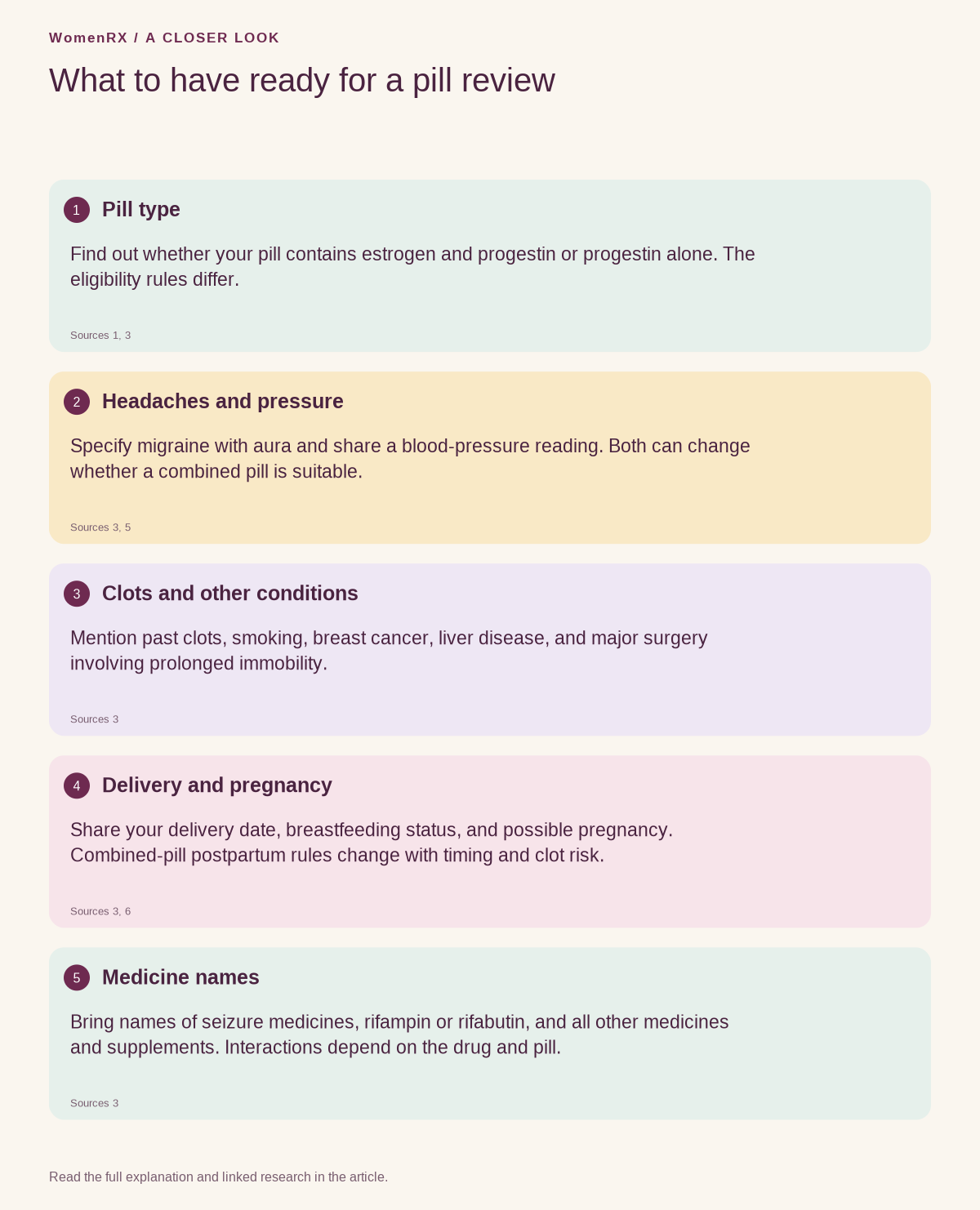
Pill type: Find out whether your pill contains estrogen and progestin or progestin alone. The eligibility rules differ.13
Headaches and pressure: Specify migraine with aura and share a blood-pressure reading. Both can change whether a combined pill is suitable.35
Clots and other conditions: Mention past clots, smoking, breast cancer, liver disease, and major surgery involving prolonged immobility.3
Delivery and pregnancy: Share your delivery date, breastfeeding status, and possible pregnancy. Combined-pill postpartum rules change with timing and clot risk.36
Medicine names: Bring names of seizure medicines, rifampin or rifabutin, and all other medicines and supplements. Interactions depend on the drug and pill.3
Read the figure as text
These details help separate combined-pill concerns from questions that also affect progestin-only pills.- Pill type: Find out whether your pill contains estrogen and progestin or progestin alone. The eligibility rules differ.13
- Headaches and pressure: Specify migraine with aura and share a blood-pressure reading. Both can change whether a combined pill is suitable.35
- Clots and other conditions: Mention past clots, smoking, breast cancer, liver disease, and major surgery involving prolonged immobility.3
- Delivery and pregnancy: Share your delivery date, breastfeeding status, and possible pregnancy. Combined-pill postpartum rules change with timing and clot risk.36
- Medicine names: Bring names of seizure medicines, rifampin or rifabutin, and all other medicines and supplements. Interactions depend on the drug and pill.3
More questions, answered
Do I need a pelvic exam or a full set of blood tests before starting a pill?
Usually not. For healthy patients starting a combined hormonal method, CDC guidance calls for a blood-pressure measurement but not a routine pelvic exam or the listed screening blood tests. For healthy patients starting a progestin-only pill, no exam or test is required for initiation. Known medical conditions may call for a more individualized assessment. 56
Sources you can check
- Birth Control | Contraception | Contraceptives | MedlinePlusAccessed 2026-09-25Return to first citation
- The Contraindications to Combined Oral Contraceptives among Reproductive-Aged Women in an Obstetrics and Gynaecology Clinic: A Single-Centre Cross-Sectional Study.Assiri GA, Bannan DF, Alshehri GH, Alshyhani M, Almatri W, Mahmoud MA. · International journal of environmental research and public health · 2022Return to first citation
- Appendix A: Summary of Classifications for U.S. Medical Eligibility Criteria for Contraceptive Use, 2024 | Contraception | CDCAccessed 2026-09-25Return to first citation
- Appendix C: Classifications for Progestin-Only Contraceptives | Contraception | CDCAccessed 2026-09-25Return to first citation
- Combined Hormonal Contraceptives | Contraception | CDCAccessed 2026-09-25Return to first citation
- Progestin-Only Pills | Contraception | CDCAccessed 2026-09-25Return to first citation