How to Get Birth Control Online: What to Expect
An online request usually starts with a health questionnaire or conversation, but a prescription depends on clinical review and what the service can provide.
You can request contraception through telemedicine, but approval isn’t automatic. Share your health history and current medicines, and mention if you’re postpartum or breastfeeding. If you’re requesting a combined hormonal method, ask how to report your blood pressure. The clinician may prescribe a method, request more information, or direct you to in-person care for a procedure or exam. 24

Before you start: decide what you’re asking for
Online contraception care can include counseling, starting or renewing methods that don’t require a procedure, and some follow-up. A clinician reviews your request; filling out a form does not guarantee a prescription. 2
If you already use a method, note its name and whether you want a refill or a change. If you’re choosing for the first time, think about what matters most to you: how often you want to use it, whether you want hormones, whether you may want pregnancy in the near future, and whether you also need protection from sexually transmitted infections. Condoms can help reduce STI risk; most other birth-control methods don’t provide that protection. 1
Online services don’t all offer the same methods or follow the same process. A 2020 study of US platforms assessed as of February 2018 found differences in the methods offered, service locations, fees, and prescribing procedures. That study describes platforms at that time, not today’s options, so check the current service directly before paying or submitting personal information. 5
What to have ready for the review
Gather a list of your current medicines and supplements, any health conditions you’ve been told about, allergies, and your contraception history. Include the date of your last period if you know it, and whether pregnancy is possible. This helps the clinician assess your request and decide whether a different method or more evaluation is appropriate.
Say clearly if you’re pregnant, recently gave birth, breastfeeding, or recently had a pregnancy loss or abortion. An American Family Physician review says most patients can begin progestin-only contraception immediately after childbirth; that doesn’t mean every method is suitable for every person. 4
If you’re requesting a combined hormonal method, such as a method containing estrogen and progestin, ask how the service handles blood-pressure information. The Society of Family Planning recommends that clinicians explain how to collect and report blood pressure remotely and discuss alternatives if a health risk is identified. 2
You generally don’t need to delay hormonal contraception just to get a Pap test first, according to the same clinical review. Whether a particular method is appropriate is a separate question for the prescriber. 4
What happens after you submit the request
The service may ask follow-up questions, arrange a phone or video conversation, or review your answers asynchronously. Telemedicine guidance supports counseling, starting or renewing methods that don’t require procedural placement, and follow-up that doesn’t require a physical exam. It also recommends letting the patient choose among available remote formats. 2
The clinician may prescribe a method, suggest another option, request information such as a blood-pressure reading, or explain that you need an in-person visit. These are all possible outcomes of clinical review, not signs that you filled out the request incorrectly.
Some methods require a clinician to place or administer them. An IUD is inserted into the uterus, while an implant is placed under the skin; an injection is given by a provider. The Society of Family Planning recommends a hybrid approach for long-acting reversible contraception, which includes IUDs and implants, and says people should retain the option of in-person provision without first having telemedicine counseling. Its hybrid-care recommendation is specific to long-acting reversible contraception; injections also require provider administration. 12
Check the practical details before paying
Before you complete a request, look for clear answers to these questions:
- Cost: Is there a visit or consultation fee, and is the medication cost separate? Does the service accept your insurance, or offer a self-pay option?
- Prescription and pharmacy: If approved, where will the prescription be sent? Can you choose a pharmacy?
- Delivery: If medication is shipped, what are the delivery arrangements and packaging? What happens if it’s delayed?
- Refills: How do you request a refill, and how much notice does the service require? Ask whether the clinician can prescribe a longer supply. Society of Family Planning recommends a one-year supply of combined hormonal contraceptives without requiring a check-in during that year unless the patient requests one; a specific service may have its own process. 2
- Privacy: Who can see messages and records? If you’re a teen or use someone else’s insurance, ask how confidentiality works and whether billing or communications could reveal the visit. Privacy protections and rules for adolescents can vary, and the research review found limited evidence on confidentiality in contraceptive telemedicine for patients under 18. 3
Don’t assume that a low advertised fee includes the medication, delivery, or future refills. Confirm what’s included with the service before you submit payment.
When the online route may not be enough
An online visit may be a starting point rather than the whole plan if you want an IUD, implant, or injection, because these methods involve placement or administration. You can ask whether the service coordinates in-person care or whether you’ll need to arrange it separately. 12
If you’re contacting a service about a new or troubling symptom, describe it in your request rather than treating the visit as a routine refill. Telemedicine guidance supports remote follow-up for symptoms or complications when a physical exam isn’t needed; when an exam is needed, the clinician may direct you to in-person evaluation. 2
Before you finish, make sure you know how to reach the prescriber with questions after the visit, what to do if the pharmacy can’t fill the prescription, and where to go for any in-person service the chosen method requires. Online care can make some steps easier, but the right next step depends on your method, health history, and the service’s current options.
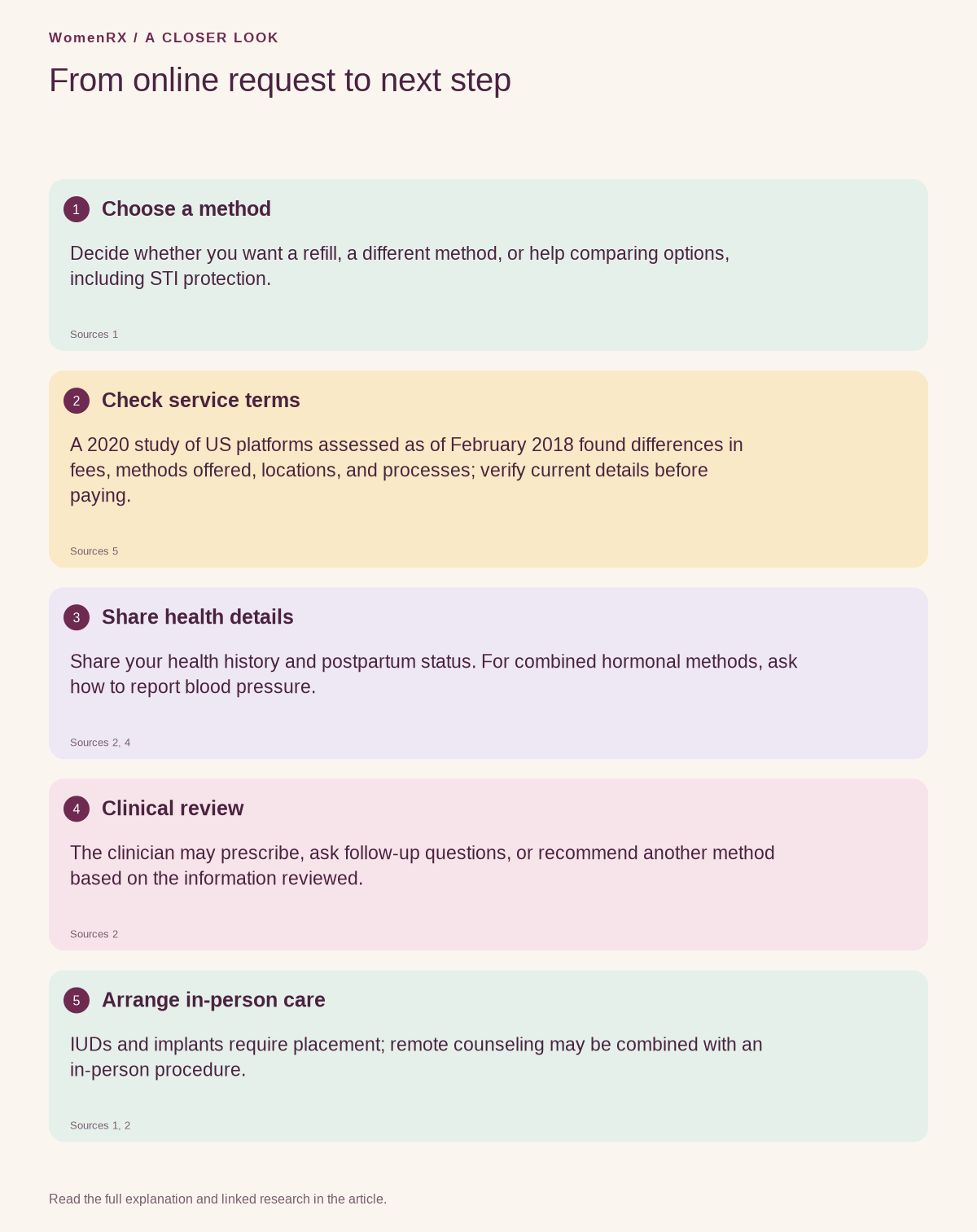
From online request to next step
Choose a method: Decide whether you want a refill, a different method, or help comparing options, including STI protection.1
Check service terms: A 2020 study of US platforms assessed as of February 2018 found differences in fees, methods offered, locations, and processes; verify current details before paying.5
Share health details: Share your health history and postpartum status. For combined hormonal methods, ask how to report blood pressure.24
Clinical review: The clinician may prescribe, ask follow-up questions, or recommend another method based on the information reviewed.2
Arrange in-person care: IUDs and implants require placement; remote counseling may be combined with an in-person procedure.12
Read the figure as text
A request may end with a prescription, a follow-up question, or a referral for an in-person service, depending on the method and clinical review.- Choose a method: Decide whether you want a refill, a different method, or help comparing options, including STI protection.1
- Check service terms: A 2020 study of US platforms assessed as of February 2018 found differences in fees, methods offered, locations, and processes; verify current details before paying.5
- Share health details: Share your health history and postpartum status. For combined hormonal methods, ask how to report blood pressure.24
- Clinical review: The clinician may prescribe, ask follow-up questions, or recommend another method based on the information reviewed.2
- Arrange in-person care: IUDs and implants require placement; remote counseling may be combined with an in-person procedure.12
More questions, answered
Can an online visit provide an IUD or implant?
A telemedicine visit can support counseling and planning, but an IUD must be inserted and an implant placed by a provider. Guidance supports combining remote care with in-person provision for these methods. 12
Do I need a Pap test before getting hormonal birth control?
A recent Pap test is not necessary before prescribing hormonal contraception, according to an American Family Physician review. A clinician may still need other health information to assess which method is appropriate. 4
Sources you can check
- Birth Control | Contraception | Contraceptives | MedlinePlusAccessed 2026-09-25Return to first citation
- Society of Family Planning Clinical Recommendation: Telemedicine in family planning care part 2 - Contraception.Patil R, Dethier D, Fleming M, Godfrey E, Kohn JE, with the assistance of Jennifer Chin, Bhavik Kumar, Jennifer Lesko, April Lockley, Shawana S. Moore, and Laurie Ray on behalf of ... · Contraception · 2026Return to first citation
- Confidentiality and privacy considerations for adolescents receiving contraceptive health services via telemedicine: A narrative review.Reilly K, Ebersole A. · Women's health (London, England) · 2024Return to first citation
- Initiating Hormonal Contraception.Lesnewski R. · American family physician · 2021Return to first citation
- Breaking down barriers to birth control access: An assessment of online platforms prescribing birth control in the USA.Zuniga C, Grossman D, Harrell S, Blanchard K, Grindlay K. · Journal of telemedicine and telecare · 2020Return to first citation