Getting Birth Control Online: Where Remote Care Stops
Online care may help you discuss contraception or get a prescription, but methods that require fitting or insertion still need an in-person step.
An online visit can help you discuss birth control and may lead to a prescription. Be ready to describe your current method, what you want from a new one, and relevant health concerns. Ask how prescriptions and refills work. If you choose an IUD or implant, you’ll need provider placement; some symptoms or assessment needs may also call for in-person care. 125
Start by checking what the service actually offers
“Birth control online” can mean a remote conversation, a prescription renewal, or a service that arranges medication delivery. Those aren’t the same thing, and one service’s options shouldn’t be assumed to match another’s. Before paying or filling out a long intake form, ask which specific methods it can prescribe where you live, whether it provides refills, how prescriptions are filled, and what happens if the clinician recommends an in-person visit.
A remote appointment can be useful for discussing preferences and possible options. Whether the service can prescribe a particular method depends on your situation and the service’s policies and local requirements. US guidance on telemedicine family-planning care emphasizes person-centered care and making in-person services accessible when someone needs them. 5
Know the difference between a prescription and a procedure
Some contraceptive methods are medicines; others require a device to be fitted or placed. Pills, patches, and vaginal rings are hormonal methods. An IUD must be inserted into the uterus, an implant placed under the skin, and a diaphragm or cervical cap sized for you. MedlinePlus describes IUD and implant placement as provider procedures. 1
That means a remote consultation may help you decide that you want an IUD, but it cannot perform the insertion. You’ll need an in-person appointment for the procedure. Research with patients receiving telemedicine abortion care in Scotland also found that access to long-acting methods could be harder when fitting appointments were limited. That experience isn’t a map of US services, but it illustrates the practical distinction between choosing a method remotely and being able to start it. 3
If you want a method that needs an office visit, ask whether the online service can arrange one or help you find a local clinic. If it can only prescribe or ship certain methods, knowing that up front can save time.
Bring up the details that could shape your options
An online clinician needs more than the name of the method you want. Be ready to say what you use now, whether you’re seeking a refill or a change, and what has or hasn’t worked for you. Your plans for pregnancy, need for STI protection, and concerns about side effects can also shape the discussion. For example, someone who wants to avoid a daily routine may be interested in a different set of methods than someone who wants a prescription without a procedure. These are conversation prompts, not a universal intake form. 15
Say if you’ve recently given birth or are breastfeeding. Bring up health concerns, including migraine or blood-pressure concerns, rather than trying to judge eligibility yourself. Ask whether the clinician has what they need to assess your preferred method remotely or whether another assessment is needed. Blood-pressure monitoring has been described as a practical access consideration for combined pills in a UK post-abortion care context, but that finding doesn’t establish a universal rule for US online services. 235
Postpartum or breastfeeding? Say so early
Recent childbirth and breastfeeding matter when discussing an IUD procedure. Mirena’s prescribing information says the risk of uterine perforation is higher when insertion occurs after recent childbirth and when the person is breastfeeding; in a US postmarketing safety study, risk was highest when insertion occurred within six weeks after childbirth. This concerns IUD insertion, not every birth-control method, and it’s a reason to discuss timing with the clinician arranging the procedure. 2
Breastfeeding itself is not a complete description of pregnancy protection. MedlinePlus describes the lactational amenorrhea method as relying on exclusive breastmilk feeding, no periods or spotting, and use for up to six months after birth. If any part of that description doesn’t fit, don’t assume breastfeeding alone covers you; discuss another method or a transition plan. 1
Close the loop on delivery and follow-up
Before ending the visit, make sure you understand what happens next: whether a prescription was sent, where it went, how to request refills, and who to contact if it doesn’t arrive or causes a problem. If the method you want requires a fitting or procedure, clarify whether that appointment is included or must be arranged separately.
A remote service should also be able to explain what happens when a concern needs assessment beyond the online visit. For a specific example, Mirena’s prescribing information says a clinician should consider ectopic pregnancy if someone with the IUD has lower abdominal pain, particularly with a missed period or new bleeding after periods had stopped. If that describes you, seek prompt medical assessment rather than treating it as a routine online refill question. 25
Access can also depend on practical factors beyond the appointment itself. In a survey study of young adults aged 18 to 29 in California and Texas, uninsured participants were less likely than privately insured participants to report using telemedicine to obtain contraception. The study describes one group and two states, not every person’s experience, but it’s a reminder to check coverage and any service fees before relying on a prescription pathway. 4
The most useful question isn’t just “Can I get birth control online?” It’s “Can this service help me start and continue the method I want, and what in-person steps might still be part of that plan?”
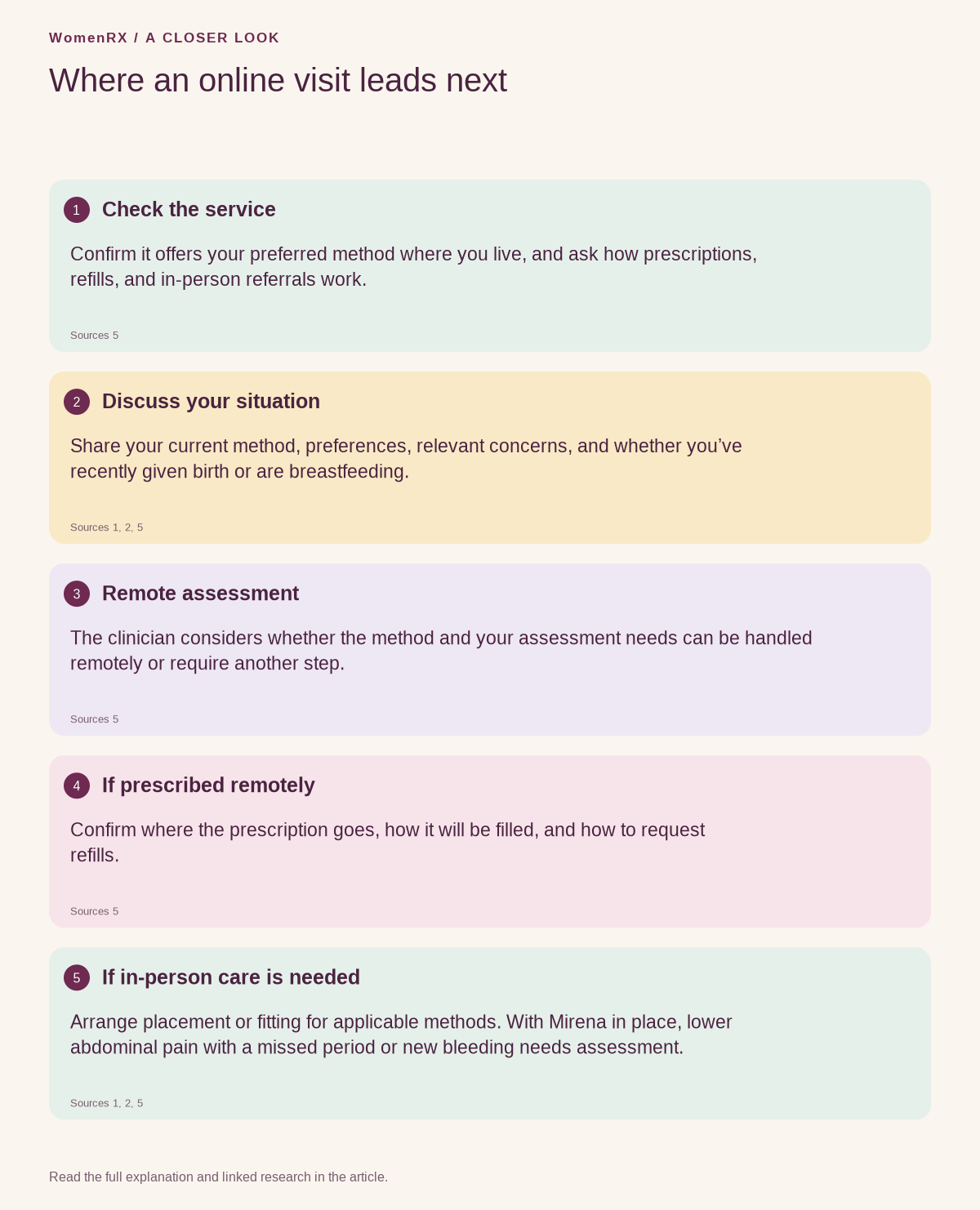
Where an online visit leads next
Check the service: Confirm it offers your preferred method where you live, and ask how prescriptions, refills, and in-person referrals work.5
Discuss your situation: Share your current method, preferences, relevant concerns, and whether you’ve recently given birth or are breastfeeding.125
Remote assessment: The clinician considers whether the method and your assessment needs can be handled remotely or require another step.5
If prescribed remotely: Confirm where the prescription goes, how it will be filled, and how to request refills.5
If in-person care is needed: Arrange placement or fitting for applicable methods. With Mirena in place, lower abdominal pain with a missed period or new bleeding needs assessment.125
Read the figure as text
Check what a service offers, then follow the next step that fits your method and assessment needs.- Check the service: Confirm it offers your preferred method where you live, and ask how prescriptions, refills, and in-person referrals work.5
- Discuss your situation: Share your current method, preferences, relevant concerns, and whether you’ve recently given birth or are breastfeeding.125
- Remote assessment: The clinician considers whether the method and your assessment needs can be handled remotely or require another step.5
- If prescribed remotely: Confirm where the prescription goes, how it will be filled, and how to request refills.5
- If in-person care is needed: Arrange placement or fitting for applicable methods. With Mirena in place, lower abdominal pain with a missed period or new bleeding needs assessment.125
More questions, answered
Can an online service provide an IUD or implant?
A remote visit may let you discuss or choose an IUD or implant, but placement is a procedure that requires a provider visit. Ask whether the service arranges that appointment or whether you need to find one separately. 13
Can I use breastfeeding as birth control?
MedlinePlus describes the lactational amenorrhea method as relying on exclusive breastfeeding, no periods or spotting, and use for up to six months after birth. If those conditions don’t describe your situation, ask about another method. 1
Sources you can check
- Birth Control | Contraception | Contraceptives | MedlinePlusAccessed 2026-09-25Return to first citation
- MIRENA (LEVONORGESTREL) INTRAUTERINE DEVICE [BAYER HEALTHCARE PHARMACEUTICALS INC.] | US prescribing information and patient instructionsAccessed 2026-09-25Return to first citation
- Abortion patients' perspectives on enhancing a telemedicine model of post-abortion contraception: a qualitative study.Boydell N, Buijsen S, Reynolds-Wright JJ, Cameron ST, Harden J. · BMJ sexual & reproductive health · 2025Return to first citation
- Use of telemedicine to obtain contraception among young adults: Inequities by health insurance.Yarger J, Hopkins K, Elmes S, Rossetto I, Van Liefde D, De La Melena S, Harper CC. · Contraception · 2024Return to first citation
- Society of Family Planning Committee Statement: Telemedicine in family planning care part 1 - Background and overarching principles.Patil R, Dethier D, Fleming M, Godfrey E, Kohn JE, with the assistance of Jennifer Chin, Bhavik Kumar, Jennifer Lesko, April Lockley, Shawana S. Moore, and Laurie Ray on behalf of ... · Contraception · 2026Return to first citation