Do Birth Control Pills Cause Weight Gain?
Studies haven’t found a large average weight effect from combined pills, but your own weight may change after you start one.
Combined birth control pills haven’t shown a large weight-gain effect in randomized trials, though the evidence can’t rule out smaller changes or predict what will happen to you. Evidence about weight change with progestin-only pills is less clear. If your weight changes after starting a pill, the timing matters, but it doesn’t establish that the pill caused it. 64
What combined-pill studies can tell you
Combined pills contain estrogen and progestin; progestin-only pills don’t contain estrogen. That distinction matters when you’re trying to make sense of a weight change, because research on one type shouldn’t automatically be applied to the other. 1
A systematic review of randomized trials of combined hormonal contraception included 42 trials lasting at least three treatment cycles. Its three placebo-controlled trials, which studied combined oral contraceptives or a skin patch, did not find evidence of weight gain caused by the contraceptive. Most comparisons between different combined contraceptives also found no substantial weight difference. The reviewers’ conclusion was measured: the evidence was insufficient to determine the effect on weight, but no large effect was apparent. The review searched for studies through 2002, so it doesn’t settle every question about current pills or longer-term use. 6
A more recent observational study followed new users of two different combined-pill formulations in Europe, Australia, and Latin America for up to two years. Among users younger than 25, it found no difference in weight change between the two pill groups. That’s useful if you’re wondering whether one of those formulations clearly stands out for weight. It doesn’t answer whether either group would have changed weight differently without taking a pill. 5
What about progestin-only pills?
There isn’t a sound basis in these findings to promise that a progestin-only pill will prevent weight gain, or to say it generally causes more weight gain than a combined pill. A review focused on treating heavy menstrual bleeding reported more weight-gain complaints with combined pills than with progestin-only pills. But its included studies used varied designs and treatments, and some of the progestin-only evidence involved an implant rather than a pill. That makes its side-effect comparison a poor basis for choosing a contraceptive solely by expected weight change. 4
The type of method also matters. An injectable contraceptive is not a progestin-only pill. Weight findings about an injection shouldn’t be presented as pill findings just because both methods use progestin. 1
If the scale changes after you start
A change is worth taking seriously without assuming its cause. Weight can shift alongside changes in sleep, activity, eating patterns, medicines, or health conditions. For example, if you started a pill during a stretch of poor sleep or while taking another new medicine, those changes are part of the picture too. 2
Timing can be particularly hard to interpret after childbirth. Your body and routine may be changing during postpartum recovery, whether or not you start contraception then. In perimenopause, it’s also worth considering what else has changed over the same period rather than assigning every change to a newly started pill. Neither situation gives a reliable way to calculate how much of an individual weight change, if any, came from the pill. 32
If weight is a deciding factor before you start, ask which pill type is being proposed, not just whether it’s hormonal. If you’ve already started and noticed a change, compare it with your own starting point and consider what changed around the same time. You can then discuss whether staying with that pill or considering another contraceptive fits your priorities. The research offers perspective on average effects; it can’t guarantee that your experience will match the average. 16
What pill weight studies answer
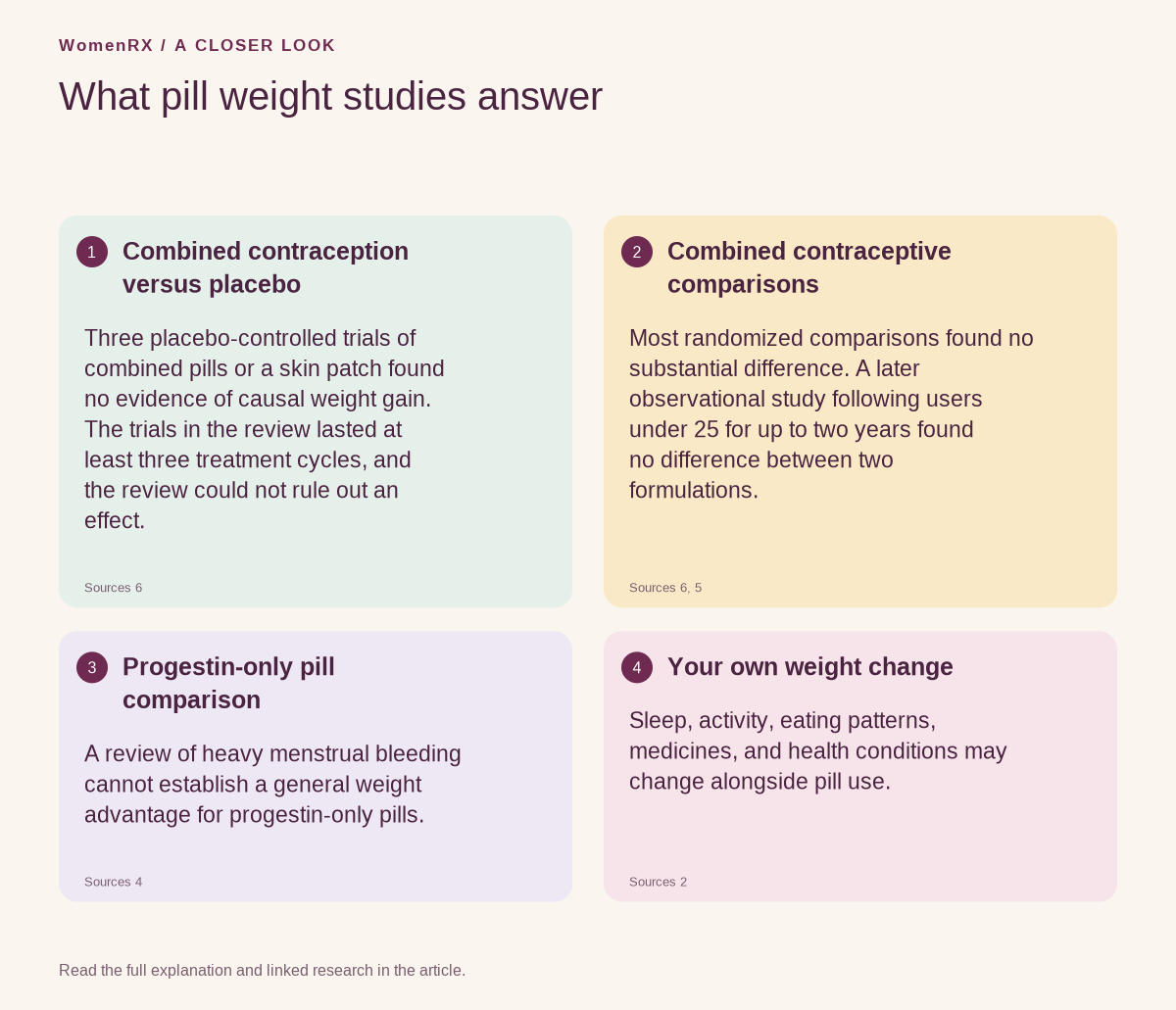
Combined contraception versus placebo: Three placebo-controlled trials of combined pills or a skin patch found no evidence of causal weight gain. The trials in the review lasted at least three treatment cycles, and the review could not rule out an effect.6
Combined contraceptive comparisons: Most randomized comparisons found no substantial difference. A later observational study following users under 25 for up to two years found no difference between two formulations.65
Progestin-only pill comparison: A review of heavy menstrual bleeding cannot establish a general weight advantage for progestin-only pills.4
Your own weight change: Sleep, activity, eating patterns, medicines, and health conditions may change alongside pill use.2
Read the figure as text
The type of comparison determines what a weight finding can tell you.- Combined contraception versus placebo: Three placebo-controlled trials of combined pills or a skin patch found no evidence of causal weight gain. The trials in the review lasted at least three treatment cycles, and the review could not rule out an effect.6
- Combined contraceptive comparisons: Most randomized comparisons found no substantial difference. A later observational study following users under 25 for up to two years found no difference between two formulations.65
- Progestin-only pill comparison: A review of heavy menstrual bleeding cannot establish a general weight advantage for progestin-only pills.4
- Your own weight change: Sleep, activity, eating patterns, medicines, and health conditions may change alongside pill use.2
More questions, answered
Would switching to another combined pill prevent weight gain?
There’s no reliable promise that it would. Most randomized comparisons between combined contraceptives found no substantial weight difference, and a study comparing two combined-pill formulations in users younger than 25 found no difference between groups over up to two years. Neither finding predicts your response to a switch. 65
Sources you can check
- Birth Control | Contraception | Contraceptives | MedlinePlusAccessed 2026-09-25Return to first citation
- Weight Control: MedlinePlusAccessed 2026-09-25Return to first citation
- Postpartum Care: MedlinePlusAccessed 2026-09-25Return to first citation
- Combined Oral Contraceptive Pills Versus Progestin-Only Pills for Heavy Menstrual Bleeding: A Systematic Review.Mohamed GS, Abdalla EM, Karamalla S, Osman TI, Hamid Musa HM, Mohamed H, Ahmed OK, Elshaikh SI, Shafiq MM. · Cureus · 2026Return to first citation
- NOMAC-E2 shows a better contraceptive effectiveness than LNG combined oral contraceptives in women under 25: real-world PRO-E2 study.von Stockum S, Bauerfeind A, Becker K, Franke C, Fruzzetti F, Calaf J, Keck C, Heinemann K. · Gynecological endocrinology : the official journal of the International Society of Gynecological Endocrinology · 2023Return to first citation
- Combination estrogen-progestin contraceptives and body weight: systematic review of randomized controlled trials.Gallo MF, Grimes DA, Schulz KF, Helmerhorst FM. · Obstetrics and gynecology · 2004Return to first citation