Alcohol and Birth Control Pills: What Changes Your Next Step
Had a drink, missed a pill, or vomited? Separate the three situations, record the timing, and find the instructions for your actual pill.
Start with the pill, not the number of drinks
You wake up wondering whether last night changed your protection. Before searching for a replacement dose, reconstruct what happened: when the pill was due, whether you took it, and whether you vomited or had diarrhea. Those details are more useful for finding the right instructions than trying to translate drinks into a pregnancy-risk estimate.
If you took your pill on schedule and were not sick, alcohol alone is not a reason to take an extra pill or change tomorrow's dose. Keep your normal schedule. Forgetting a dose is a separate event, even if drinking contributed to it. 1
Three situations that need different answers
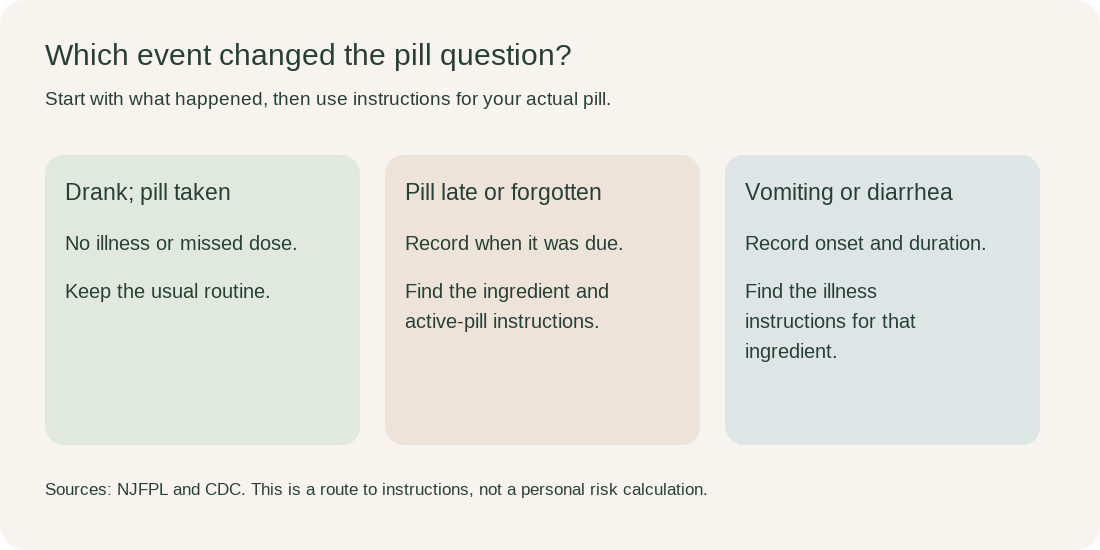
| What happened | What to check |
|---|---|
| Drank, took the pill, no illness | Keep your usual pill routine. Alcohol alone does not cancel its effect. 1 |
| Forgot or delayed a pill | Find the pill ingredient, the time it was due and whether it was an active pill. 23 |
| Vomited or had diarrhea | Record when illness began relative to the pill and how long it lasted. Use illness instructions, not an assumed missed-dose rule. 23 |
Open the full diagram
Why “take another one” is not a universal answer
CDC separates combined pills from progestin-only pills, and it separates ingredients within the progestin-only group. For norethindrone or norgestrel, vomiting or diarrhea within three hours calls for a replacement pill if possible and backup until two days after illness resolves. For drospirenone, the same within-three-hours event calls for a replacement if possible, but its seven-day backup instruction applies when illness continues for more than 24 hours. These are distinct branches, not one escalating rule for every mini-pill. 3
For combined pills, CDC does not call for a replacement pill when vomiting or diarrhea occurs within 24 hours after an active pill or lasts less than 48 hours. Keep taking the pills at the usual time if possible. Illness lasting at least 48 hours changes the instructions: use condoms or avoid sex until you have taken active pills for seven consecutive days after recovery. If this happens in the last week of active pills, the guidance also addresses skipping the hormone-free interval. Check the full instructions with your pack in hand. 2
If you forgot a pill, take the timeline with you
Open our guide to late and missed pills for the formulation-specific steps. Keeping those instructions in one place makes it easier to check the right branch without mixing an alcohol question with an entire dosing guide.
Write a short note before calling a pharmacist: “My pill is ____. It was due at ____. I took it at ____, or have not taken it. I became sick at ____. The illness stopped at ____, or is continuing.” If sex occurred around a missed dose or illness, include when. Emergency contraception may need consideration, and its choice can affect restarting hormonal contraception. 23
For example, “I took it before dinner and felt nauseated” leaves out whether you actually vomited. “I vomited at 11 p.m.; my pill was at 9 p.m.” gives a pharmacist something specific to check. This is an example of useful information, not a recommendation for that two-hour scenario.
Make the next evening easier to remember
A reminder that says “take pill” can be easy to dismiss while you are getting ready. Try a reminder you mark complete only after taking it, and keep the pack somewhere you can access at your usual time. If nights out or shifts repeatedly disrupt your routine, bring that pattern into your next contraception conversation. The useful goal is a method that fits the life you actually have. 1
Sources you can check
- New Jersey Family Planning League: alcohol and birth control
Accessed October 31, 2026
Return to first citation - CDC: combined hormonal contraceptives, missed pills and illness
Accessed October 31, 2026
Return to first citation - CDC: progestin-only pills, separate illness instructions by ingredient
Accessed October 31, 2026
Return to first citation