Combined and Progestin-Only Pills: How to Tell Them Apart
The ingredient list tells you more than the color or layout of a pill pack.
A combined birth control pill contains estrogen and a progestin; a progestin-only pill contains a progestin but no estrogen. That distinction can affect which pill fits your health history and how you use it. Don’t identify a pill by its pack pattern alone: progestin-only formulations can have different schedules and missed-pill instructions.65
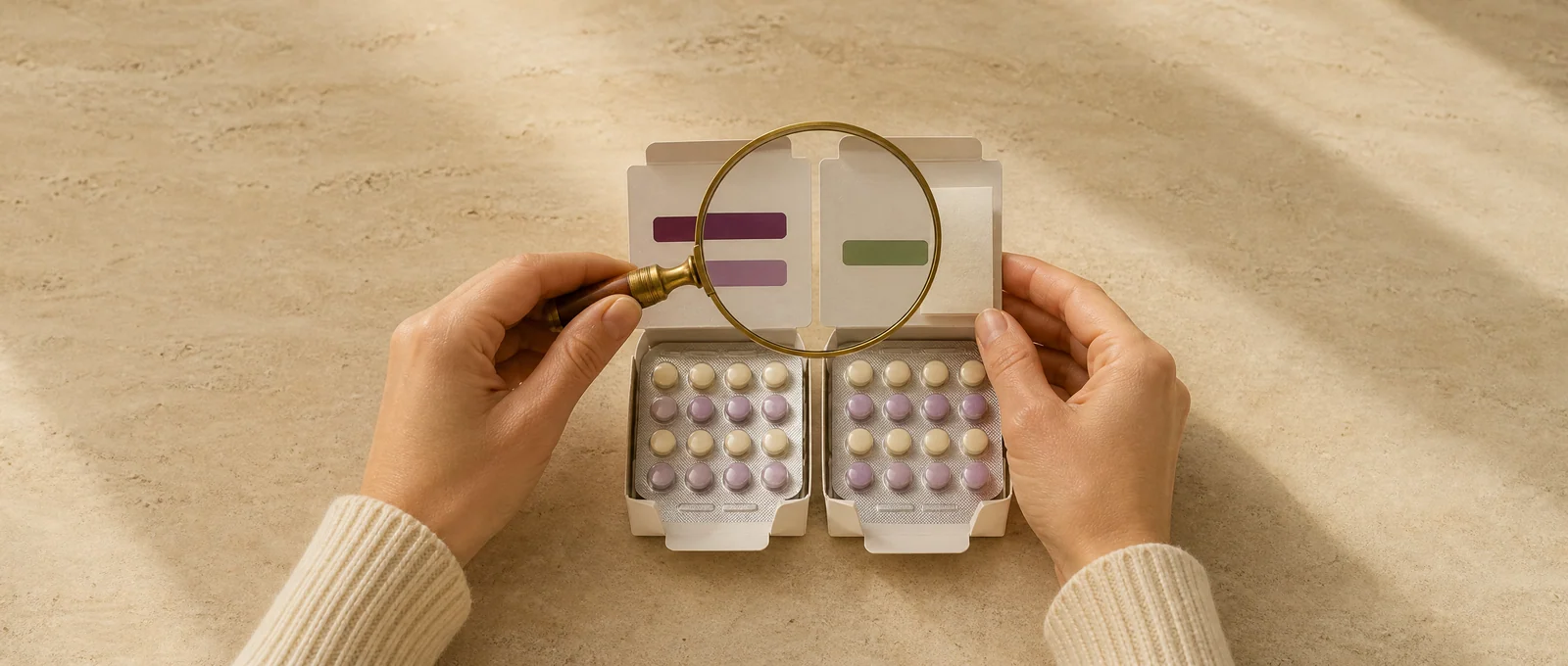
Start with the active ingredients
If you’re comparing two pill packs, look for the active ingredients before you compare the tablets or the calendar printed on the packaging. Combined pills contain estrogen and a progestin. Progestin-only pills contain no estrogen. Both are birth control pills, but the ingredient difference matters when you’re choosing a method and when a clinician checks whether it fits your health history.65
In the United States, the progestin-only pill formulations listed in CDC guidance contain norethindrone, norgestrel, or drospirenone. Seeing one of those names on a package tells you which progestin it contains. Read the full ingredient list to confirm whether estrogen is present, rather than assuming the category from one hormone name.5
Similar purpose, different ways of working
Combined pills primarily prevent pregnancy by stopping ovulation, the release of an egg. The progestin-only category is less uniform. Norethindrone and norgestrel pills stop ovulation in about half of cycles, with considerable variation between people; their effect on cervical mucus is also central to how they work. Drospirenone-only pills primarily work by stopping ovulation, more like combined pills do.5
That distinction helps explain why “the mini-pill” isn’t a single set of instructions. For norethindrone and norgestrel pills, taking a pill at approximately the same time each day matters. CDC guidance also gives different missed-pill and back-up contraception recommendations for these pills and for drospirenone-only pills. If you’re switching formulations, don’t carry over the instructions you memorized for the old pack.5
Why the pack pattern isn’t a reliable label
A pack with placebo tablets isn’t necessarily a combined pill. In a randomized study of progestin-only pills, the drospirenone formulation had active tablets followed by placebo tablets, while the desogestrel formulation was taken continuously. That study compared specific formulations, not every pill sold in the United States.2
Likewise, the FDA’s information for a norgestrel-only pill describes taking it every day without breaks between monthly packs. The practical takeaway is to identify your specific product and active ingredients, then use that product’s directions for starting, switching, missed pills, or vomiting. A pack’s colors or apparent break won’t tell you which instructions apply.45
When the ingredient distinction changes the conversation
If you have migraine with aura, tell the person helping you choose contraception. Aura can include visual changes such as flashing lights or zigzag lines. CDC’s 2024 eligibility guidance classifies combined hormonal contraception differently from progestin-only pills for migraine with aura: combined methods are category 4, indicating an unacceptable health risk, while progestin-only pills are category 1. Migraine without aura has different classifications, so that detail matters.13
The distinction also matters soon after birth. For someone who is breastfeeding less than 21 days postpartum, CDC classifies combined hormonal contraception as category 4 and progestin-only pills as category 2. The classifications change with time postpartum and, for combined methods, can also depend on other blood-clot risk factors. “Breastfeeding” alone doesn’t settle the choice without knowing how recently you gave birth.3
Other health factors can affect the comparison too. For example, CDC classifies combined hormonal contraception differently from progestin-only pills for smokers age 35 or older. Progestin-only doesn’t mean suitable for everyone, either; the exact formulation and health history still count.34
If you’re holding a new pack, the useful questions are straightforward: Does the ingredient list include estrogen? Which progestin is in it? What do this product’s instructions say about starting it and missing a pill? Those answers are more dependable than treating every combined pill, or every progestin-only pill, as interchangeable.54
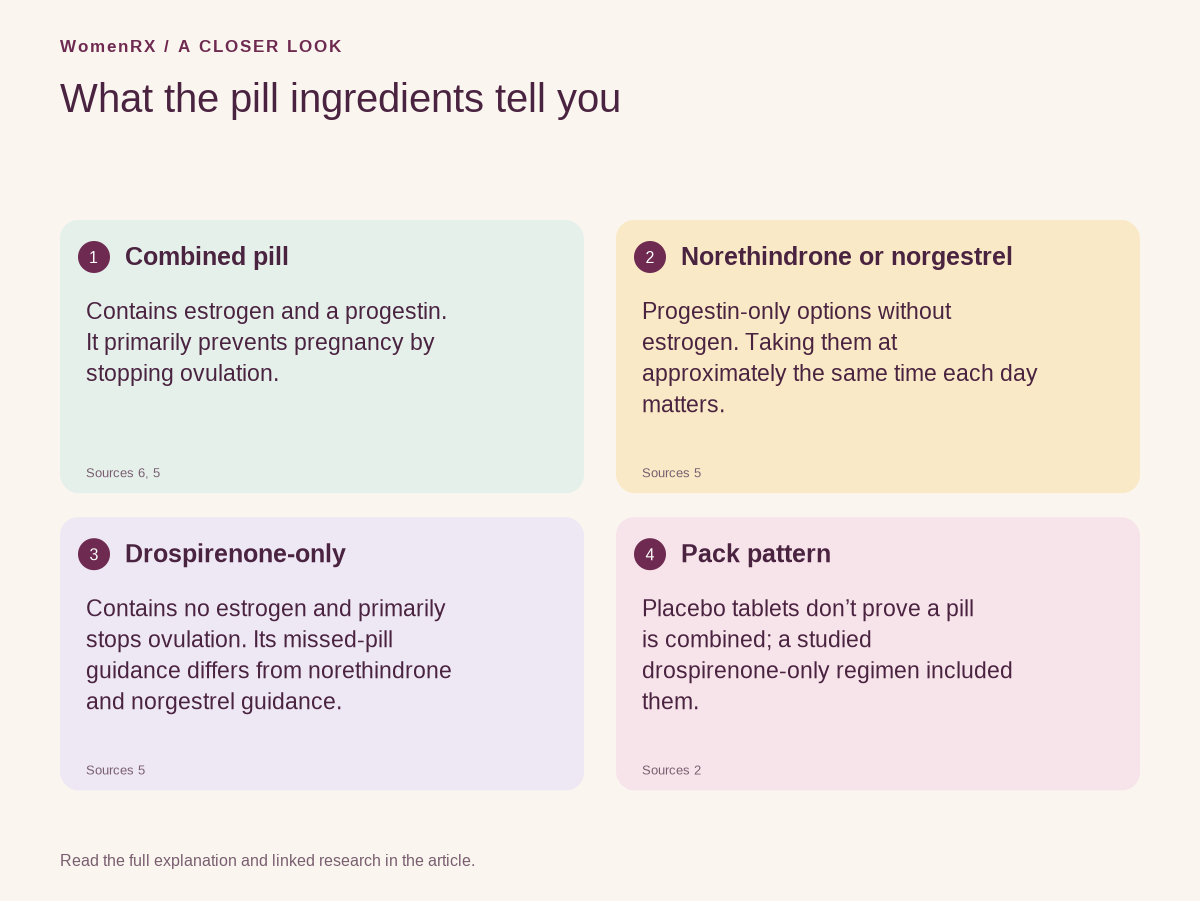
What the pill ingredients tell you
Combined pill: Contains estrogen and a progestin. It primarily prevents pregnancy by stopping ovulation.65
Norethindrone or norgestrel: Progestin-only options without estrogen. Taking them at approximately the same time each day matters.5
Drospirenone-only: Contains no estrogen and primarily stops ovulation. Its missed-pill guidance differs from norethindrone and norgestrel guidance.5
Pack pattern: Placebo tablets don’t prove a pill is combined; a studied drospirenone-only regimen included them.2
Read the figure as text
Use the active ingredients to identify the category; use the specific product directions to understand its schedule.- Combined pill: Contains estrogen and a progestin. It primarily prevents pregnancy by stopping ovulation.65
- Norethindrone or norgestrel: Progestin-only options without estrogen. Taking them at approximately the same time each day matters.5
- Drospirenone-only: Contains no estrogen and primarily stops ovulation. Its missed-pill guidance differs from norethindrone and norgestrel guidance.5
- Pack pattern: Placebo tablets don’t prove a pill is combined; a studied drospirenone-only regimen included them.2
More questions, answered
Does a progestin-only pill protect against sexually transmitted infections?
No. Progestin-only pills prevent pregnancy but don’t protect against sexually transmitted infections. Condoms can reduce STI risk.5
Sources you can check
- Migraine | MedlinePlusAccessed 2026-09-25Return to first citation
- A multicenter, double-blind, randomized trial on the bleeding profile of a drospirenone-only pill 4 mg over nine cycles in comparison with desogestrel 0.075 mg.Palacios S, Colli E, Regidor PA. · Archives of gynecology and obstetrics · 2019Return to first citation
- Appendix A: Summary of Classifications for U.S. Medical Eligibility Criteria for Contraceptive Use, 2024 | Contraception | CDCAccessed 2026-09-25Return to first citation
- Opill (0.075mg Oral Norgestrel Tablet) Information | FDAAccessed 2026-09-26Return to first citation
- Progestin-Only Pills | Contraception | CDCAccessed 2026-09-26Return to first citation
- What is the combined pill? - NHSAccessed 2026-09-26Return to first citation