How the Pill Prevents Pregnancy and Helps Symptoms
Combined and progestin-only pills work differently, and their non-contraceptive benefits depend on the condition and formulation.
Birth control pills contain either estrogen plus a progestin or a progestin alone. In combined pills, the progestin suppresses ovulation; estrogen can add to contraceptive efficacy. 7 A progestin-only pill such as norgestrel mainly thickens cervical mucus, and it suppresses ovulation in only about half of users. 4 Some pills may also help with heavy bleeding, acne, or PCOS-related symptoms, but not every formulation is suited to every goal. 2 3 8
Two pill types, with different mechanisms
Oral contraceptives come in two broad forms: combined pills, which contain estrogen and a progestin, and progestin-only pills. That distinction matters because the ingredients do not all prevent pregnancy in the same way. 1 7
With combined pills, the progestin suppresses ovulation, and estrogen can enhance contraceptive efficacy. A 2026 systematic review of combined pills containing estetrol also found that the studied pills suppressed ovulation, though its findings about this particular estrogen formulation should not be assumed to apply identically to every pill. 7
Progestin-only pills aren't one uniform formulation either. For norgestrel, a 2025 review describes thickening cervical mucus as a key barrier to sperm; it reports ovulation suppression in approximately half of users. Other progestin-only formulations, including desogestrel and drospirenone, are more like combined pills in that they prevent pregnancy by inhibiting ovulation. So the phrase “mini-pill” doesn't tell you every detail of how a specific pill works. 4 6
The same pill can have two separate goals
A pill may be used to prevent pregnancy, to manage symptoms, or for both reasons. If a clinician suggests one for bleeding or acne, that treatment goal doesn't automatically settle whether you need pregnancy prevention. It’s worth making both goals explicit when discussing options.
For heavy periods, some contraceptives, including the combined pill, are among the treatment options described in NHS guidance. A 2023 narrative review of abnormal uterine bleeding explains that combined and progestin-only pills can reduce bleeding by suppressing the hormonal cycle and thinning the uterine lining. The review also says the 52 mg levonorgestrel intrauterine system is a first-line treatment for non-organic causes, while pills may be considered when that option is declined or unsuitable. Not every pill has an approved indication for every bleeding problem, and the review calls for better comparative studies. 2 5
For acne, combined pills can help some women. The benefit isn't shared by every contraceptive pill: NHS treatment guidance says progestin-only pills can sometimes make acne worse. That’s a useful distinction if acne treatment is one of your goals, rather than assuming any pill will have the same skin effect. 3
For PCOS, age matters when interpreting the findings. A 2025 systematic review of seven randomized trials in adolescents with PCOS reported that combined pills helped regulate cycles and reduce androgen-related symptoms. Those adolescent findings don't establish which pill is best for every adult with PCOS, or mean a pill treats every feature of the condition. 8
What to compare when choosing a pill
Start with the outcome you most want to change: pregnancy risk, heavy or irregular bleeding, acne, or more than one of these. Then ask which formulation is being considered and what evidence supports it for that specific goal. For example, evidence that combined pills can help acne doesn't show that a progestin-only pill will do the same; evidence on adolescent PCOS doesn't automatically answer the question for adults.
The evidence also varies in strength and scope. Heavy-bleeding guidance lists the combined pill as an option, while a review of abnormal bleeding highlights the limited number of well-designed comparisons among oral formulations. The PCOS review covers adolescents, not a broad adult population. These differences matter when weighing a possible symptom benefit against your contraceptive preferences. 2 5 8
A useful question is: “Which outcome is this pill meant to improve, and what should I expect it to do for my other goal?” That keeps symptom treatment and pregnancy prevention in the same conversation without assuming one automatically takes care of the other.
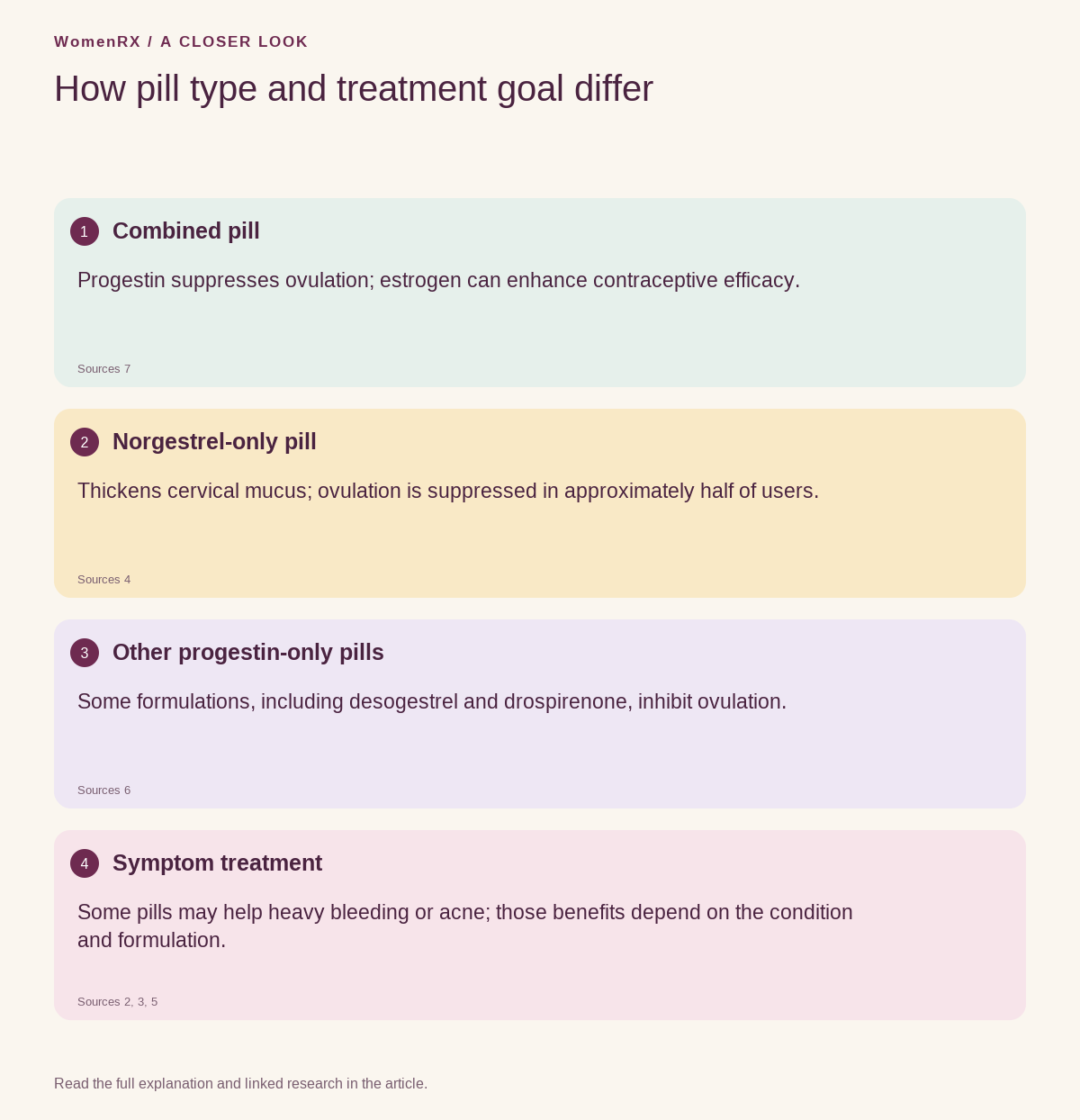
How pill type and treatment goal differ
Combined pill: Progestin suppresses ovulation; estrogen can enhance contraceptive efficacy.7
Norgestrel-only pill: Thickens cervical mucus; ovulation is suppressed in approximately half of users.4
Other progestin-only pills: Some formulations, including desogestrel and drospirenone, inhibit ovulation.6
Symptom treatment: Some pills may help heavy bleeding or acne; those benefits depend on the condition and formulation.235
Read the figure as text
The contraceptive mechanism depends on the pill’s ingredients; symptom benefits are separate and vary by condition.- Combined pill: Progestin suppresses ovulation; estrogen can enhance contraceptive efficacy.7
- Norgestrel-only pill: Thickens cervical mucus; ovulation is suppressed in approximately half of users.4
- Other progestin-only pills: Some formulations, including desogestrel and drospirenone, inhibit ovulation.6
- Symptom treatment: Some pills may help heavy bleeding or acne; those benefits depend on the condition and formulation.235
More questions, answered
Does a pill prescribed for acne also prevent pregnancy?
Yes. If it's a combined contraceptive pill prescribed to help acne, it still works to prevent pregnancy. The reason you're taking it doesn't change its contraceptive action. Confirm which pill you're taking and discuss pregnancy prevention as a separate goal. Combined pills can help acne, while progestin-only pills can sometimes worsen it. 1 3 7
Are all progestin-only pills expected to stop ovulation?
No. A review reports that norgestrel suppresses ovulation in approximately half of users, while newer progestin-only formulations such as desogestrel and drospirenone are described as inhibiting ovulation. The mechanism depends on the specific formulation. 4 6
Sources you can check
- Birth Control | Contraception | Contraceptives | MedlinePlusAccessed 2026-09-25Return to first citation
- Heavy periods - NHSAccessed 2026-09-25Return to first citation
- Acne - Treatment - NHSAccessed 2026-09-25Return to first citation
- A review of recommendations, efficacy, and patient safety for over-the-counter norgestrel for daily contraception.Tran G, Wollen J, Davis S, Wang EM, Arriazola J, Rosario N. · Exploratory research in clinical and social pharmacy · 2025Return to first citation
- Oral hormonal therapy as treatment option for abnormal uterine bleeding.Selmi C, La Marca A. · The European journal of contraception & reproductive health care : the official journal of the European Society of Contraception · 2023Return to first citation
- Effectiveness and efficacy rates of progestin-only pills: A comprehensive literature review.Zuniga C, Blanchard K, Harper CC, Wollum A, Key K, Henderson JT. · Contraception · 2023Return to first citation
- Estetrol-based combined oral contraceptives: A systematic review of clinical outcomes.Råberg M, Vad IR, Axelsdóttir KH, Løkkegaard ECL. · Acta obstetricia et gynecologica Scandinavica · 2026Return to first citation
- Comparative Efficacy of Metformin and Combined Oral Contraceptives in the Management of Adolescent Polycystic Ovary Syndrome: A Systematic Review of Randomized Controlled Trials.Mandvia A, George R, Kumari K, Kumari K, Sabbagh LI, Bhullar A, Mohamed Ismail D, Kolanu ND, Ali A. · Cureus · 2025Return to first citation