How to Read Birth Control Pill Reviews With a Clearer Eye
A personal review can help you name questions and tradeoffs, but it can’t tell you how a pill will work for you.
Treat a birth control pill review as one person’s account, not a prediction or a ranking. Pills may be combined, containing estrogen and progestin, or progestin-only. 1 Check the pill’s name or stated ingredients when available, what the person hoped it would help with, how long they used it, and what context they share. Those details help you judge whether the account relates to your question, but they can’t forecast your experience.
A review saying “this pill worked for me” leaves out the details you need to know whether the account relates to your own decision. The pill may have been a different formulation, the person may have been treating a different problem, or the review may describe only one part of their experience.
Use reviews to spot questions you want answered, not to decide that a pill is right or wrong for you.
Start with the pill and the reason for taking it
“Birth control pill” can mean a progestin-only pill or a combined pill containing estrogen and progestin. 1 If the reviewer names the pill or lists its ingredients, note those details too. A review that doesn’t identify the pill is harder to compare with your options. Even when you can identify it, one person’s response doesn’t show how another person will respond.
Look for what the writer hoped the pill would do. Preventing pregnancy, easing heavy bleeding, and treating endometriosis-related pain are different goals. A review about pain relief doesn’t establish how well a pill will suit someone whose main concern is bleeding or contraception. Research on women with endometriosis, for example, looks at psychological and sexual well-being in that specific group. 2 A separate trial compared treatments for heavy menstrual bleeding. 3 Those findings answer different questions.
Check what “worked” means, and for how long
A review may say “better” without explaining better in what way: less pain, lighter bleeding, fewer unwanted effects, or something else. The distinction matters. A treatment can help with one goal without answering every question someone has about it.
Also check how long the person used the pill and when they wrote the review. An account from one point in use describes that person’s experience at that time; it can’t tell you what happened outside the period they describe. In studies of women with endometriosis, follow-up was short on average and measures varied, limiting what the review could conclude about longer-term outcomes. 2
That doesn’t make a short review useless. It means you should read it as a snapshot, not a complete account or a reliable forecast.
Look for the context around the outcome
A person’s starting point helps explain what an outcome means. Someone seeking relief from heavy bleeding may judge a pill differently from someone whose periods were not heavy to begin with. In one comparative study of women with heavy menstrual bleeding, outcomes were examined in women with and without fibroids; results differed for the fibroid subgroup. That study doesn’t predict your outcome, but it illustrates why a review that omits the reason for treatment or relevant health history may leave out useful context. 3
Menstrual history and health conditions are worth noting when comparing experiences. If a reviewer mentions postpartum or breastfeeding status, note what they report without assuming it predicts your response to a pill. Another person’s review is still only an account of that person’s experience.
A quick review-reading checklist
Before giving a review much weight, ask:
- Which pill? Does the writer name the pill or state its ingredients? Do they say whether it was progestin-only or combined?
- For what goal? Were they using it for contraception, heavy bleeding, endometriosis-related pain, or another reason?
- For how long? Is the time period clear, and does it match the question you’re asking?
- What changed? Does the person say what improved or what they disliked, rather than only calling it “good” or “bad”?
- What’s missing? Do they mention their menstrual history or relevant health conditions?
If several answers are missing, the account may still help you think of a question. It just offers little basis for comparing pills.
Bring the useful questions forward
You might ask: “Which type of pill are we discussing, and what’s its intended benefit for me?” “How will we tell whether it’s helping the concern I care about?” “Does my menstrual history or health history change which options make sense?” These questions turn a review from a verdict into a starting point for a more personal conversation.
Research can help compare defined outcomes in defined groups. For example, a study of women with dysmenorrhea found differences across treatment groups, but its unadjusted descriptive analysis could not establish that a particular treatment caused those differences. 4 A testimonial has even less ability to separate a pill’s effect from a person’s circumstances.
You don’t have to dismiss personal stories to read them carefully. Let them show you what someone noticed; use research and a discussion tailored to your health and goals to judge what that might mean for you.
Before You Trust a Pill Review
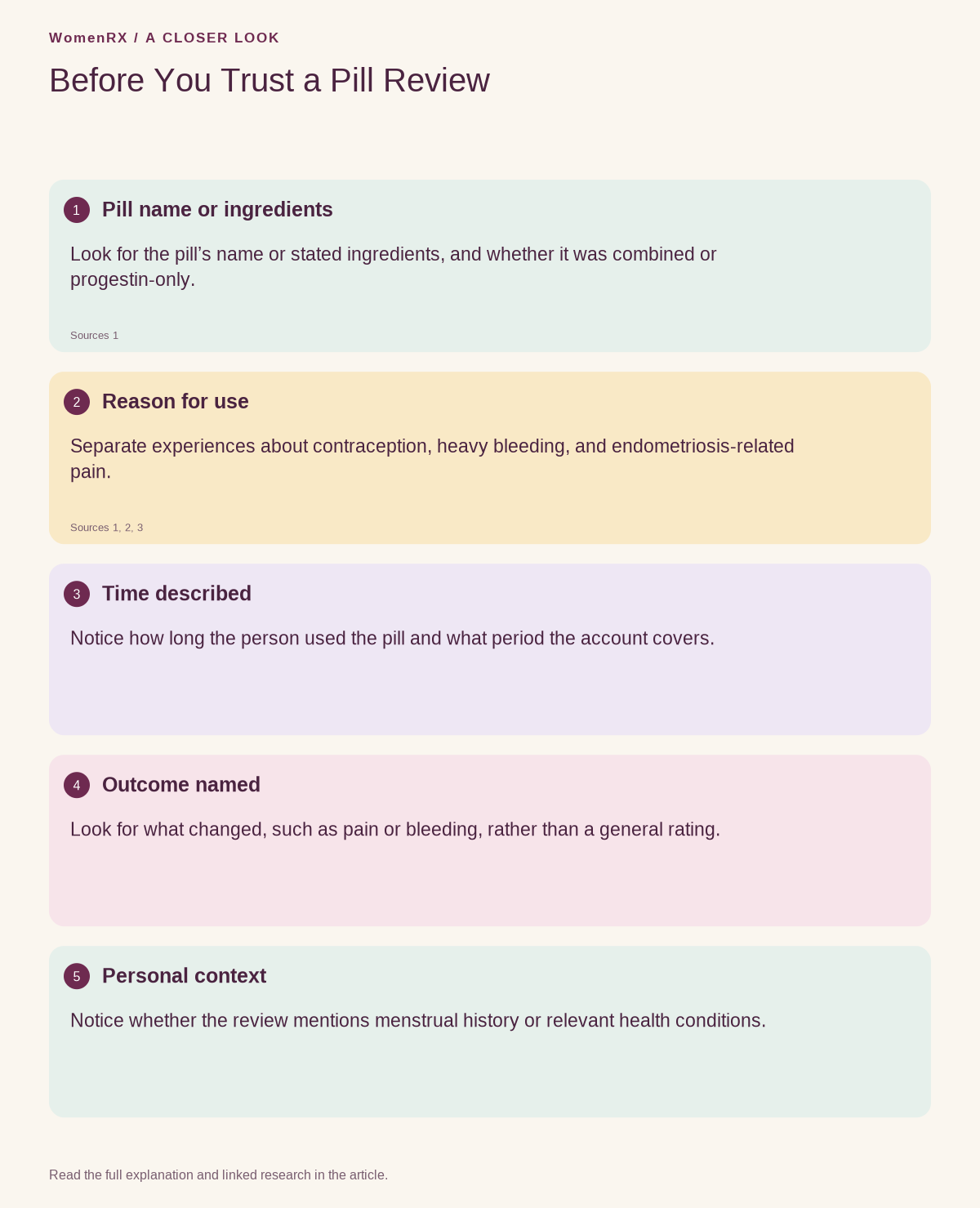
Pill name or ingredients: Look for the pill’s name or stated ingredients, and whether it was combined or progestin-only.1
Reason for use: Separate experiences about contraception, heavy bleeding, and endometriosis-related pain.123
Time described: Notice how long the person used the pill and what period the account covers.
Outcome named: Look for what changed, such as pain or bleeding, rather than a general rating.
Personal context: Notice whether the review mentions menstrual history or relevant health conditions.
Read the figure as text
Check whether an account includes the details that help you decide if it relates to your question. A closer match adds context, not a personal prediction.- Pill name or ingredients: Look for the pill’s name or stated ingredients, and whether it was combined or progestin-only.1
- Reason for use: Separate experiences about contraception, heavy bleeding, and endometriosis-related pain.123
- Time described: Notice how long the person used the pill and what period the account covers.
- Outcome named: Look for what changed, such as pain or bleeding, rather than a general rating.
- Personal context: Notice whether the review mentions menstrual history or relevant health conditions.
More questions, answered
Can reviews tell me which birth control pill is best?
Not reliably. Reviews describe individual experiences, and the pill, reason for use, and health context may differ. Use them to identify questions or concerns, not to rank pills for your own situation.
Why do studies about pill experiences sometimes disagree?
They may study different groups, goals, outcomes, or lengths of follow-up. A systematic review of women with endometriosis found only a small number of eligible studies and noted varied measures and short follow-up, so its findings shouldn’t be treated as a forecast for every pill user. 2
Sources you can check
- Birth Control | Contraception | Contraceptives | MedlinePlusAccessed 2026-09-25Return to first citation
- Impact of combined oral contraceptives and progestin-only pills on psychological and sexual well-being of women with endometriosis: A systematic review.Salmeri N, Piccini M, Caprara F, Somigliana E, Viganò P, Vercellini P. · Acta obstetricia et gynecologica Scandinavica · 2026Return to first citation
- Efficacy of Oral Tranexamic Acid Versus Combined Oral Contraceptives for Heavy Menstrual Bleeding.Rahman S, Khan FS, Samin KA, Afridi N, Ahmed M. · Cureus · 2021Return to first citation
- Dysmenorrhea patients' experience with work productivity impact and treatment in Japan.Hiraike O, Goto D, Uchiyama M, Takahashi S, Osuga Y. · BMC women's health · 2026Return to first citation