Birth Control Beyond the Pill: What Fits Your Life?
The best alternative depends on what you want to stop doing, whether that’s remembering a daily pill or managing bleeding.
If a daily pill isn’t working for you, you can discuss a weekly patch, a vaginal ring, an injection, an implant, an IUD, or condoms. They differ in how often you act and whether a clinician places or gives them. If heavy periods, migraine with aura, or recent childbirth are part of the picture, those details can change the conversation. 124
Start with what isn’t working
Forgetting pills is a different problem from disliking how you feel on them. If the daily routine is the problem, a patch or ring changes that routine, but you still have to keep up with replacements. An injection requires a visit about every three months. An implant or IUD is placed by a clinician and works for years without a daily task. Condoms are used each time you have sex and, unlike the other methods listed here, can also help prevent sexually transmitted infections (STIs). 1
If the concern is a health condition or a side effect, changing how you use birth control may not answer it. Bring the name of your current pill and what’s bothering you into the discussion. The useful question is whether you want a different routine, a different hormone approach, or no hormones.
Match the method to the effort you want
Patch or vaginal ring: These are hormonal options you manage yourself rather than pills you take daily. The patch is changed weekly. The ring described by MedlinePlus stays in the vagina for three weeks, followed by a week out before a new ring. They may appeal if you want to avoid a daily pill but prefer a method you can start and stop without a placement procedure. 1
Injection: A clinician gives a hormonal injection about every three months. It removes the daily task, but replaces it with repeat visits. If getting to appointments is the hardest part of your current routine, that tradeoff matters. 1
Implant: A clinician places a thin rod under the skin of your upper arm. It’s a years-long option without a daily or weekly task. Bleeding deserves its own question: irregular bleeding during implant use can be bothersome, and a systematic review examined treatments for that problem. It doesn’t tell you in advance what your own bleeding pattern will be. 15
IUD: A clinician places a device in the uterus. There are hormonal and copper types, and duration varies by device. If heavy periods are already a concern, ask specifically about a levonorgestrel IUD rather than treating all IUDs as interchangeable. In a trial of reproductive-aged women with confirmed heavy menstrual bleeding, Mirena reduced menstrual blood loss more than the treatment it was compared with over six cycles. Spotting or irregular bleeding is common in its first months, so a potential longer-term bleeding benefit doesn’t mean an immediately predictable period. 12
Condoms and other methods used around sex: Condoms don’t require a placement visit or a hormone routine, and they can help prevent STIs. Other barrier methods include a diaphragm or cervical cap, which require fitting. Fertility-awareness methods involve identifying fertile days and avoiding sex or using a barrier method on those days; MedlinePlus notes they may have higher pregnancy rates than other methods. These choices ask for more attention around sex or across your cycle than an implant or IUD does. 1
If you’re sure you don’t want a future pregnancy, sterilization is another discussion, but it’s permanent rather than a reversible substitute for the pill. 1
Two health details that change the shortlist
Migraine with aura: Aura can include visual changes such as flashing lights or zigzag lines before or during a migraine. A review of menstrual migraine cites US contraceptive eligibility guidance advising against combined hormonal contraception for someone with a history of menstrual migraine with aura. If that describes you, don’t assume a patch or ring resolves a concern you had with a combined pill just because it isn’t swallowed. Ask whether the specific option you’re considering is combined hormonal contraception. Migraine without aura is a different history to describe accurately. 34
Recent childbirth or breastfeeding: Timing matters as well as method. Mirena’s prescribing information describes both insertion immediately after childbirth and a later insertion approach, with different considerations for each; that isn’t a one-size-fits-all schedule for every IUD. Breastfeeding alone also isn’t an open-ended contraceptive method. The lactational amenorrhea method described by MedlinePlus depends on exclusive breastfeeding, no periods or spotting, and being within six months after birth. If any of those conditions doesn’t fit, ask about another plan rather than relying on breastfeeding for pregnancy prevention. 12
A practical way to narrow the choice is to name your top two priorities. For example: “I don’t want a daily task, and my heavy periods are difficult,” or “I want something I control myself, and I have migraine with aura.” That gives a clinician more to work with than simply saying the pill isn’t for you.
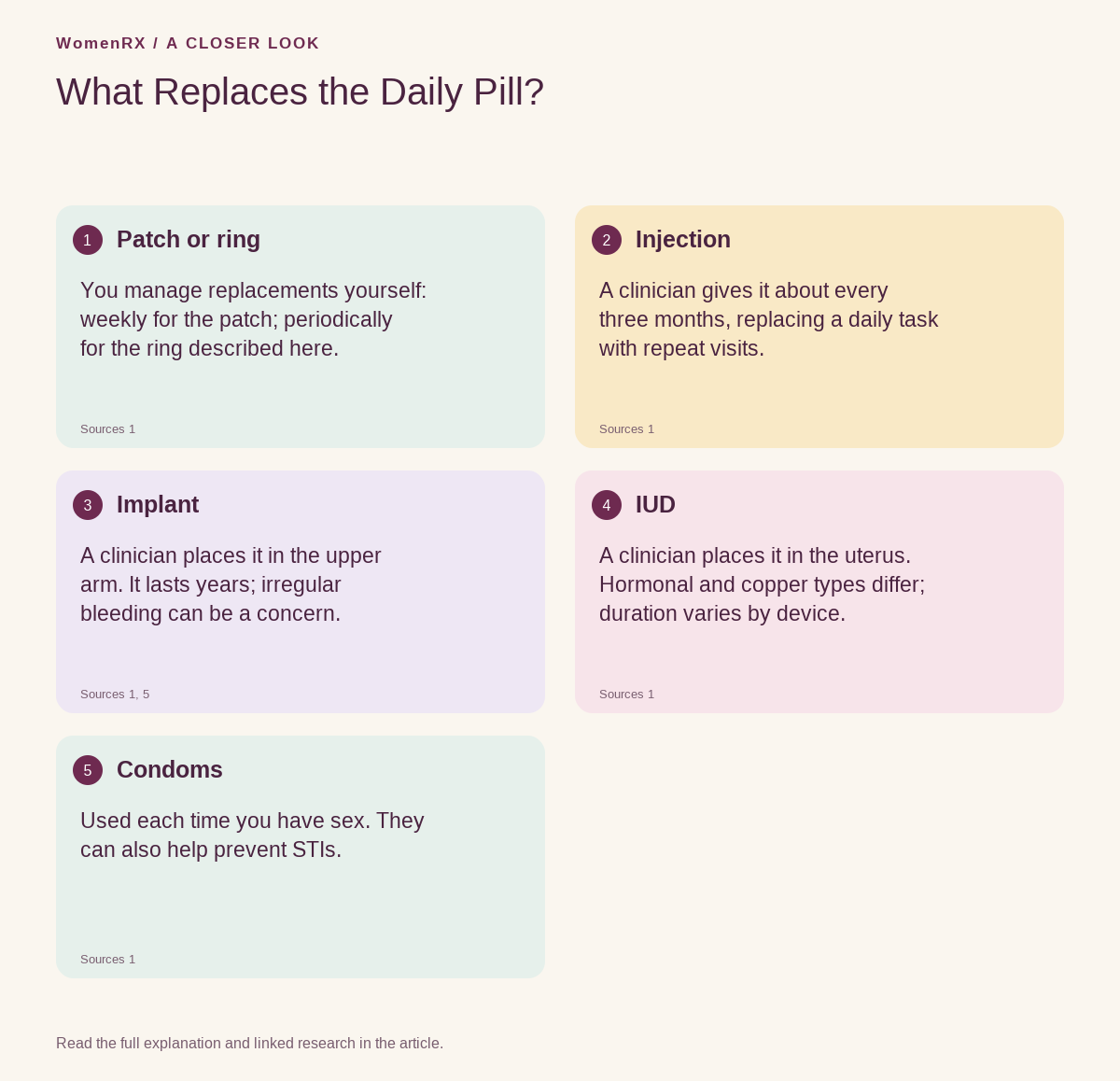
What Replaces the Daily Pill?
Patch or ring: You manage replacements yourself: weekly for the patch; periodically for the ring described here.1
Injection: A clinician gives it about every three months, replacing a daily task with repeat visits.1
Implant: A clinician places it in the upper arm. It lasts years; irregular bleeding can be a concern.15
IUD: A clinician places it in the uterus. Hormonal and copper types differ; duration varies by device.1
Condoms: Used each time you have sex. They can also help prevent STIs.1
Read the figure as text
A quick comparison of who handles each method and when it needs attention.- Patch or ring: You manage replacements yourself: weekly for the patch; periodically for the ring described here.1
- Injection: A clinician gives it about every three months, replacing a daily task with repeat visits.1
- Implant: A clinician places it in the upper arm. It lasts years; irregular bleeding can be a concern.15
- IUD: A clinician places it in the uterus. Hormonal and copper types differ; duration varies by device.1
- Condoms: Used each time you have sex. They can also help prevent STIs.1
More questions, answered
Can I use condoms alongside another birth control method?
Yes. Condoms can add STI protection that an implant, IUD, injection, patch, or ring does not provide. 1
Is a hormonal IUD the same as having no hormones?
No. Hormonal IUDs release a hormone; copper IUDs are the nonhormonal IUD option. If avoiding hormones is your priority, make that distinction explicit when discussing an IUD. 1
Sources you can check
- Birth Control | Contraception | Contraceptives | MedlinePlusAccessed 2026-09-25Return to first citation
- MIRENA (LEVONORGESTREL) INTRAUTERINE DEVICE [BAYER HEALTHCARE PHARMACEUTICALS INC.] | US prescribing information and patient instructionsAccessed 2026-09-25Return to first citation
- Migraine | MedlinePlusAccessed 2026-09-25Return to first citation
- Menstrual Migraines: Diagnosis, Evidence, and Treatment.Olson AK, Hansen KA. · South Dakota medicine : the journal of the South Dakota State Medical Association · 2021Return to first citation
- Management of bleeding irregularities during contraceptive implant use: A systematic review.Cohen MA, Snyder EM, Curtis KM, Nguyen AT, Clark EA, Folger SG, Gaffield ME, Whiteman MK. · Contraception · 2026Return to first citation