How to Choose Birth Control That Fits Your Life
Start with the pregnancy prevention you want, the routine you can live with, and how each option fits your periods and health history.
Choose a shortlist by asking what matters most: strong pregnancy prevention, little day-to-day effort, a particular bleeding pattern, avoiding hormones, or STI protection. An IUD, a pill, and a condom answer those needs differently, and you can use condoms alongside another method. Recent childbirth, breastfeeding, and conditions such as migraine with aura can change which options fit your health as well as your preferences.1511
Birth control isn’t a contest with one winner. A method can be highly effective against pregnancy but change your bleeding, require a placement procedure, or offer no protection against sexually transmitted infections (STIs). Start with the tradeoffs you care about, then check whether your health history changes the shortlist.
How much work do you want birth control to take?
Picture an ordinary busy week. Would you reliably take a pill every day? A patch has a weekly routine, an injection is repeated every three months, and condoms require action when you have sex. MedlinePlus describes one vaginal-ring routine as three weeks in place followed by a week out. IUDs and implants are placed by a clinician and don’t require a daily task; how long a particular product lasts varies.1
The routine affects pregnancy prevention in real life. During the first year of typical use, the CDC estimates pregnancy in about 0.8 per 100 copper IUD users, compared with 13 per 100 external-condom users. It lists 17 per 100 diaphragm users and 21 per 100 internal-condom users over that same first year. Typical use reflects how methods are actually used, rather than assuming every use goes perfectly.5 The copper figure isn’t a stand-in for every IUD, but the CDC also says fewer than one in 100 IUD users becomes pregnant during the first year of typical use.4 These figures don’t predict your individual outcome or give a comparable number for every hormonal method. Inconsistent pill use is a major cause of oral-contraceptive failure, so a method that doesn’t depend on remembering a pill may be especially appealing if your schedule is unpredictable.10
Hormonal methods aren’t all the same. Combined pills, patches, and rings contain estrogen and progestin. Progestin-only pills, the etonogestrel arm implant, the DMPA injection, and levonorgestrel IUDs are hormonal options without estrogen. The copper IUD is nonhormonal. These categories matter when your health history rules out one kind of hormone but not another; they don’t tell you which method you’ll like using.11112
If you prefer to avoid both hormones and a placed device, a diaphragm, condoms, or fertility awareness may be worth comparing. A diaphragm is used with spermicide; fertility-awareness methods involve identifying fertile days and avoiding sex or using a barrier method then. The CDC’s first-year typical-use failure estimates for different fertility-awareness methods range from 2 to 23 per 100 users, not one rate that applies to them all. Withdrawal has higher pregnancy rates than many other methods.15
Control matters, too. You might prefer a condom you choose to use at the time of sex over a placed method, even knowing the typical-use pregnancy figures differ. Or you might welcome an IUD because you’d rather not think about contraception each week. Both are useful answers to the question, “What will I actually want to keep using?”
Compare periods and hormones separately
Wanting no hormones and wanting lighter periods can point in different directions. The copper IUD has no hormones, but spotting or heavier or longer bleeding is common in its first three to six months. It often decreases with continued use. With a levonorgestrel hormonal IUD, early spotting is also expected, but bleeding generally decreases over time; many users eventually have light bleeding or no periods.14
That distinction matters if heavy periods are already a problem. Mirena, a specific levonorgestrel IUD, is indicated to treat heavy menstrual bleeding in women who choose an IUD for contraception. Its heavy-bleeding indication doesn’t promise an immediate change: irregular bleeding or spotting is common in the first months. Don’t assume every hormonal IUD has the same indication.3 If bleeding is persistent or unusual for you, ask about evaluating it before placement rather than assuming contraception will explain or fix it; Mirena’s prescribing information specifically calls for assessment of possible endometrial causes before insertion in that situation.3
Other routines can affect bleeding, too. Spotting may occur during the first three to six months of extended or continuous use of a combined hormonal pill, patch, or ring and usually improves with continued use. That finding isn’t a prediction for every hormonal regimen.9 And hormone-free doesn’t mean side-effect-free: condoms can irritate or slip, while a diaphragm used with spermicide can cause irritation or urinary tract infections.6
Give STI protection its own answer
Most contraceptives, including IUDs and hormonal methods, don’t protect against STIs. External latex condoms help reduce the risk of HIV and other STIs. Polyurethane external condoms can also help prevent STIs, which is useful to know if latex bothers you; lambskin condoms may not provide that protection. Internal condoms can help prevent STIs as well.1511
You don’t have to ask one method to do both jobs. For example, you might choose an IUD for low-maintenance pregnancy prevention and use condoms with a new partner for STI protection. STIs can have no symptoms, so feeling well doesn’t settle whether testing would be useful.211
Let future plans and life stage change the comparison
If pregnancy might be part of your future, distinguish reversible contraception from permanent contraception. IUDs are reversible; tubal ligation and vasectomy are intended to be permanent. You don’t need a lifelong plan to choose a reversible method now.14
After childbirth, ask about timing rather than assuming you must wait for a later visit to discuss an IUD. Both copper and levonorgestrel IUDs can be placed immediately postpartum in appropriate circumstances, but they’re more likely to come out than IUDs placed later. In a systematic review of postpartum placements, the pooled expulsion rate was 10.0% for IUDs placed within 10 minutes after delivery of the placenta, versus 1.9% for placement at least four weeks postpartum. Immediate placement may be easier to arrange; later placement has a lower observed expulsion rate. Those pooled results aren’t a prediction for your delivery.47
Breastfeeding alone isn’t a standing birth-control plan. The temporary lactational amenorrhea method applies only while all three conditions hold: you haven’t had a period since birth, you’re fully or nearly fully breastfeeding, and you’re less than six months postpartum. Once one changes, another method is needed to prevent pregnancy.5
Postpartum timing also changes medical eligibility. CDC guidance says combined hormonal methods, such as the combined pill, patch, and ring, should not be used in the first 21 days after birth, whether or not you’re breastfeeding. Progestin-only pills have different guidance and may be started immediately postpartum when pregnancy can reasonably be ruled out; the choice still depends on your circumstances.910 If you’re approaching menopause, don’t count sequential combined hormone replacement therapy (HRT) as birth control. Pregnancy can still be possible while taking it.8
Check the health details that can change your shortlist
A preferred routine isn’t the same thing as medical eligibility. The CDC classifies combined hormonal contraception as an unacceptable health risk with migraine with aura or severely elevated blood pressure. Those conditions aren’t classified the same way for copper IUDs, levonorgestrel IUDs, or progestin-only pills. Current breast cancer changes the comparison differently: the CDC classifies hormonal methods as unacceptable risks, while a copper IUD has no restriction on that basis.911
Medicines can matter as well. For example, CDC guidance flags interactions involving rifampin or rifabutin and certain anticonvulsants, including carbamazepine and topiramate, for some hormonal methods; the copper and levonorgestrel IUDs aren’t classified the same way for those interactions.11 These distinctions make for a focused conversation: “I want to avoid a daily pill, but my periods are heavy. How would the two IUD types compare for me?” Or, “I like the patch’s routine. Does my migraine history change that option?” Your priorities make the question specific; your history helps determine which choices remain suitable.3411
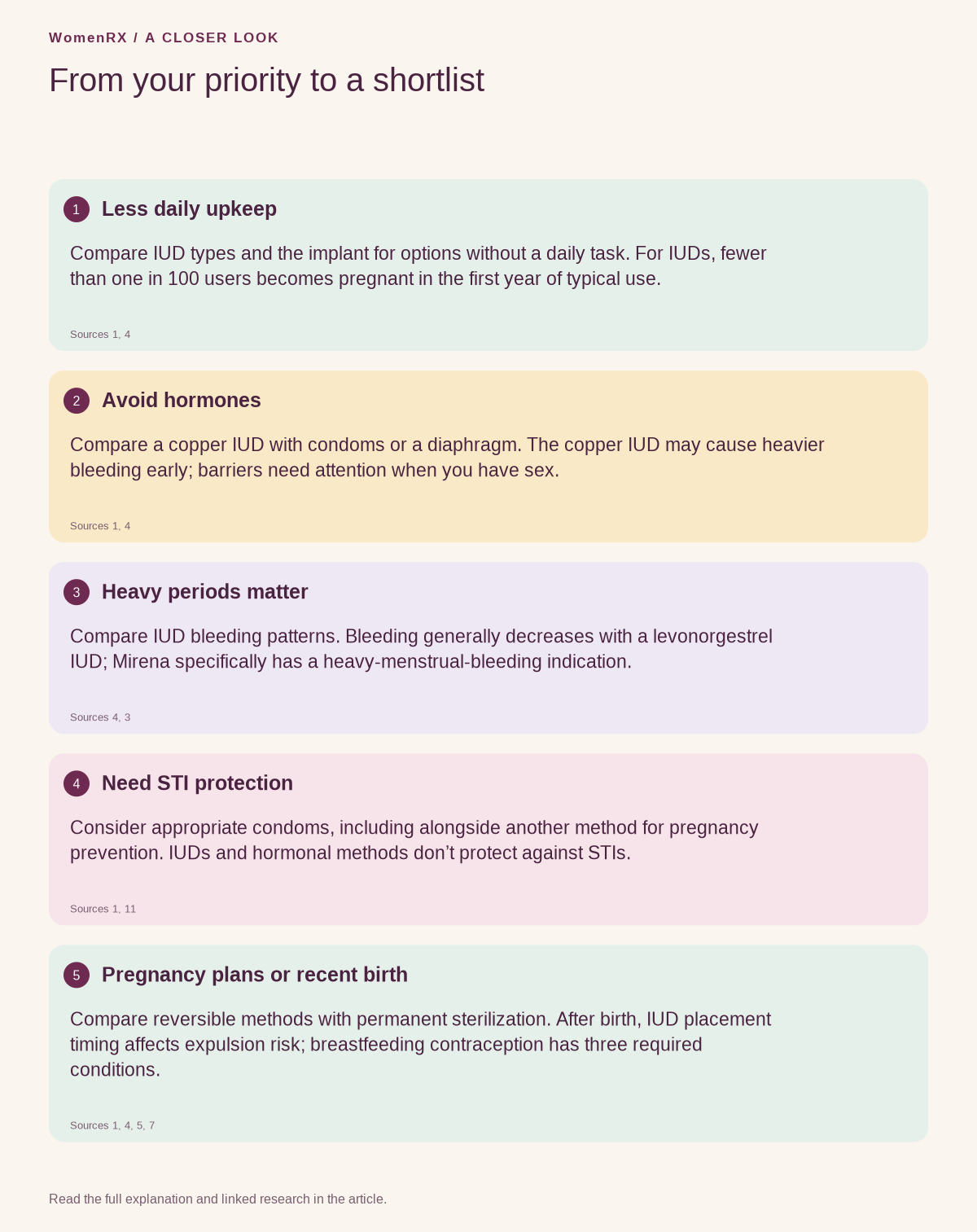
From your priority to a shortlist
Less daily upkeep: Compare IUD types and the implant for options without a daily task. For IUDs, fewer than one in 100 users becomes pregnant in the first year of typical use.14
Avoid hormones: Compare a copper IUD with condoms or a diaphragm. The copper IUD may cause heavier bleeding early; barriers need attention when you have sex.14
Heavy periods matter: Compare IUD bleeding patterns. Bleeding generally decreases with a levonorgestrel IUD; Mirena specifically has a heavy-menstrual-bleeding indication.43
Need STI protection: Consider appropriate condoms, including alongside another method for pregnancy prevention. IUDs and hormonal methods don’t protect against STIs.111
Pregnancy plans or recent birth: Compare reversible methods with permanent sterilization. After birth, IUD placement timing affects expulsion risk; breastfeeding contraception has three required conditions.1457
Read the figure as text
Start with the priority that matters most to you. Each route suggests options to compare, not a winner; every route ends with checking medical fit.- Less daily upkeep: Compare IUD types and the implant for options without a daily task. For IUDs, fewer than one in 100 users becomes pregnant in the first year of typical use.14
- Avoid hormones: Compare a copper IUD with condoms or a diaphragm. The copper IUD may cause heavier bleeding early; barriers need attention when you have sex.14
- Heavy periods matter: Compare IUD bleeding patterns. Bleeding generally decreases with a levonorgestrel IUD; Mirena specifically has a heavy-menstrual-bleeding indication.43
- Need STI protection: Consider appropriate condoms, including alongside another method for pregnancy prevention. IUDs and hormonal methods don’t protect against STIs.111
- Pregnancy plans or recent birth: Compare reversible methods with permanent sterilization. After birth, IUD placement timing affects expulsion risk; breastfeeding contraception has three required conditions.1457
More questions, answered
What if a condom breaks before I’ve chosen another method?
Emergency contraception is separate from choosing an ongoing method. One option is a copper IUD placed within five days of unprotected sex, so ask promptly about your options if pregnancy prevention is a concern.15
Sources you can check
- Birth Control | Contraception | Contraceptives | MedlinePlusAccessed 2026-09-25Return to first citation
- Sexually Transmitted Infections | MedlinePlusAccessed 2026-09-25Return to first citation
- MIRENA (LEVONORGESTREL) INTRAUTERINE DEVICE [BAYER HEALTHCARE PHARMACEUTICALS INC.] | US prescribing information and patient instructionsAccessed 2026-09-25Return to first citation
- CDC: Intrauterine contraception and copper IUD bleedingAccessed 2026-09-25Return to first citation
- CDC: Birth control methods, barrier methods, fertility awareness and breastfeedingAccessed 2026-09-25Return to first citation
- Office on Women's Health: Barrier contraception side effectsAccessed 2026-09-25Return to first citation
- Intrauterine Device Expulsion After Postpartum Placement: A Systematic Review and Meta-analysis.Jatlaoui TC, Whiteman MK, Jeng G, Tepper NK, Berry-Bibee E, Jamieson DJ, Marchbanks PA, Curtis KM. · Obstetrics and gynecology · 2018Return to first citation
- Pregnancy, breastfeeding and fertility while taking or using sequential combined hormone replacement therapy (HRT) - NHSAccessed 2026-09-25Return to first citation
- Combined Hormonal Contraceptives | Contraception | CDCAccessed 2026-09-25Return to first citation
- Progestin-Only Pills | Contraception | CDCAccessed 2026-09-25Return to first citation
- Appendix A: Summary of Classifications for U.S. Medical Eligibility Criteria for Contraceptive Use, 2024 | Contraception | CDCAccessed 2026-09-25Return to first citation
- Appendix C: Classifications for Progestin-Only Contraceptives | Contraception | CDCAccessed 2026-09-25Return to first citation