Nonhormonal Birth Control: What Are Your Options?
The copper IUD, barriers, and fertility-awareness methods all avoid hormones, but they ask very different things of you.
Yes. The copper IUD, condoms, diaphragms, and fertility-awareness methods are established nonhormonal options. The copper IUD has a 0.8% typical-use failure estimate; a clinician places it, and bleeding changes are common at first.13 Condoms and diaphragms are barrier options, while fertility awareness calls for method-specific guidance. Breastfeeding may be used as temporary contraception only while three specific conditions apply.1

Start with the kind of effort you want
Avoiding hormones doesn’t mean you have to rely on a vaguely defined “natural” approach. You can choose a method that stays in place, a barrier method, or a specific fertility-awareness method. Those differences may matter as much as a failure-rate number when you’re deciding what will work in your life.1
If you prefer a clinician-placed method, consider the copper IUD. A clinician places it in the uterus.3 The CDC lists its typical-use failure rate as 0.8%. Placement is a step to arrange, and it won’t protect you from sexually transmitted infections (STIs).1 Spotting or heavier or longer bleeding is common in the first three to six months, though it often decreases with continued use. That’s worth weighing if bleeding is already a concern for you.3
If you prefer a barrier method, compare condoms and diaphragms. The CDC lists typical-use failure rates of 13% for external condoms, 21% for internal condoms, and 17% for diaphragms. A diaphragm is used with spermicide. External latex condoms also help protect against HIV and other STIs; lambskin condoms may not. Most contraceptive methods, including the copper IUD, don’t provide STI protection.13
For example, if you want the copper IUD’s pregnancy prevention but also need STI protection, an external latex condom can serve a different purpose alongside it. If you’d rather avoid an inserted device, an external condom may fit better for you.13
Fertility awareness is a method, not a guess
Fertility-awareness methods have distinct rules, and a result reported for one method shouldn’t be assumed to apply to another. The CDC gives a 2% to 23% range for typical-use failure across these methods. That is not the failure rate of one app, calendar, or tracking technique, and it shouldn’t be used to promise how well a particular approach will work for you.12
The distinction matters if “natural” means tracking your cycle. For example, a calendar estimate made without following a defined method isn’t the same choice as learning and consistently using a specific fertility-awareness method. A product labeled “fertility balance” isn’t a set of contraception instructions. If avoiding pregnancy is your goal, choose a defined method with pregnancy-prevention guidance.1
After birth, don’t use your old calendar as the plan
Postpartum fertility awareness deserves its own decision. A systematic review found only four studies with effectiveness data for a specific fertility-awareness method in postpartum people; none was rated high quality for the review’s question. The evidence was mostly low quality, so a result from one method shouldn’t be applied to another or treated as a reliable prediction for every breastfeeding woman.2
Breastfeeding itself qualifies as temporary contraception under the lactational amenorrhea method only while all three conditions hold: you haven’t had a menstrual period since birth, you’re fully or nearly fully breastfeeding, and you’re less than six months postpartum. Once any one condition no longer applies, another method is needed if you want to prevent pregnancy. Having no period, by itself, doesn’t meet the method’s criteria.1
For example, if you’re breastfeeding but have started having periods again, the breastfeeding method’s conditions no longer hold. And if you want to use fertility awareness after birth, look for guidance for the particular postpartum method you intend to follow rather than returning to a pre-pregnancy calendar routine. Research on postpartum methods is limited, which makes those distinctions especially useful.12
The practical choice is less about whether a method sounds “natural” and more about what it requires: clinician placement, choosing a barrier method, or learning a specific fertility-awareness method. Pick the kind of work you can actually sustain, and account separately for STI protection if you need it.13
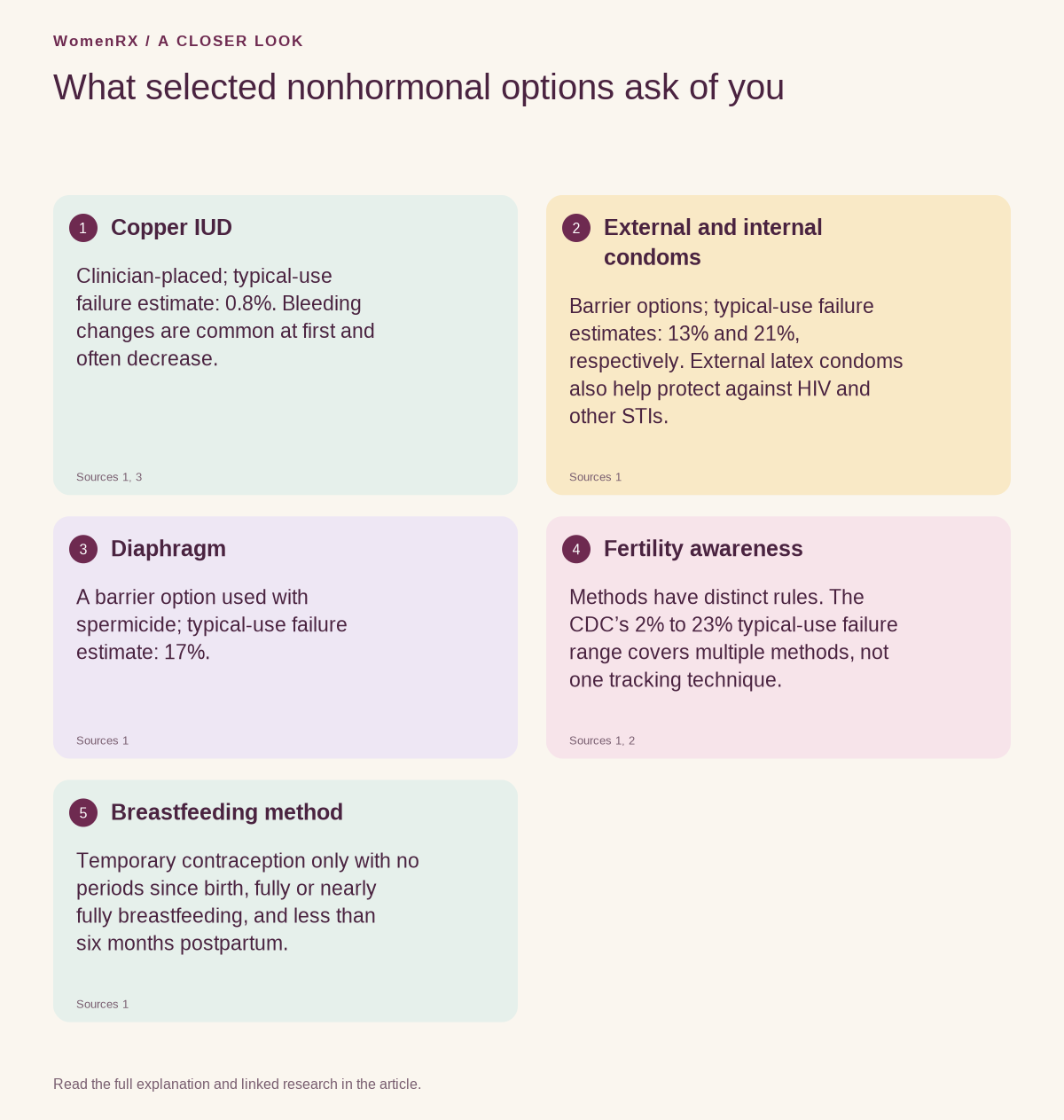
What selected nonhormonal options ask of you
Copper IUD: Clinician-placed; typical-use failure estimate: 0.8%. Bleeding changes are common at first and often decrease.13
External and internal condoms: Barrier options; typical-use failure estimates: 13% and 21%, respectively. External latex condoms also help protect against HIV and other STIs.1
Diaphragm: A barrier option used with spermicide; typical-use failure estimate: 17%.1
Fertility awareness: Methods have distinct rules. The CDC’s 2% to 23% typical-use failure range covers multiple methods, not one tracking technique.12
Breastfeeding method: Temporary contraception only with no periods since birth, fully or nearly fully breastfeeding, and less than six months postpartum.1
Read the figure as text
This comparison focuses on how methods differ in use and timing, not on how many years a particular device lasts.- Copper IUD: Clinician-placed; typical-use failure estimate: 0.8%. Bleeding changes are common at first and often decrease.13
- External and internal condoms: Barrier options; typical-use failure estimates: 13% and 21%, respectively. External latex condoms also help protect against HIV and other STIs.1
- Diaphragm: A barrier option used with spermicide; typical-use failure estimate: 17%.1
- Fertility awareness: Methods have distinct rules. The CDC’s 2% to 23% typical-use failure range covers multiple methods, not one tracking technique.12
- Breastfeeding method: Temporary contraception only with no periods since birth, fully or nearly fully breastfeeding, and less than six months postpartum.1
More questions, answered
Is there a nonhormonal option after unprotected sex?
Yes. A copper IUD can be placed within five days of unprotected sex for emergency contraception. If that’s the situation you’re in, contact a contraception provider promptly to discuss placement.1
Sources you can check
- CDC: Birth control methods, barrier methods, fertility awareness and breastfeedingAccessed 2026-09-25Return to first citation
- Effectiveness of fertility awareness-based methods for pregnancy prevention during the postpartum period.Redmond JJ, Jensen ET, Stanford JB, Greene ME, Kennedy E, Urrutia RP. · Contraception · 2022Return to first citation
- CDC: Intrauterine contraception and copper IUD bleedingAccessed 2026-09-25Return to first citation