Birth Control Side Effects: What Changes by Method
Bleeding changes are common with several methods, but the pattern and other possible side effects depend on what you use.
The method matters. A copper IUD can make bleeding heavier or longer, while a hormonal IUD often leads to lighter bleeding over time. Pills, patches, rings, implants, and shots have different reported effects; barrier methods can cause local irritation. Severe pain or fever soon after Mirena placement, or pain or bleeding that worsens after placement, needs prompt assessment.347
If a symptom started after you changed birth control, timing is a useful clue, not proof of the cause. Start with the method itself: does it contain estrogen and progestin, progestin alone, copper, or no hormones? That distinction helps you compare what you’re feeling with the effects reported for your method.13
Bleeding: the clearest difference between the IUDs
A copper IUD contains no hormones. Spotting, heavier bleeding, or longer bleeding is common in the first 3 to 6 months and generally decreases with continued use. Cramps can occur after insertion. If heavier periods would be especially difficult for you, that’s a meaningful tradeoff to consider before choosing copper.37
A levonorgestrel, or hormonal, IUD tends to go in the other direction over time. Spotting or light bleeding is expected in the first 3 to 6 months; later, bleeding generally decreases, and some users have very light or no periods. Heavy or prolonged bleeding is uncommon during use. Neither an initially irregular pattern nor a missed period means everyone will eventually stop bleeding.7 A systematic review of studies using bleeding diaries found that 18.2% of users of the levonorgestrel IUDs it studied had at least one 90-day stretch without bleeding during their first year. That estimate describes those devices and that definition of no bleeding, not every hormonal IUD or every user.6
Mirena can cause pain during or after placement. Both IUDs have less common complications, including expulsion. If bleeding or cramping bothers you, you can discuss it with your provider. Mirena’s instructions specifically say to report symptoms that continue or are severe.47
Pills, patch, and ring: check whether estrogen is included
Combined hormonal contraception includes combined pills, the patch, and the vaginal ring. These contain estrogen and a progestin. Reported effects include period changes, headache, breast soreness, and upset stomach; the patch can irritate skin, while the ring can cause vaginal irritation or discharge. Spotting is particularly common during the first 3 to 6 months of extended or continuous combined-method use and generally decreases with continued use.38
Combined methods also have less common but serious risks, including blood clots and high blood pressure. Smoking and being 35 or older make those risks particularly relevant when choosing a method. They’re separate considerations from the expected bleeding changes described here, not a reason to assume every new symptom is caused by contraception.23
A progestin-only pill has no estrogen. Spotting or bleeding between periods, breast soreness, headache, and nausea are among its reported effects.39 If you’re considering a switch because you can’t use estrogen, that distinction matters, but “progestin-only” doesn’t mean “no side effects.”
Implant and shot: both progestin-only, with different tradeoffs
With an arm implant, irregular periods, headache, sore breasts, and weight gain are reported effects.3 In a review of six randomized trials involving 1,503 reproductive-aged women, implant users had higher odds of reporting acne, weight gain, and removal due to side effects than users of a levonorgestrel IUD. Those are group comparisons, not a prediction of what will happen to you.5
The contraceptive shot can cause bleeding between periods or missed periods; reported effects also include weight gain, mood changes, breast soreness, and headaches. Bone loss with long-term use is another consideration, particularly if bone health is already high on your list of priorities.3 A systematic review found broadly similar bleeding, weight, and other reported effects when comparing subcutaneous and intramuscular forms of the shot. That comparison doesn’t tell you how the shot will feel compared with every other birth control method.10
Copper and barriers avoid hormones, not all side effects
If you want to avoid hormonal effects, copper and barrier methods offer different compromises. Copper avoids hormones but can bring heavier or longer bleeding. Condoms, diaphragms, caps, sponges, and spermicides don’t create the same hormonal bleeding pattern, but irritation or an allergic reaction can occur. Spermicides and some barrier methods can also cause vaginal irritation or urinary tract infections. Latex or polyurethane condoms can help protect against sexually transmitted infections; most other contraceptive methods don’t.13
That distinction is useful when a symptom is local. For example, irritation that appears with condom use points to a different set of possibilities than spotting that begins after an IUD is placed. Neither timing nor location alone confirms the cause.3
When a change needs a conversation or prompt care
Early spotting with an IUD can fit an expected pattern. If bleeding bothers you, you can discuss whether keeping the method, addressing the bleeding, or changing methods better fits what you want.7 If you use Mirena, report bleeding or cramps that continue or are severe, as its product instructions advise. A significant new bleeding change after you’ve used it for a while also deserves assessment rather than being assumed to be an adjustment.4
Severe pain or fever shortly after Mirena placement needs immediate medical attention. Pain or bleeding that worsens after placement, or strings you can no longer feel, can signal that it has moved or come out. Contact your provider to check its position; if you can’t feel the strings, avoid intercourse or use a nonhormonal backup method until its location is confirmed.4
If you think you’re pregnant with an IUD in place, contact your provider promptly. If you’re pregnant with an IUD, seek prompt care for heavy bleeding, cramping or pain, abnormal vaginal discharge, or fever. Don’t treat those symptoms as ordinary IUD adjustment.47
How your circumstances can change the tradeoff
After childbirth or while breastfeeding, IUD placement has a consideration beyond the usual bleeding comparison: Mirena’s information reports a higher risk of uterine perforation with placement after a recent birth or while breastfeeding, and a higher risk of expulsion with placement immediately after delivery. These are placement-related risks, not a prediction that breastfeeding will cause more day-to-day side effects.4 Separately, breastfeeding works as temporary birth control only when you have no periods, are fully or nearly fully breastfeeding, and are less than six months postpartum. Those conditions concern pregnancy prevention, not whether a symptom is a side effect.2
In perimenopause, the useful comparison is still your method and the bleeding you’d find manageable. If heavier bleeding is already a concern, copper’s tendency toward heavier or longer bleeding early on may matter more to you than the hormonal IUD’s tendency toward lighter bleeding over time. That’s a choice about your priorities, not a perimenopause-specific prediction.7 If you’re 35 or older and smoke, the risks of combined methods also deserve particular attention.23
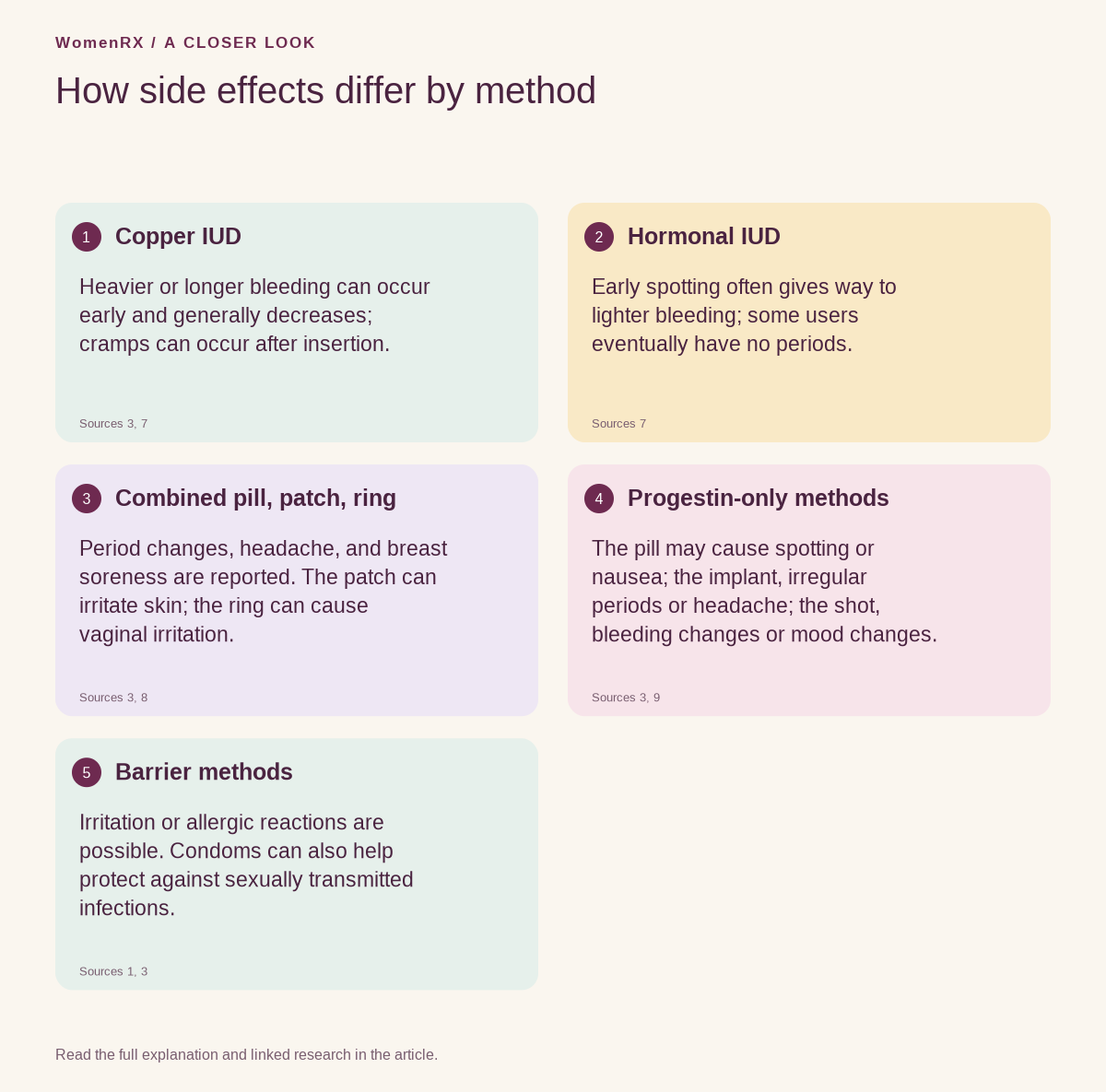
How side effects differ by method
Copper IUD: Heavier or longer bleeding can occur early and generally decreases; cramps can occur after insertion.37
Hormonal IUD: Early spotting often gives way to lighter bleeding; some users eventually have no periods.7
Combined pill, patch, ring: Period changes, headache, and breast soreness are reported. The patch can irritate skin; the ring can cause vaginal irritation.38
Progestin-only methods: The pill may cause spotting or nausea; the implant, irregular periods or headache; the shot, bleeding changes or mood changes.39
Barrier methods: Irritation or allergic reactions are possible. Condoms can also help protect against sexually transmitted infections.13
Read the figure as text
Compare the usual bleeding direction with other reported effects. The caption distinguishes those patterns from symptoms that need assessment.- Copper IUD: Heavier or longer bleeding can occur early and generally decreases; cramps can occur after insertion.37
- Hormonal IUD: Early spotting often gives way to lighter bleeding; some users eventually have no periods.7
- Combined pill, patch, ring: Period changes, headache, and breast soreness are reported. The patch can irritate skin; the ring can cause vaginal irritation.38
- Progestin-only methods: The pill may cause spotting or nausea; the implant, irregular periods or headache; the shot, bleeding changes or mood changes.39
- Barrier methods: Irritation or allergic reactions are possible. Condoms can also help protect against sexually transmitted infections.13
More questions, answered
Will a hormonal IUD definitely stop my periods?
No. Bleeding often becomes lighter over time, but not everyone stops bleeding. In a review of studies of certain levonorgestrel IUDs, 18.2% of users had at least one 90-day interval without bleeding during the first year.67
Can I use condoms with another birth control method?
Yes. Condoms can be used alongside another contraceptive method when you also want protection against sexually transmitted infections. Most birth control methods don’t provide that protection.23
Sources you can check
- Birth Control | Contraception | Contraceptives | MedlinePlusAccessed 2026-09-25Return to first citation
- CDC: Birth control methods, barrier methods, fertility awareness and breastfeedingAccessed 2026-09-25Return to first citation
- Office on Women's Health: Barrier contraception side effectsAccessed 2026-09-25Return to first citation
- MIRENA (LEVONORGESTREL) INTRAUTERINE DEVICE [BAYER HEALTHCARE PHARMACEUTICALS INC.] | US prescribing information and patient instructionsAccessed 2026-09-25Return to first citation
- Subdermal implants vs. levonorgestrel intrauterine devices outcomes in reproductive-aged women: a systematic review and meta-analysis.Oliveira JA, Neves GL, Pinhati MES, de Oliveira FR, Filho ALDS. · Archives of gynecology and obstetrics · 2025Return to first citation
- Levonorgestrel intrauterine system associated amenorrhea: a systematic review and metaanalysis.Sergison JE, Maldonado LY, Gao X, Hubacher D. · American journal of obstetrics and gynecology · 2019Return to first citation
- CDC: Intrauterine contraception and copper IUD bleedingAccessed 2026-09-25Return to first citation
- Combined Hormonal Contraceptives | Contraception | CDCAccessed 2026-09-25Return to first citation
- Progestin-Only Pills | Contraception | CDCAccessed 2026-09-25Return to first citation
- The safety of subcutaneously administered depot medroxyprogesterone acetate (104mg/0.65mL): A systematic review.Dragoman MV, Gaffield ME. · Contraception · 2016Return to first citation