What Side Effects Can Birth Control Pills Cause?
Bleeding changes are common questions with either type of pill, but estrogen changes both the bleeding pattern and the safety conversation.
Combined pills can cause spotting or other bleeding changes, nausea, headaches, and breast tenderness.5 Bleeding changes, nausea, and headaches have also been reported with one progestin-only formulation.4 Combined pills contain estrogen and progestin; progestin-only pills contain no estrogen, and their bleeding patterns can differ by formulation.145 A combined pill also carries a blood-clot risk that deserves a separate conversation. New leg swelling or unexpected shortness of breath needs urgent assessment.5
First, check which pill you’re taking
“The pill” can mean a combined pill, which contains estrogen and progestin, or a progestin-only pill. That distinction matters when you’re trying to make sense of a new symptom.1
With combined pills, nausea, headaches, breast tenderness, and occasional bleeding between expected bleeds can occur. Changes in sexual desire are also reported. Some effects ease with continued use, but you don’t have to wait out a symptom that’s disrupting your life.5
With progestin-only pills, bleeding between expected periods can also occur. Nausea and headaches were among the reported effects in a study of one progestin-only formulation. Neither symptom, on its own, tells you which kind of pill would suit you better.4 If a change began around the time you started or changed pills, that timing is useful to share with your prescriber, even though timing alone doesn’t prove the pill caused it.
Bleeding patterns are a tradeoff, not a scorecard
Estrogen helps reduce irregular bleeding in combined pills. Without it, bleeding can be less predictable on a progestin-only pill, but progestin-only pills aren’t all alike.54 In a trial of women ages 18 to 45 comparing two progestin-only pills, the drospirenone group had fewer unscheduled bleeding days than the desogestrel group. That finding compares those two formulations, not progestin-only pills as a whole against combined pills.4
For example, occasional light spotting may be an inconvenience you’re willing to live with, while repeated bleeding that interrupts work, sex, or sleep may make a different option worth discussing. Tell your prescriber if bleeding persists, becomes troublesome, or changes after a pattern that had been stable. The useful question isn’t just “Is this normal?” It’s “Does this pattern fit this pill, and what else could explain the change?”
The combined pill has a separate clot concern
Combined pills are associated with an increased risk of blood clots.5 Seek urgent medical assessment for new leg swelling or unexpected shortness of breath, rather than assuming either is a routine adjustment to the pill.5
Clot risk shouldn’t be assigned to every pill formulation as if they were identical. Guidance on cerebral venous thrombosis distinguishes estrogen-containing contraception from oral progestin-only contraception when discussing thrombosis risk, including for women with a previous clot.6 If you’ve had a clot, make sure the person prescribing contraception knows. This is a choice to review in light of your history, not a side effect to discover by trial and error.6
After childbirth or as cycles change
After birth, bleeding may come and go for weeks even without a pill, which can make spotting harder to interpret.3 When you discuss a pill or new bleeding after delivery, say when you gave birth and whether you’re breastfeeding. Those details put the symptom and your contraceptive choice in context. Breastfeeding by itself counts as temporary contraception only under specific conditions, so it shouldn’t be treated as a substitute for reviewing your method.2
In the years when your usual cycle is changing, don’t automatically credit every new bleed or headache to either the pill or perimenopause. Note what was typical for you before the change and whether you recently switched formulations. Age is also one factor in assessing clot risk with a combined pill, so a method that suited you earlier may be worth revisiting as your circumstances change.5
If a symptom is persistent or bothersome, the next move can be a focused discussion about the specific pill you take: what bleeding pattern is expected with it, whether another formulation might fit your priorities better, and whether the symptom needs another explanation. You can take the symptom seriously without assuming every change means something dangerous.
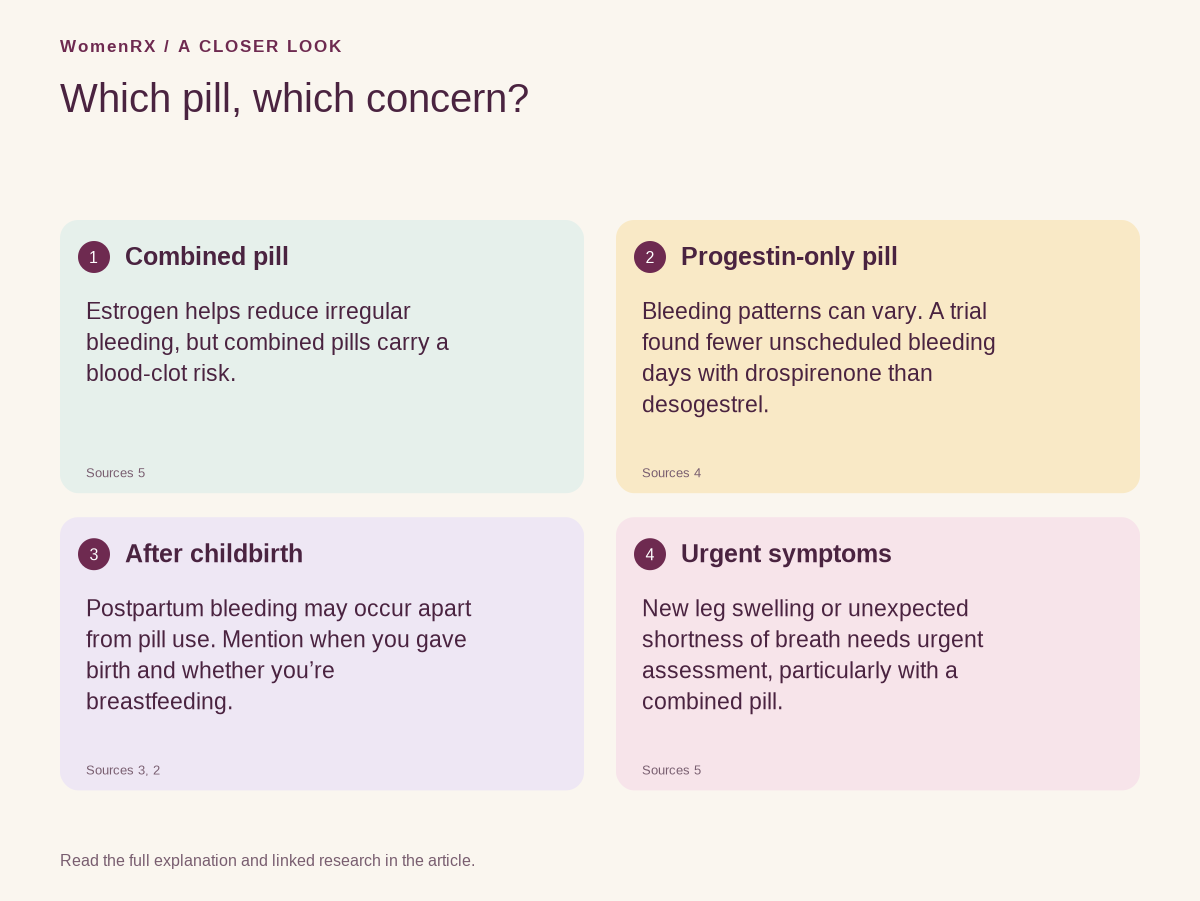
Which pill, which concern?
Combined pill: Estrogen helps reduce irregular bleeding, but combined pills carry a blood-clot risk.5
Progestin-only pill: Bleeding patterns can vary. A trial found fewer unscheduled bleeding days with drospirenone than desogestrel.4
After childbirth: Postpartum bleeding may occur apart from pill use. Mention when you gave birth and whether you’re breastfeeding.32
Urgent symptoms: New leg swelling or unexpected shortness of breath needs urgent assessment, particularly with a combined pill.5
Read the figure as text
The formulation helps separate bleeding questions from symptoms that need urgent attention.- Combined pill: Estrogen helps reduce irregular bleeding, but combined pills carry a blood-clot risk.5
- Progestin-only pill: Bleeding patterns can vary. A trial found fewer unscheduled bleeding days with drospirenone than desogestrel.4
- After childbirth: Postpartum bleeding may occur apart from pill use. Mention when you gave birth and whether you’re breastfeeding.32
- Urgent symptoms: New leg swelling or unexpected shortness of breath needs urgent assessment, particularly with a combined pill.5
More questions, answered
Do all progestin-only pills cause the same amount of spotting?
No. In a trial comparing drospirenone-only and desogestrel-only pills in women ages 18 to 45, the drospirenone group had fewer unscheduled bleeding days. That result shows a difference between two progestin-only formulations; it does not tell us how every progestin-only pill compares with every combined pill.4
Sources you can check
- Birth Control | Contraception | Contraceptives | MedlinePlusAccessed 2026-09-25Return to first citation
- CDC: Birth control methods, barrier methods, fertility awareness and breastfeedingAccessed 2026-09-25Return to first citation
- Postpartum Care: MedlinePlusAccessed 2026-09-25Return to first citation
- Combined Oral Contraceptive Pills Versus Progestin-Only Pills for Heavy Menstrual Bleeding: A Systematic Review.Mohamed GS, Abdalla EM, Karamalla S, Osman TI, Hamid Musa HM, Mohamed H, Ahmed OK, Elshaikh SI, Shafiq MM. · Cureus · 2026Return to first citation
- A Multi-Institutional Informed Consent Proposal as a Prevention Tool for Combined Oral Contraceptive Intake and Thrombotic Risk.Vinciguerra M, Cascardi E, Lamanna B, Marrone M, Pititto F, Macorano E, Sciorio R, Baldini GM, Malvasi A, Ballini A, Cazzato G, Vimercati A, Kumaran S, Cicinelli E, Scacco S, Delli... · Journal of personalized medicine · 2023Return to first citation
- New recommendations on cerebral venous and dural sinus thrombosis from the German consensus-based (S2k) guideline.Weimar C, Beyer-Westendorf J, Bohmann FO, Hahn G, Halimeh S, Holzhauer S, Kalka C, Knoflach M, Koennecke HC, Masuhr F, Mono ML, Nowak-Göttl U, Scherret E, Schlamann M, Linnemann B. · Neurological research and practice · 2024Return to first citation