Choosing Birth Control With PCOS: Start With Your Goal
The best fit depends on whether you most want pregnancy prevention, more predictable bleeding, help with acne or excess hair, or a method without hormones.
If you have PCOS, start with the job you need contraception to do. In trials involving adolescents with PCOS, combined oral contraceptives helped regulate cycles and reduce androgen-related symptoms. An IUD may be more appealing if you want pregnancy prevention without a daily pill. A copper IUD avoids hormones; consider your menstrual and androgen-symptom goals separately. Your health history and pregnancy plans help determine which tradeoffs make sense for you.1267
One condition, several different goals
PCOS can disrupt ovulation, so periods may be irregular or absent. It can also cause acne or extra facial and body hair. These concerns don’t always point to the same contraceptive choice. And irregular ovulation doesn’t mean pregnancy is impossible: many women with PCOS can still get pregnant.2
A useful first question is, What would I most like this method to change? For example, someone bothered by unpredictable bleeding and acne may weigh options differently from someone who mainly wants reliable pregnancy prevention without taking a pill. Contraception can address some PCOS symptoms, but it isn’t a complete treatment for the condition’s metabolic or skin-related concerns.25
If bleeding and androgen symptoms are the priorities
Combined oral contraceptives contain estrogen and progestin. They’re used to manage menstrual irregularity in PCOS. A systematic review of seven randomized trials in adolescents with PCOS found that combined oral contraceptives helped regulate cycles and reduce hyperandrogenic symptoms. The review also raised metabolic concerns, but the trials varied and their findings shouldn’t be treated as a prediction of what will happen to every person taking the pill.16
PCOS can disrupt ovulation, while hormonal birth control may make periods more regular. If your longer-term goal is pregnancy, managing periods with contraception and addressing PCOS-related fertility difficulties are different goals.26
Combined pills won’t be the right choice for everyone. Contraceptive eligibility depends on individual health characteristics and medical conditions. For example, if you have sickle cell disease, ask how it affects the safety of a combined pill; guidance identifies increased safety concerns for that pairing.7
If avoiding a daily combined pill matters more
A progestin-only pill is a distinct pill option: unlike a combined pill, it doesn’t contain estrogen. If predictable bleeding matters to you, ask what is known about bleeding with the particular pill you’re considering rather than assuming it will improve cycles or acne in the same way.16
A hormonal IUD is another contraceptive option that doesn’t require a daily pill. MedlinePlus includes hormonal IUDs among hormonal birth-control approaches that may help with PCOS-related menstrual symptoms, but that broad guidance doesn’t establish that every hormonal method works equally well for acne, excess hair, or predictable bleeding. If one of those is your main concern, ask what evidence applies to the specific method you’re considering.12
For pregnancy prevention, convenience matters too. In a three-year prospective study of contraceptive users ages 18 to 45 who wanted to avoid pregnancy, failure rates were low across the methods studied, including IUDs and pills. Participants chose their methods with counseling and access barriers removed; the study did not report PCOS-specific results. It’s useful evidence about contraception in practice, not proof that one method is best for women with PCOS.8
If you want contraception without hormones
The copper IUD prevents pregnancy without hormones. It may fit if avoiding hormones is your priority; consider PCOS-related irregular cycles, acne, or excess hair as separate goals when comparing methods. CDC guidance lists its typical-use pregnancy rate as 0.8%. Placement requires a clinician.1234
Condoms are another hormone-free option and can help protect against sexually transmitted infections, which most contraceptive methods don’t prevent. They require use each time you have sex, making that practical step part of the decision, not an afterthought.13
When your priorities change
If you’re planning a pregnancy now, contraception is no longer the tool for managing PCOS symptoms; ovulation and fertility become a different conversation. If you’re not trying to conceive, don’t treat missed periods as birth control.2
You also don’t have to make one method carry the whole job. For example, if you prefer an IUD for pregnancy prevention but acne remains your main frustration, PCOS care can address skin symptoms separately. Likewise, menstrual management doesn’t replace attention to metabolic health. The most useful comparison is not simply “Which birth control is best for PCOS?” It’s “Which of my goals will this method meet, and which will need another plan?”25
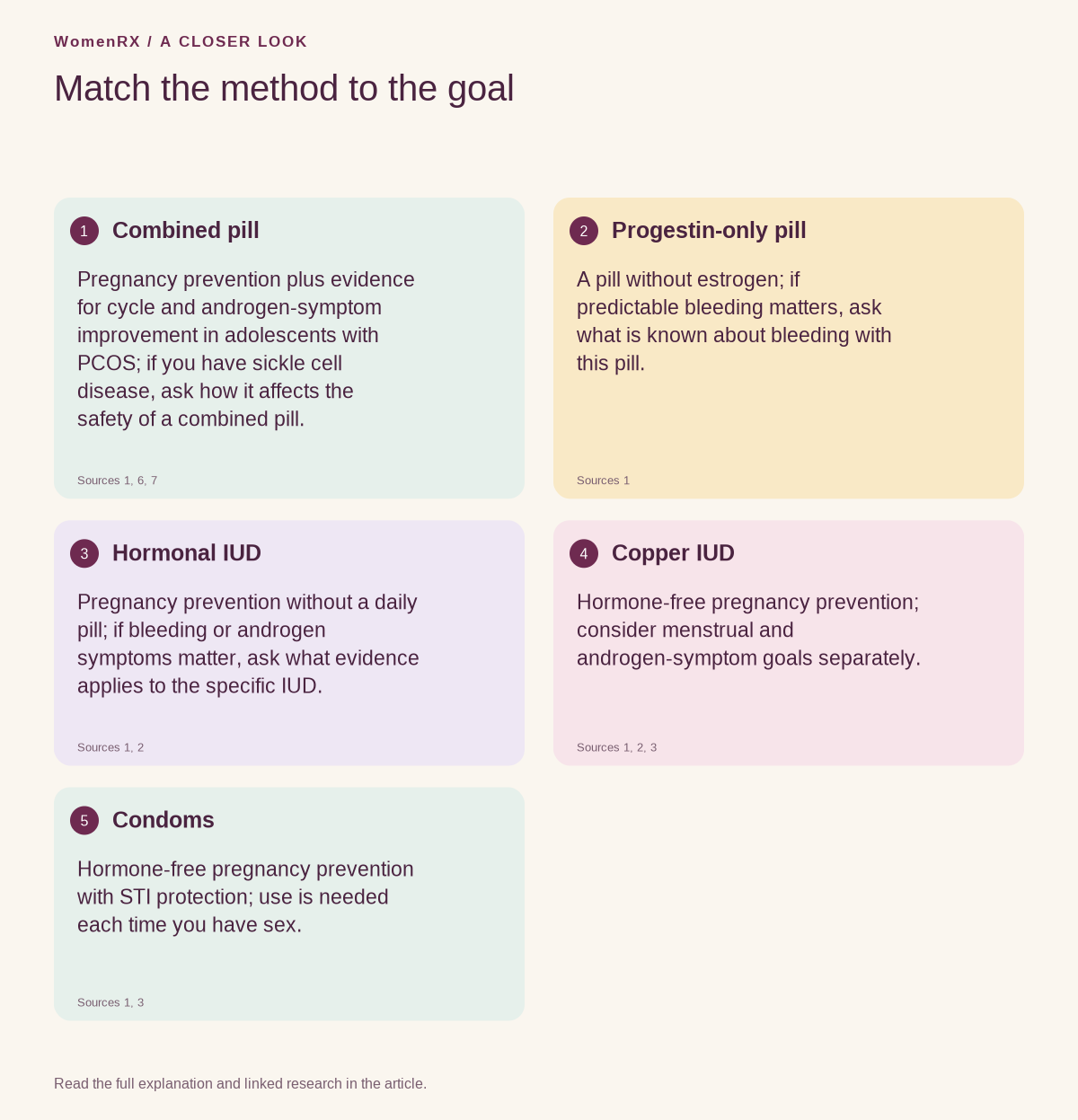
Match the method to the goal
Combined pill: Pregnancy prevention plus evidence for cycle and androgen-symptom improvement in adolescents with PCOS; if you have sickle cell disease, ask how it affects the safety of a combined pill.167
Progestin-only pill: A pill without estrogen; if predictable bleeding matters, ask what is known about bleeding with this pill.1
Hormonal IUD: Pregnancy prevention without a daily pill; if bleeding or androgen symptoms matter, ask what evidence applies to the specific IUD.12
Copper IUD: Hormone-free pregnancy prevention; consider menstrual and androgen-symptom goals separately.123
Condoms: Hormone-free pregnancy prevention with STI protection; use is needed each time you have sex.13
Read the figure as text
These options solve different parts of the PCOS-and-contraception decision; none treats every PCOS concern.- Combined pill: Pregnancy prevention plus evidence for cycle and androgen-symptom improvement in adolescents with PCOS; if you have sickle cell disease, ask how it affects the safety of a combined pill.167
- Progestin-only pill: A pill without estrogen; if predictable bleeding matters, ask what is known about bleeding with this pill.1
- Hormonal IUD: Pregnancy prevention without a daily pill; if bleeding or androgen symptoms matter, ask what evidence applies to the specific IUD.12
- Copper IUD: Hormone-free pregnancy prevention; consider menstrual and androgen-symptom goals separately.123
- Condoms: Hormone-free pregnancy prevention with STI protection; use is needed each time you have sex.13
More questions, answered
Do I need contraception if PCOS makes my periods rare?
Yes, if you have sex that could lead to pregnancy and don’t want to conceive. PCOS may make ovulation irregular, but many women with PCOS can still get pregnant.2
Sources you can check
- Birth Control | Contraception | Contraceptives | MedlinePlusAccessed 2026-09-25Return to first citation
- PCOS | Polycystic Ovary Syndrome | MedlinePlusAccessed 2026-09-25Return to first citation
- CDC: Birth control methods, barrier methods, fertility awareness and breastfeedingAccessed 2026-09-25Return to first citation
- Office on Women's Health: Barrier contraception side effectsAccessed 2026-09-25Return to first citation
- Polycystic ovary syndrome: pragmatic management across levels of care.Arshad A, Armeni E, Broughton S, Ali A, Blendis E, Gleeson H, Robinson L, Kempegowda P. · Gynecological endocrinology : the official journal of the International Society of Gynecological Endocrinology · 2025Return to first citation
- Comparative Efficacy of Metformin and Combined Oral Contraceptives in the Management of Adolescent Polycystic Ovary Syndrome: A Systematic Review of Randomized Controlled Trials.Mandvia A, George R, Kumari K, Kumari K, Sabbagh LI, Bhullar A, Mohamed Ismail D, Kolanu ND, Ali A. · Cureus · 2025Return to first citation
- Using updated clinical recommendations to support contraceptive decision-making: U.S. medical eligibility criteria for contraceptive use, 2024.Curtis KM, Nguyen AT, Tepper NK, Whiteman MK. · Contraception · 2026Return to first citation
- Three-Year Contraceptive Failure Rates During the HER Salt Lake Contraceptive Initiative.Sanders JN, Carter G, Bullington BW, Gero A, Simmons R, Gawron LM, Kaiser JE, Turok DK. · JAMA network open · 2026Return to first citation