Irregular Periods After Birth Control: Could It Be PCOS?
A period change after stopping birth control doesn’t diagnose PCOS; the full cycle pattern and other symptoms matter.
Irregular periods after stopping hormonal birth control don’t, by themselves, establish PCOS. Irregular periods can have several causes, including pregnancy and thyroid problems, and PCOS assessment considers more than periods alone. 1 2 If you remember what your cycles were like before birth control, you can share that as background, but it isn’t proof of a particular cause.
A period change is not a diagnosis
It can feel unsettling when your periods change after you stop birth control, especially if you’re trying to conceive or had regular cycles before using it. The change alone doesn’t establish why it happened. Irregular periods can have several causes, including pregnancy, thyroid problems, changes in weight or exercise, and PCOS. Hormonal contraception is also listed among possible causes of irregular periods. 1
If you remember what your cycles were like before birth control, you can share whether they were regular, widely spaced, or absent. Treat that as background, not as evidence that a returning pattern is PCOS. Irregular periods alone don’t identify the cause.
What makes PCOS more than a period problem?
PCOS can involve irregular or absent ovulation, signs of higher androgen levels, and a particular appearance of the ovaries on ultrasound. A diagnostic framework described in PCOS research looks for at least two of these three features, while also ruling out other possible causes. That’s why irregular periods alone aren’t enough to identify PCOS. 2
A useful assessment considers the whole picture: your cycle pattern, other symptoms, and whether another condition could explain the change. The cited PCOS research describes ruling out conditions such as congenital adrenal hyperplasia, Cushing’s syndrome, and androgen-producing tumors. It doesn’t provide a complete guide to what testing is appropriate for every person, so the assessment depends on the history and findings. 2
Keep track of the pattern, not just the date
Write down the first day of each period and the number of days until the next one. The NHS describes cycles as irregular when the gap is less than 21 days or more than 35 days; a diary or app can help make the pattern clearer. Also note bleeding between periods, periods lasting longer than seven days, and changes such as facial hair, weight gain, tiredness, or dry or oily skin. 1
This record can help distinguish a single unexpected cycle from a recurring pattern. It can also help you describe what you’ve noticed and when. No single cycle pattern, by itself, confirms PCOS.
When an assessment may help
Consider an appointment if your periods are irregular, if you have other symptoms such as increased facial hair, or if you’re struggling to get pregnant. Thyroid problems and PCOS are among the conditions that may be considered when periods are irregular; pregnancy is another possible explanation for a missed period. 1
If you’re trying to conceive, irregular cycles can make it harder to know whether you’re ovulating regularly. If pregnancy isn’t your goal, you can still seek an assessment to understand the change; treatment isn’t always needed, and any treatment depends on the cause. 1
When you seek care, bring your cycle notes and the name of the birth control method you stopped, if you know it. The key question isn’t simply whether your period changed after birth control. It’s whether the full pattern and any other symptoms point to PCOS, another cause, or a change that doesn’t need treatment.
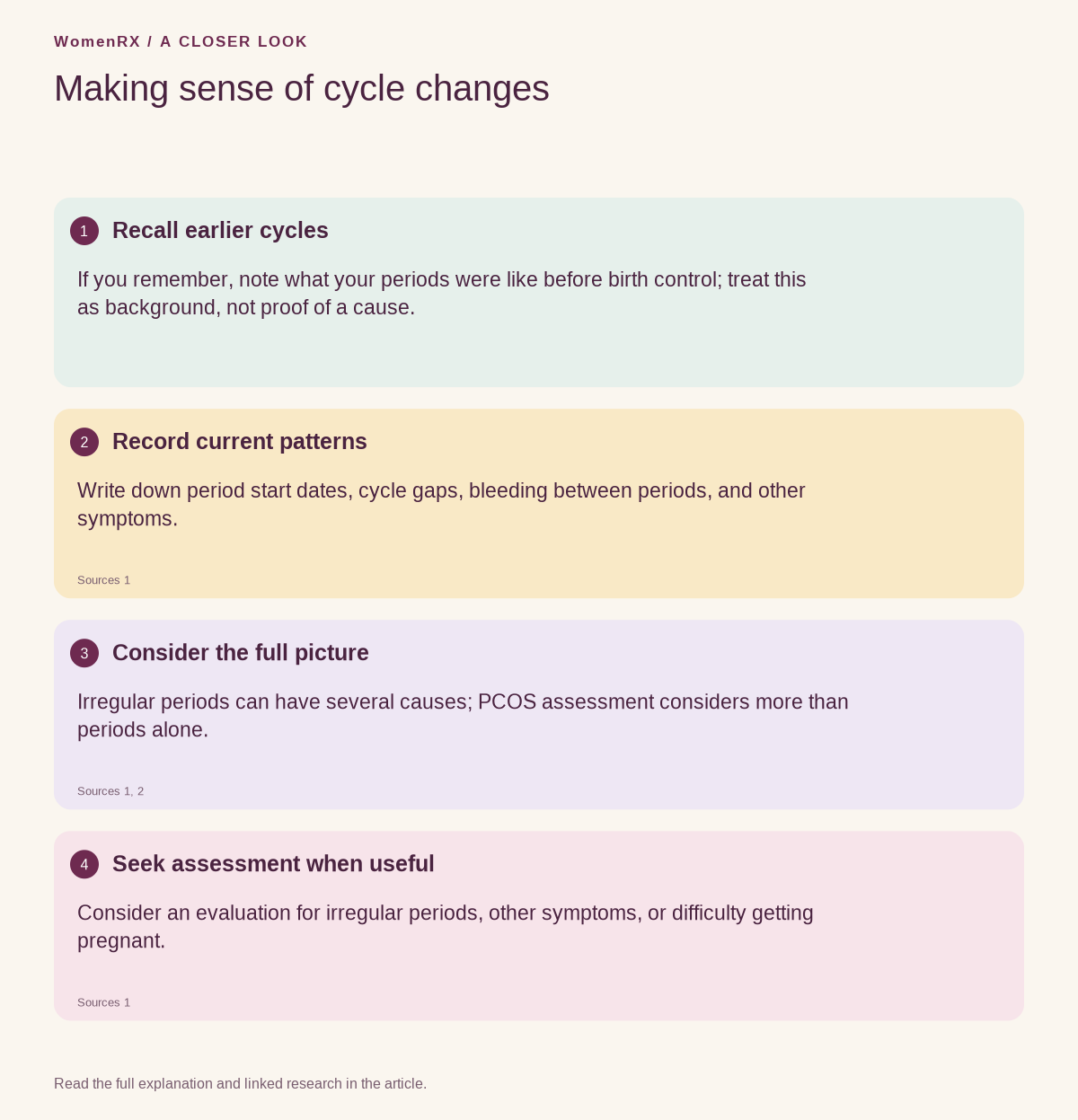
Making sense of cycle changes
Recall earlier cycles: If you remember, note what your periods were like before birth control; treat this as background, not proof of a cause.
Record current patterns: Write down period start dates, cycle gaps, bleeding between periods, and other symptoms.1
Consider the full picture: Irregular periods can have several causes; PCOS assessment considers more than periods alone.12
Seek assessment when useful: Consider an evaluation for irregular periods, other symptoms, or difficulty getting pregnant.1
Read the figure as text
Use these steps to organize what you notice. They don’t set a recovery timeline or diagnose PCOS.- Recall earlier cycles: If you remember, note what your periods were like before birth control; treat this as background, not proof of a cause.
- Record current patterns: Write down period start dates, cycle gaps, bleeding between periods, and other symptoms.1
- Consider the full picture: Irregular periods can have several causes; PCOS assessment considers more than periods alone.12
- Seek assessment when useful: Consider an evaluation for irregular periods, other symptoms, or difficulty getting pregnant.1
More questions, answered
Does an irregular period mean I can’t get pregnant?
Not necessarily. Irregular cycles can mean you don’t ovulate regularly, which can make conception harder, but cycle irregularity alone doesn’t establish whether or when you ovulate. If you’re struggling to conceive, an assessment may help identify the cause. 1
Can birth control itself be linked to irregular periods?
Yes. Hormonal contraception, including some progestin-only methods, is listed among possible causes of irregular periods. That association doesn’t show that contraception caused PCOS or explain why a particular person’s cycle changed after stopping it. 1
Sources you can check
- Irregular periods - NHSAccessed 2026-09-25Return to first citation
- Vitamin D levels and prolonged menstrual cycle in women with polycystic ovary syndrome: a cross-sectional study.Wang L. · Frontiers in nutrition · 2026Return to first citation