Irregular Periods: When to Consider PCOS
Irregular cycles can be one clue to PCOS, but they are not enough to diagnose it.
Irregular periods alone don’t establish PCOS. In adults, diagnosis generally requires at least two of three features: irregular ovulation or cycles, signs or lab evidence of higher androgens, and polycystic ovarian appearance on ultrasound or elevated AMH. Puberty, approaching menopause, thyroid problems, and heavy exercise can also be relevant, so the pattern and your life stage matter. 1 2
Start with the pattern, not a label
A cycle change can be worth discussing without meaning something is wrong. Periods are more likely to be irregular when they first begin and as menopause approaches. Thyroid problems and exercising too much are among the other considerations named in clinical guidance. 1
Write down the first day of each period and how long bleeding lasts. Note the usual gap between periods, the longest gap, and whether your pattern has changed. As one general reference point, gaps under 21 days or over 35 days are described as irregular; those numbers describe a pattern, not a PCOS diagnosis. 1
What points toward PCOS?
For adults, PCOS is generally assessed using three features: irregular cycles or ovulatory dysfunction; clinical or blood-test evidence of higher androgens, such as excess facial or body hair or elevated testosterone; and polycystic ovarian appearance on ultrasound or elevated anti-Müllerian hormone (AMH). At least two features are needed for the criteria described in the research literature. Irregular periods are only one of them. 2
This distinction helps explain why an ultrasound finding alone, or a cycle pattern alone, shouldn’t be treated as a complete answer. Bring up symptoms such as new or increasing facial hair, as well as any hormone-test or imaging results you already have. Those details can help frame the discussion, but they don’t make a diagnosis by themselves. 2
Age and life stage change the picture
If your periods began recently, mention how old you were when they started and how many years it has been. In adolescence, normal pubertal changes can overlap with PCOS features. Reviews of adolescent guidance describe a more cautious approach: persistent menstrual irregularity together with hyperandrogenism is central to diagnosis, while a young person with only one feature may be considered at risk and reassessed later. 3 4
Also mention whether pregnancy is possible and whether you have recently given birth, including roughly when. These details add context when you describe a cycle change, but they do not by themselves establish PCOS.
If you are closer to menopause, include any other changes in your usual pattern. Irregular periods are more common near menopause, but a change from your own baseline is still useful to mention. 1
Other explanations deserve a place in the conversation
PCOS is not the only possible explanation for irregular cycles. Thyroid problems are one named alternative; puberty, approaching menopause, and exercising too much can also be associated with irregular periods. 1 A clinician may consider other hormonal explanations as well, because irregular cycles and androgen-related features can have overlapping causes. 5
The point isn’t to arrive with a list of diagnoses. It’s to share what has changed and what else is happening: cycle dates, exercise changes, symptoms such as facial hair or tiredness, and any relevant health history. Pregnancy possibility and postpartum timing belong in that history too, even though they do not by themselves establish PCOS.
When an assessment is reasonable
Consider arranging an assessment if your periods are irregular or your usual pattern changes, especially if you also have facial hair growth, weight gain, tiredness, or skin changes. Guidance also recommends seeking assessment for bleeding between periods, periods lasting longer than seven days, or irregular cycles alongside difficulty getting pregnant. These are reasons to discuss what may be happening, not proof of PCOS. 1
You can bring a short record rather than trying to interpret every cycle: period start dates and duration, when the pattern changed, age at first period, pregnancy possibility, postpartum timing, and any associated symptoms or major exercise changes. The next useful step is a discussion of possible causes, not a self-diagnosis.
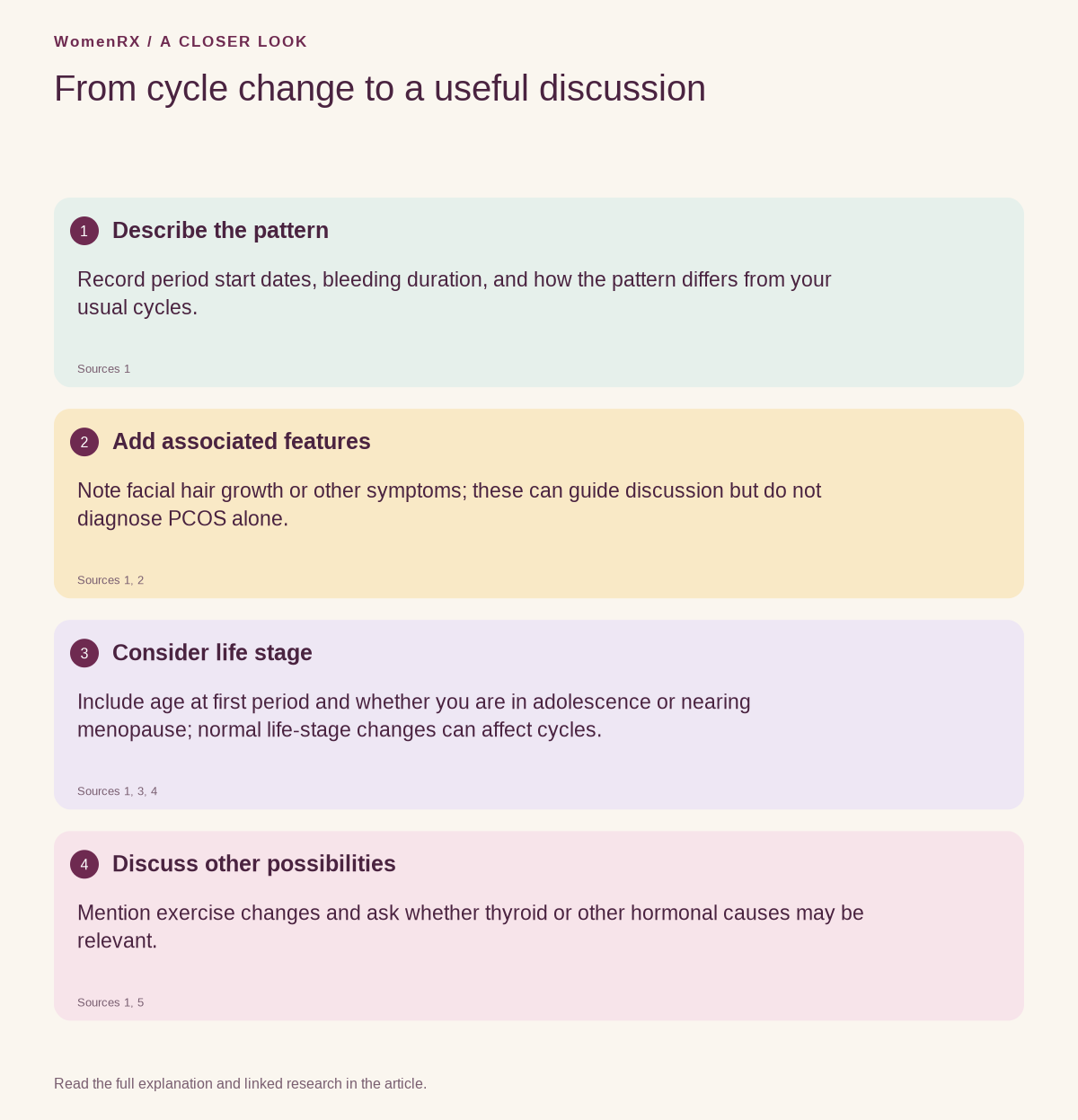
From cycle change to a useful discussion
Describe the pattern: Record period start dates, bleeding duration, and how the pattern differs from your usual cycles.1
Add associated features: Note facial hair growth or other symptoms; these can guide discussion but do not diagnose PCOS alone.12
Consider life stage: Include age at first period and whether you are in adolescence or nearing menopause; normal life-stage changes can affect cycles.134
Discuss other possibilities: Mention exercise changes and ask whether thyroid or other hormonal causes may be relevant.15
Read the figure as text
Use this path to organize what you notice and what to share; it does not diagnose PCOS.- Describe the pattern: Record period start dates, bleeding duration, and how the pattern differs from your usual cycles.1
- Add associated features: Note facial hair growth or other symptoms; these can guide discussion but do not diagnose PCOS alone.12
- Consider life stage: Include age at first period and whether you are in adolescence or nearing menopause; normal life-stage changes can affect cycles.134
- Discuss other possibilities: Mention exercise changes and ask whether thyroid or other hormonal causes may be relevant.15
More questions, answered
Can irregular periods by themselves mean I have PCOS?
No. Irregular cycles are one of the features used in adult PCOS criteria, but at least two of three features are generally needed. 2
Does an irregular cycle mean something is wrong?
Not necessarily. Irregularity is more common when periods first begin and as menopause approaches, and it can have other explanations. A change from your usual pattern or associated symptoms can still be worth discussing. 1
Sources you can check
- Irregular periods - NHSAccessed 2026-09-25Return to first citation
- A machine learning approach for non-invasive PCOS diagnosis from ultrasound and clinical features.Agirsoy M, Oehlschlaeger MA. · Scientific reports · 2025Return to first citation
- Approach to the diagnosis and treatment of polycystic ovarian syndrome in adolescent patients.Machado IFR, Tinano FR, Latronico AC, Gomes LG. · The Journal of clinical endocrinology and metabolism · 2026Return to first citation
- Practical considerations for diagnosis and treatment of polycystic ovary syndrome in adolescence - distilling guidelines into clinical practice.DiVall SA. · Current opinion in pediatrics · 2023Return to first citation
- Correlation Between Athlete Status and Clinical Features of Polycystic Ovary Syndrome in Collegiate Females.Hibshman L, Schlehr M, Rueger C, Quint N, Speelman D. · Cureus · 2025Return to first citation