Could Irregular Periods or Acne Be PCOS?
PCOS is diagnosed from a combination of features, not from acne or an ultrasound finding alone.
In adults, clinicians generally look for at least two of three features: irregular or absent ovulation, signs or blood-test evidence of higher androgens, and a polycystic pattern on ovarian imaging, after considering other explanations. If irregular cycles and androgen excess are both present, imaging may not be needed to meet the criteria. In teens, normal puberty-related cycle changes make timing and interpretation more careful. 1 5 7
What counts toward a PCOS diagnosis?
PCOS has no single test that confirms it. In adults, the diagnostic approach usually combines at least two of three features: irregular or absent ovulation, clinical or blood-test evidence of higher androgen levels, and a polycystic pattern on ovarian imaging. Other possible causes of the symptoms should also be considered. 1 6 7
That combination matters. Irregular periods by themselves don’t establish PCOS, and neither does an ultrasound report by itself. If someone has both irregular cycles and signs of androgen excess, the third feature, an ultrasound finding, may not be needed to meet the criteria. 1 6
Androgens are hormones everyone produces, though levels and effects differ. Higher androgen levels can contribute to coarse facial or body hair. Acne can occur with hormonal changes, but acne alone is not enough to diagnose PCOS. Sudden acne in adulthood is more suggestive of a possible hormonal issue when it appears alongside symptoms such as excess facial or body hair or irregular periods. 1 2 3
The word “cysts” can also be confusing. The ovarian appearance involved in PCOS refers to a pattern of follicles, and it is only one possible diagnostic feature. It doesn’t mean that a scan alone proves someone has the syndrome. 1 6
Period patterns depend on age
Some cycle variation is expected soon after periods begin. The 2023 international guideline describes irregular cycles as normal during the first year after a first period. From one to fewer than three years after the first period, cycles shorter than 21 days or longer than 45 days are considered irregular; from three years after the first period through perimenopause, the thresholds are shorter than 21 days, longer than 35 days, or fewer than eight cycles a year. A cycle longer than 90 days after the first year is also a reason to assess the pattern. These definitions help guide assessment; they don’t diagnose PCOS on their own. 5
For adolescents, the guideline recommends discussing the value and timing of assessment with the young person and, when appropriate, a parent or guardian, taking the challenges of diagnosis at this life stage into account. A clinician may consider whether it’s better to assess now or revisit the question as cycle patterns become clearer. 5
In adulthood, a new or changing pattern still deserves context. Pregnancy, hormonal contraception, thyroid problems, and changes such as very intense exercise can also be associated with irregular periods. A clinician can use the history and, when appropriate, blood tests to sort through possible explanations rather than assume every irregular cycle is PCOS. 1 4
What an assessment may involve
A clinician may ask about cycle timing, acne, hair growth, and other changes, and may order blood tests that check hormone levels. Depending on what’s going on, they may consider other conditions that can affect periods or androgen levels. Thyroid problems are one possible explanation for irregular cycles; other hormone disorders may also need consideration when symptoms overlap. The right evaluation depends on the pattern, not on one symptom in isolation. 1 4 7
Body size isn’t one of the diagnostic features. A person can’t be diagnosed from body size, acne, or ovarian appearance alone; the diagnosis depends on the combination of features and the assessment of other possible causes. 1 6
A diagnosis isn’t a prediction about fertility
PCOS can make ovulation less regular, which can make it harder to predict fertile days and may make getting pregnant more difficult for some people. But a PCOS diagnosis doesn’t mean you can’t get pregnant: many women with PCOS do. The diagnosis describes a set of hormonal and reproductive features, not a guaranteed fertility outcome. 1
If your periods are persistently irregular, or irregular periods come with new facial or body hair or adult-onset acne, those details can help a clinician decide what to assess. The aim is to understand the pattern and its cause, not to label a single symptom as PCOS. 2 4
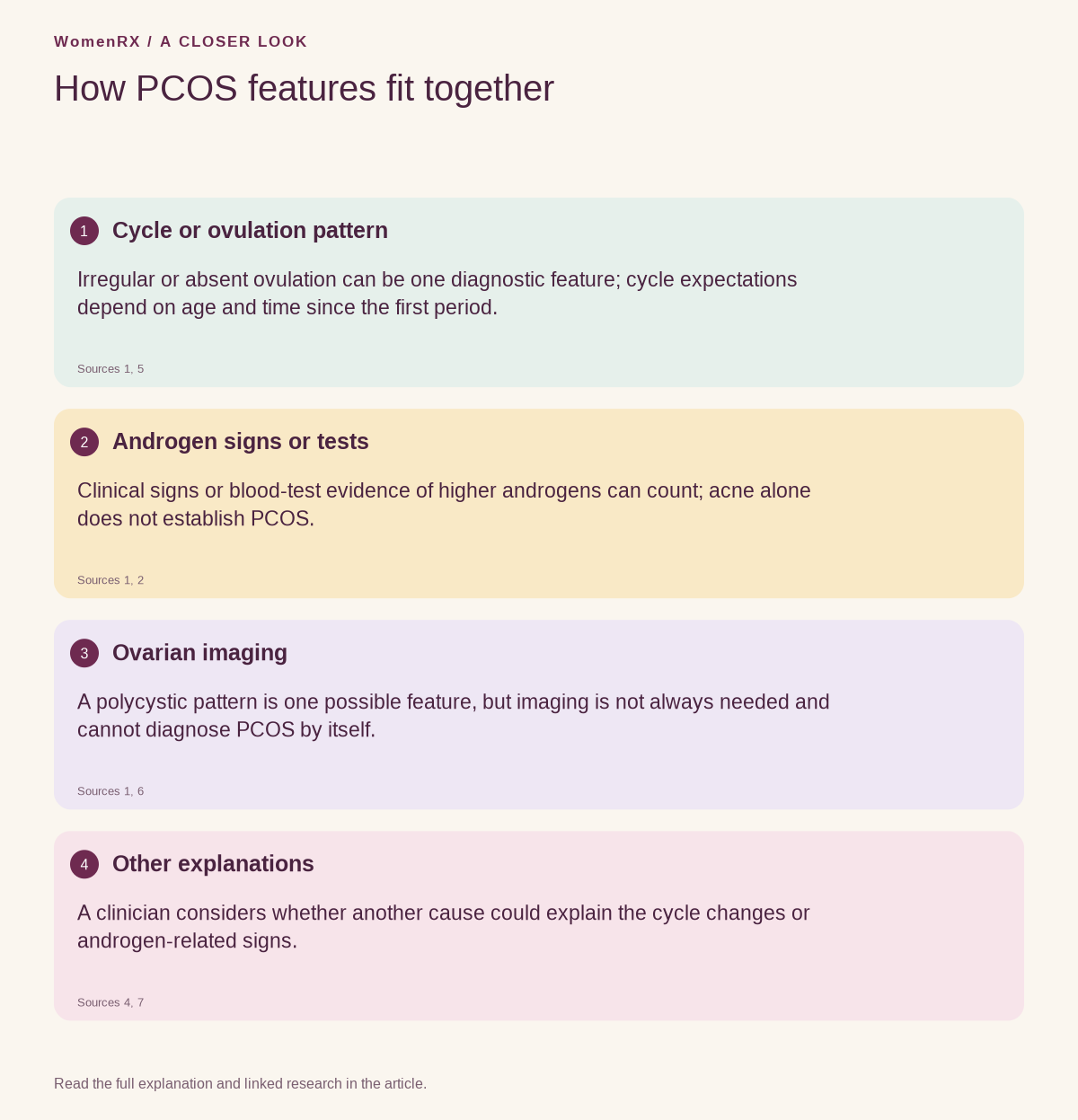
How PCOS features fit together
Cycle or ovulation pattern: Irregular or absent ovulation can be one diagnostic feature; cycle expectations depend on age and time since the first period.15
Androgen signs or tests: Clinical signs or blood-test evidence of higher androgens can count; acne alone does not establish PCOS.12
Ovarian imaging: A polycystic pattern is one possible feature, but imaging is not always needed and cannot diagnose PCOS by itself.16
Other explanations: A clinician considers whether another cause could explain the cycle changes or androgen-related signs.47
Read the figure as text
A diagnosis uses a combination of findings. These features are not all required, and other possible causes may need consideration.- Cycle or ovulation pattern: Irregular or absent ovulation can be one diagnostic feature; cycle expectations depend on age and time since the first period.15
- Androgen signs or tests: Clinical signs or blood-test evidence of higher androgens can count; acne alone does not establish PCOS.12
- Ovarian imaging: A polycystic pattern is one possible feature, but imaging is not always needed and cannot diagnose PCOS by itself.16
- Other explanations: A clinician considers whether another cause could explain the cycle changes or androgen-related signs.47
More questions, answered
Does having PCOS mean I’ll be infertile?
No. PCOS is a common cause of fertility difficulty, partly because ovulation can be irregular, but many women with PCOS can still get pregnant. A diagnosis alone can’t predict an individual person’s fertility. 1
Can an ultrasound diagnose PCOS by itself?
No. Ovarian appearance is one feature in a combination-based diagnosis. An ultrasound finding alone doesn’t establish PCOS, and imaging may not be needed when other diagnostic features are already present. 1 6
Sources you can check
- PCOS | Polycystic Ovary Syndrome | MedlinePlusAccessed 2026-09-25Return to first citation
- Acne - Diagnosis - NHSAccessed 2026-09-25Return to first citation
- Acne - Causes - NHSAccessed 2026-09-25Return to first citation
- Irregular periods - NHSAccessed 2026-09-25Return to first citation
- Recommendations from the 2023 International Evidence-based Guideline for the Assessment and Management of Polycystic Ovary Syndrome†.Teede HJ, Tay CT, Laven J, Dokras A, Moran LJ, Piltonen TT, Costello MF, Boivin J, Redman LM, Boyle JA, Norman RJ, Mousa A, Joham AE, International PCOS Network. · Human reproduction (Oxford, England) · 2023Return to first citation
- The Effect of Free Androgen Index on the Quality of Life of Women With Polycystic Ovary Syndrome: A Cross-Sectional Study.Abdalla MA, Deshmukh H, Mohammed I, Atkin S, Reid M, Sathyapalan T. · Frontiers in physiology · 2021Return to first citation
- Correlation Between Athlete Status and Clinical Features of Polycystic Ovary Syndrome in Collegiate Females.Hibshman L, Schlehr M, Rueger C, Quint N, Speelman D. · Cureus · 2025Return to first citation