PCOS Weight Management: Measure More Than Pounds
PCOS care can target cycles, metabolic health, fertility, or weight, and those goals don’t always call for the same approach.
Weight loss isn’t the only way to approach PCOS, and it isn’t the right measure for every goal. Healthy eating is one option described for PCOS; a small study in infertile women with PCOS and overweight or obesity also examined coaching that included physical activity. Medicines may address particular symptoms or insulin resistance, while fertility care has its own outcomes. Judge progress by the goal you’re targeting, not the scale alone. 1 2 5
Start with the outcome you want
PCOS can involve irregular or absent periods, higher androgen levels, and insulin resistance, but people’s symptoms differ. That means “manage my PCOS” may mean different things: making periods more regular, addressing acne or excess hair, improving blood sugar, preparing for pregnancy, or changing weight. It’s reasonable to name your priority before weighing options. 1
Weight is one health measure, not a complete report card. It includes muscle, bone, fat, and water, and it can’t show changes in all of those separately. Depending on your goal, a more useful check-in might include menstrual patterns, symptoms such as acne, relevant blood tests, or waist measurement as well as weight. 1 2
If your focus is metabolic health
Insulin resistance is one factor that may be involved in PCOS, and women with PCOS are among those at increased risk of metabolic syndrome. These concerns can exist even when weight isn’t your main goal. Fasting blood sugar, blood pressure, and cholesterol are examples of measures you could ask about rather than relying on weight to stand in for metabolic health. 1 3
MedlinePlus lists eating healthy foods among PCOS treatment options. Physical activity was part of a coaching study in 78 infertile women with PCOS and overweight or obesity, but that study’s results should be understood in that specific group. The practical question for you is what outcome an approach is meant to support, and whether it fits your preferences and life well enough to continue. 1 5
In that study, the coaching group improved more than the routine-care group on waist circumference and reported physical activity. The difference in weight change between groups was not statistically significant. Those findings make waist and activity useful outcomes to discuss; they don’t show that coaching reliably produces additional weight loss. 5
MedlinePlus describes insulin-sensitizing medicines as improving insulin resistance and helping keep blood glucose steady; they may also lower androgen levels. Those potential effects aren’t a guarantee that a particular medicine will change your weight, cycles, or symptoms in a specific way. 1
A useful check-in is specific: “Are we trying to improve glucose measures, reduce symptoms, change weight, or more than one of these?” Then agree on how you’ll recognize progress for that goal. If weight changes but the measure you care about doesn’t, that’s useful information, not a reason to assume you’ve failed.
If your focus is periods, acne, or excess hair
These concerns may call for treatments aimed directly at symptoms rather than weight. MedlinePlus describes hormonal birth control as an option that can make periods more regular and may help with acne and extra facial or body hair. It’s an option only if you’re not currently trying to get pregnant. Anti-androgen medicines may also be used for acne, hair growth, or hair loss, but they can cause problems during pregnancy; pregnancy plans therefore matter to the choice. 1
In other words, a weight-management plan and a symptom-treatment plan aren’t interchangeable. If your main concern is unpredictable periods or unwanted hair, ask what treatment is intended to improve that symptom and how you’ll assess whether it is working. Weight change alone may not answer that question.
If you’re hoping to become pregnant
Say so when discussing treatment. Some options used for cycle or androgen symptoms aren’t suitable when pregnancy is the immediate goal. PCOS is a common cause of infertility, but many women with PCOS can still become pregnant. 1
Research about weight-focused programs and fertility also needs careful reading. In one randomized trial, 127 women aged 18 to 40 with infertility and either obesity or overweight with PCOS (BMI of at least 30, or at least 27 for participants with PCOS) were assigned to a six-month lifestyle program before fertility treatment or usual fertility care. The group offered the program lost more weight by six months, but the study did not show a statistically clear increase in live births within 18 months. Natural pregnancy was more frequent in the intervention group, but the trial included women with and without PCOS and did not report a separate PCOS result. It can inform a conversation, but it doesn’t establish what a weight-loss program will do for fertility for an individual woman with PCOS. 4
Ask whether a proposed plan is meant to support general health, change a particular PCOS symptom, or improve fertility outcomes. Those are distinct aims, and a change in one doesn’t automatically prove a change in another.
Make progress meaningful, not scale-only
Choose a measure that matches your goal. For cycle symptoms, that could be whether periods become more regular. For metabolic health, ask whether fasting blood sugar, blood pressure, or cholesterol is relevant to follow. For weight management, weight or waist measurement may be part of the picture, but neither describes your whole health. 1 2 3
It’s also reasonable to revisit the plan if it feels unsustainable or isn’t helping the outcome you chose. PCOS care can include lifestyle approaches and medicines for specific symptoms; match the approach to your priorities and assess the outcome directly. 1
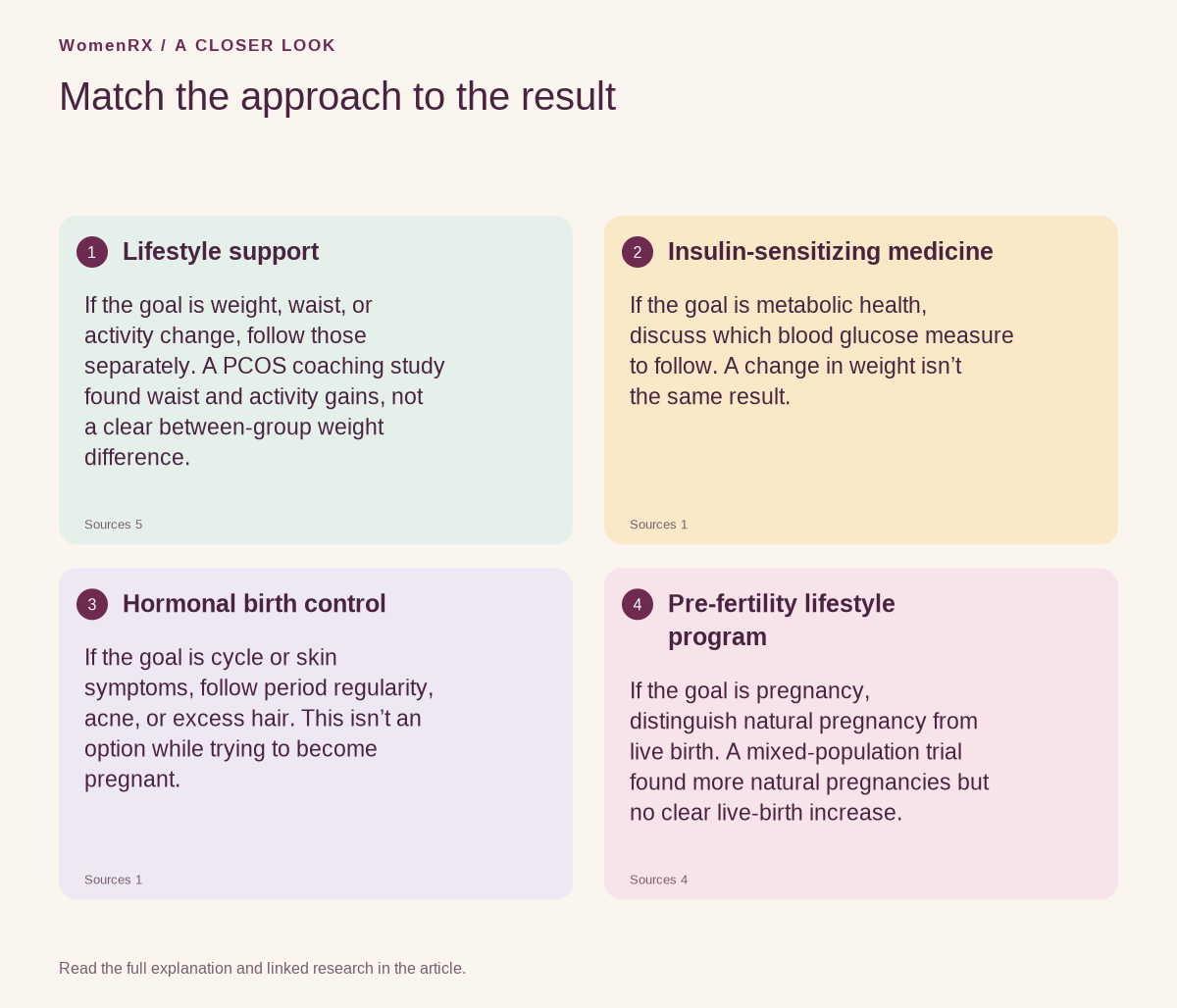
Match the approach to the result
Lifestyle support: If the goal is weight, waist, or activity change, follow those separately. A PCOS coaching study found waist and activity gains, not a clear between-group weight difference.5
Insulin-sensitizing medicine: If the goal is metabolic health, discuss which blood glucose measure to follow. A change in weight isn’t the same result.1
Hormonal birth control: If the goal is cycle or skin symptoms, follow period regularity, acne, or excess hair. This isn’t an option while trying to become pregnant.1
Pre-fertility lifestyle program: If the goal is pregnancy, distinguish natural pregnancy from live birth. A mixed-population trial found more natural pregnancies but no clear live-birth increase.4
Read the figure as text
Each approach has an intended outcome. The measure you follow should reflect that outcome, not just weight.- Lifestyle support: If the goal is weight, waist, or activity change, follow those separately. A PCOS coaching study found waist and activity gains, not a clear between-group weight difference.5
- Insulin-sensitizing medicine: If the goal is metabolic health, discuss which blood glucose measure to follow. A change in weight isn’t the same result.1
- Hormonal birth control: If the goal is cycle or skin symptoms, follow period regularity, acne, or excess hair. This isn’t an option while trying to become pregnant.1
- Pre-fertility lifestyle program: If the goal is pregnancy, distinguish natural pregnancy from live birth. A mixed-population trial found more natural pregnancies but no clear live-birth increase.4
More questions, answered
Does weight change tell me whether my PCOS symptoms have improved?
Not by itself. A change on the scale doesn’t establish whether your periods, androgen-related symptoms, or metabolic concerns have changed. Check the outcome you care about directly, such as menstrual patterns, symptoms, or relevant test results. 1 2
Can I discuss PCOS treatment if I’m not trying to lose weight?
Yes. Treatment options can target concerns such as irregular periods, acne, excess hair, or insulin resistance. Tell your clinician which outcome matters most to you so the options can be discussed in that context. 1
Sources you can check
- PCOS | Polycystic Ovary Syndrome | MedlinePlusAccessed 2026-09-25Return to first citation
- Body Weight: MedlinePlusAccessed 2026-09-25Return to first citation
- Metabolic Syndrome | MedlinePlusAccessed 2026-09-25Return to first citation
- Lifestyle intervention before and during fertility treatment in women with obesity or with overweight and PCOS-a RCT.Belan M, Giguère-Johnson M, Carranza-Mamane B, Pesant MH, AinMelk Y, Langlois MF, Lavoie H, Greenblatt EM, Laredo S, Sagle M, Waddell G, Jean-Denis F, Baillargeon JP. · The Journal of clinical endocrinology and metabolism · 2026Return to first citation
- Impact of a health coaching intervention on anthropometric indicators, physical activity, and life style of infertile women with polycystic ovary syndrome: A quasi-experimental study.Delavar MA, Delavar MA, Ghadimi R, Esmaeilzadeh S, Amiri M. · BMC research notes · 2025Return to first citation