Can Diet Balance Hormones? PCOS and Menopause Evidence
Food choices may support specific PCOS or menopause goals, but the evidence doesn’t show one diet can regulate hormones across both conditions.
“Hormone balancing” is too broad to be a useful nutrition goal. The PCOS guidance discussed here includes healthy eating as part of management, while a trial compared dietary adjustment alone with dietary adjustment plus Tai Chi; neither tests a named diet as a standalone treatment for PCOS hormones. For postmenopausal hot flashes, one small randomized trial found symptom improvement with a combined low-fat, vegan diet and daily soybeans. 1 4 5
Start with the outcome, not the hormone claim
“Hormone balance” can sound like a single measurable problem, but PCOS and menopause involve different changes and different goals. With PCOS, a useful nutrition question might be whether an eating pattern supports metabolic health. During menopause, it might be whether a specific approach eases hot flashes. Evidence for one outcome in one group of women doesn’t automatically apply to another.
PCOS can involve irregular or absent periods, higher androgen levels, and insulin resistance, but not everyone has the same symptoms or health concerns. Insulin resistance is one factor associated with PCOS, not a complete explanation of the condition. 1 5
PCOS: don’t mistake a metabolic target for a hormone cure
Because insulin resistance is relevant to PCOS, it can be tempting to assume that a named diet will lower androgens, restore regular periods, or “balance” hormones. The PCOS guidance discussed here includes healthy eating as part of management, while the trial described below compares dietary adjustment alone with dietary adjustment plus Tai Chi. Neither source tests a named diet as a standalone treatment for androgen levels or all PCOS symptoms. 1 5
One randomized trial enrolled 120 female college students with PCOS in China and compared dietary adjustment alone with dietary adjustment plus Tai Chi. In the analysis reported, the combined group had a larger reduction in testosterone than the diet-adjustment group. But the study can’t tell us that diet caused that difference: the groups differed in exercise, and the study’s dietary-nutrition measure did not show a significant time-by-group effect. The results also came from young students, so they shouldn’t be treated as a universal PCOS prescription. 5
A practical takeaway is to choose an eating approach for a clear, personal goal, such as supporting general health or managing a metabolic concern, rather than expecting it to correct all PCOS-related hormone patterns. A varied, sustainable eating pattern is a more grounded starting point than a restrictive “hormone reset” promise. 1 2
Menopause: one trial tested hot flashes, not hormone balance
A randomized trial studied 84 postmenopausal women who reported at least two moderate-to-severe hot flashes a day. Participants were assigned either to make no dietary changes or to follow a combined intervention: a low-fat vegan diet that included cooked soybeans daily. Over 12 weeks, moderate-to-severe hot flashes decreased by 88% in the intervention group and 34% in the control group. These are changes within each group, not evidence that the diet balanced hormones. 4
The result is promising for the specific symptom and group studied, but it doesn’t tell us whether soybeans, eating less fat, the broader plant-based pattern, or a combination drove the improvement. Nor does a trial in postmenopausal women establish the same result for every person in perimenopause. The study measured symptoms and menopause-related quality of life, not hormone levels as proof of “balance.” 4
A separate 45-day trial in 82 postmenopausal women in Hyderabad tested a package of lifestyle changes that included nutrition, physical activity, stress management, and other domains. Symptoms improved in the intervention group, but because several parts were combined, the results can’t show that nutrition alone caused the change. 3
A useful way to judge a nutrition claim
Before changing how you eat for a hormone-related concern, ask three questions: Which condition was studied? Which outcome changed, such as hot flashes, testosterone, or a metabolic marker? And was food tested by itself, or as part of a larger program? Those details help separate a relevant finding from a claim that stretches the evidence.
diet can be part of caring for your health, and a specific dietary approach may help a specific symptom for some women. But PCOS and menopause are not interchangeable, and this research doesn’t support one diet as a general hormone-balancing treatment.
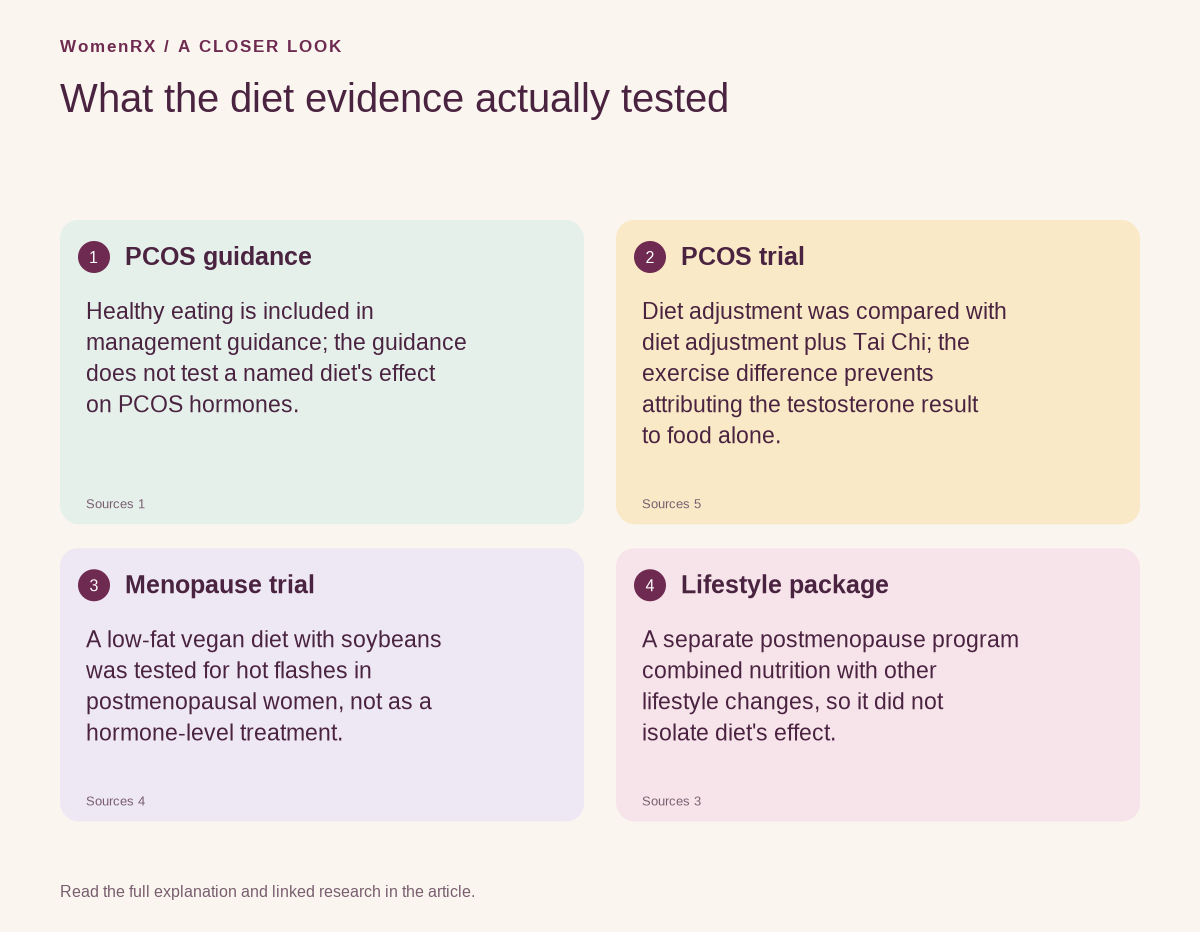
What the diet evidence actually tested
PCOS guidance: Healthy eating is included in management guidance; the guidance does not test a named diet's effect on PCOS hormones.1
PCOS trial: Diet adjustment was compared with diet adjustment plus Tai Chi; the exercise difference prevents attributing the testosterone result to food alone.5
Menopause trial: A low-fat vegan diet with soybeans was tested for hot flashes in postmenopausal women, not as a hormone-level treatment.4
Lifestyle package: A separate postmenopause program combined nutrition with other lifestyle changes, so it did not isolate diet's effect.3
Read the figure as text
Compare the condition, intervention, and outcome before applying a nutrition claim to yourself.- PCOS guidance: Healthy eating is included in management guidance; the guidance does not test a named diet's effect on PCOS hormones.1
- PCOS trial: Diet adjustment was compared with diet adjustment plus Tai Chi; the exercise difference prevents attributing the testosterone result to food alone.5
- Menopause trial: A low-fat vegan diet with soybeans was tested for hot flashes in postmenopausal women, not as a hormone-level treatment.4
- Lifestyle package: A separate postmenopause program combined nutrition with other lifestyle changes, so it did not isolate diet's effect.3
More questions, answered
Does the menopause trial show soy balances estrogen?
No. It tested a combined diet and measured hot flashes and quality-of-life symptoms, not whether soy changed hormone levels or whether soy alone caused the improvement. 4
Sources you can check
- PCOS | Polycystic Ovary Syndrome | MedlinePlusAccessed 2026-09-25Return to first citation
- Nutrition: MedlinePlusAccessed 2026-09-25Return to first citation
- Effect of health-promoting behaviors and menopausal symptoms of urban women of Hyderabad: A randomized controlled trial.Bala S, Komarraju SL, Dasarathan S, Muralidharan S. · Journal of biological methods · 2024Return to first citation
- A dietary intervention for vasomotor symptoms of menopause: a randomized, controlled trial.Barnard ND, Kahleova H, Holtz DN, Znayenko-Miller T, Sutton M, Holubkov R, Zhao X, Galandi S, Setchell KDR. · Menopause (New York, N.Y.) · 2023Return to first citation
- Effects of Tai Chi combined with dietary intervention on health-promoting lifestyle and metabolic and reproductive outcomes in female college students with polycystic ovary syndrome: a randomized controlled trial.Ren J, Chen H, Zhang L, Cui C, Wang L, He Q, Feng Y, Liang L. · Frontiers in endocrinology · 2026Return to first citation