Hormone Balance Supplements: Start With the Symptom
A supplement’s usefulness depends on the symptom or diagnosed condition it targets, not a broad promise to “balance” hormones.
“Hormone balance” isn’t a specific health condition, so the phrase alone can’t tell you whether a supplement is likely to help. For menopause-related hot flashes and night sweats, a 2023 North American Menopause Society statement does not recommend supplements or herbal remedies. PCOS calls for a different, symptom-specific question: first clarify whether PCOS is present and what you want help with. 1 3
Replace the broad claim with a specific question
Hormones have different roles, and a supplement that affects one measure, or is marketed as “hormone balancing”, hasn’t necessarily been shown to improve a symptom. Before considering a product, pin down the claim: Is it meant to reduce hot flashes, make periods more regular, ease acne, support fertility, or treat a diagnosed condition? Those are different goals, and evidence for one doesn’t establish evidence for the others.
A useful product check is to ask what outcome was studied, in whom, and compared with what. Evidence in people with a diagnosed condition is more relevant to that condition than a general claim about “hormone balance.” Also look for whether the result was a change in a lab measurement or a difference you might actually notice, such as fewer bothersome hot flashes.
If the concern is PCOS, clarify the diagnosis and goal
Polycystic ovary syndrome can involve reproductive, metabolic, and psychological features. Possible concerns include irregular periods, acne or excess facial and body hair, and difficulty getting pregnant, but one symptom by itself doesn’t establish PCOS. There isn’t one specific test; evaluation may include your health history, an exam, and blood tests. 1 4
That matters when judging supplements: a product’s general promise to “balance hormones” doesn’t tell you whether it has been shown to help with a particular PCOS concern. Ask what outcome the claim refers to and whether evidence applies to people with PCOS. The PCOS reference describes care aimed at managing symptoms, including healthy eating and medicines selected for particular concerns. It does not establish a general hormone-balancing supplement as treatment. 1
If period changes, acne, unwanted facial or body hair, or fertility concerns are what prompted your search, identifying the cause can make the next step more useful than choosing a product based on a broad label. PCOS is one possible explanation, not the only one. 1
If you’re in menopause, separate hot flashes from other symptoms
For menopause-related hot flashes and night sweats, the 2023 North American Menopause Society statement does not recommend dietary supplements or herbal remedies. That’s a conclusion about their use for vasomotor symptoms, not proof that every supplement is ineffective for every purpose. Soy foods and soy extracts are separately listed among options not recommended for these symptoms. 3
Menopause hormone therapy is a different category from a dietary supplement. The Society’s 2022 position statement describes hormone therapy as the most effective treatment for vasomotor symptoms and genitourinary symptoms of menopause. It also says benefits and risks depend on factors such as age, time since menopause, treatment type, and duration, so the decision is individualized. 2
If vaginal or urinary symptoms are your main concern, don’t assume evidence about hot flashes answers that question. The position statement discusses distinct options for bothersome genitourinary symptoms, including low-dose vaginal estrogen or other therapies in some circumstances. 2
A quick way to assess the label
Before buying a product, try to find clear answers to four questions:
- Which symptom or diagnosed condition is it for? A broad hormone claim isn’t a defined outcome.
- What changed in the study? A lab result isn’t automatically the same as symptom relief.
- Who was studied? Evidence in a different population may not apply to your situation.
- Does a relevant guideline support it for that symptom? For menopause hot flashes and night sweats, the 2023 statement does not recommend supplements or herbal remedies. 3
If the label doesn’t name a specific outcome, or the evidence you find concerns a different condition or life stage, you don’t have a clear reason to expect that product to address your concern. Narrowing the question to one symptom, or first finding out what may be causing it, gives you a more useful basis for comparing options.
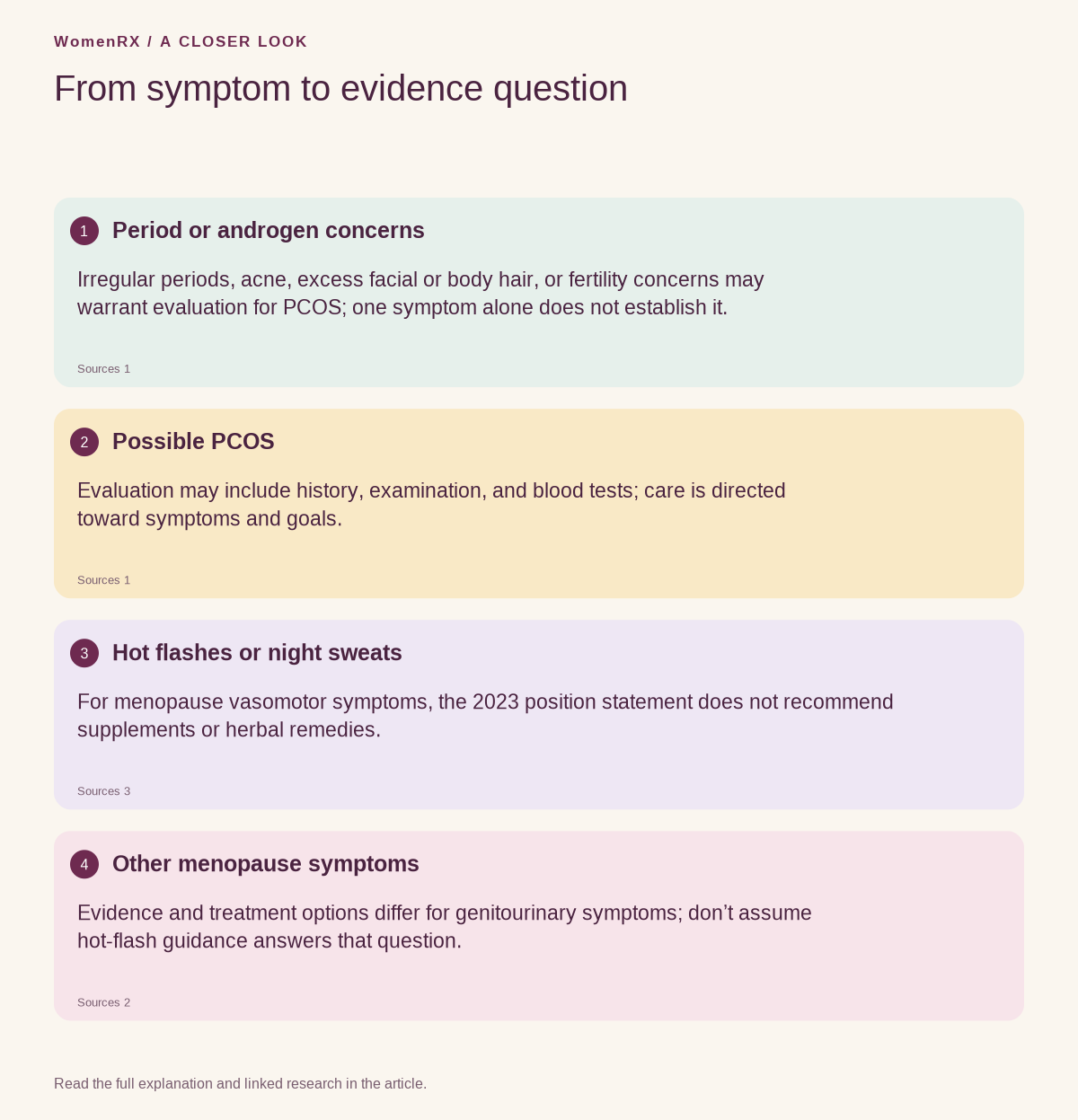
From symptom to evidence question
Period or androgen concerns: Irregular periods, acne, excess facial or body hair, or fertility concerns may warrant evaluation for PCOS; one symptom alone does not establish it.1
Possible PCOS: Evaluation may include history, examination, and blood tests; care is directed toward symptoms and goals.1
Hot flashes or night sweats: For menopause vasomotor symptoms, the 2023 position statement does not recommend supplements or herbal remedies.3
Other menopause symptoms: Evidence and treatment options differ for genitourinary symptoms; don’t assume hot-flash guidance answers that question.2
Read the figure as text
Start with the concern you want to address, then match it to evidence for that symptom or diagnosis rather than to a broad hormone claim.- Period or androgen concerns: Irregular periods, acne, excess facial or body hair, or fertility concerns may warrant evaluation for PCOS; one symptom alone does not establish it.1
- Possible PCOS: Evaluation may include history, examination, and blood tests; care is directed toward symptoms and goals.1
- Hot flashes or night sweats: For menopause vasomotor symptoms, the 2023 position statement does not recommend supplements or herbal remedies.3
- Other menopause symptoms: Evidence and treatment options differ for genitourinary symptoms; don’t assume hot-flash guidance answers that question.2
Sources you can check
- PCOS | Polycystic Ovary Syndrome | MedlinePlusAccessed 2026-09-25Return to first citation
- The 2022 hormone therapy position statement of The North American Menopause Society.“The 2022 Hormone Therapy Position Statement of The North American Menopause Society” Advisory Panel. · Menopause (New York, N.Y.) · 2022Return to first citation
- The 2023 nonhormone therapy position statement of The North American Menopause Society.Menopause (New York, N.Y.) · 2023Return to first citation
- Recommendations from the 2023 International Evidence-based Guideline for the Assessment and Management of Polycystic Ovary Syndrome†.Teede HJ, Tay CT, Laven J, Dokras A, Moran LJ, Piltonen TT, Costello MF, Boivin J, Redman LM, Boyle JA, Norman RJ, Mousa A, Joham AE, International PCOS Network. · Human reproduction (Oxford, England) · 2023Return to first citation