What “Hormone Balance” Supplements Actually Claim to Treat
A useful supplement claim names a condition and a result you can check, not just a promise to “balance” hormones.
“Hormone balance” isn’t a diagnosis or a single treatment goal. Before taking a supplement, ask what condition the claim addresses, whether studies measured the result you want, and whether the product matches what was studied. Inositol research in women with PCOS, for example, has found changes in hormone-related blood markers. That doesn’t establish a benefit for every cause of irregular periods. 13
Turn the promise into a question
A bottle might promise support for cycles, stress, fertility, or menopause under the same “hormone balance” label. Those promises aren’t interchangeable. Ask: Which condition is this for, and what would improve if it worked? Then check whether the evidence measured that improvement in people with that condition.
This matters if your periods have changed. Irregular cycles can occur as menopause approaches, but thyroid problems and PCOS can also be causes. Treatment, when needed, depends on the cause. A supplement claim about “regular cycles” can’t tell you which explanation applies to you. 1
Inositol for PCOS: blood markers versus everyday results
Inositol offers an example of a specific research question. A 2026 systematic review and meta-analysis combined nine randomized trials involving 440 women diagnosed with PCOS. It found changes in androgen-related blood markers, including testosterone and sex hormone-binding globulin. Results varied substantially across several outcomes. The authors called for better studies measuring results such as ovulation, excess hair growth, and symptoms reported by participants. 3
So if a product says inositol “balances hormones,” ask what that means. A change in a blood marker in women with PCOS isn’t, by itself, evidence that a particular blend will make your periods predictable, improve a symptom, or help if your irregular cycles have another cause. The review also explored whether women with different metabolic profiles responded differently, but those subgroup findings were exploratory, not a way to forecast your response. 3
Study design matters when a claim shifts from markers to cycles. In one 12-week trial involving 192 women with PCOS, the proportion reporting cycle regularization was 64.6% in the inositol-only group and 85.4% in the group receiving inositol, metformin, and a calorie-restricted diet together. The combined-group result can’t be credited to inositol alone. The short follow-up shows early improvement, not whether changes lasted. 4
Ashwagandha: a stress claim is not a cycle claim
Ashwagandha is another ingredient that may appear under the same marketing umbrella, but much of its clinical research concerns stress, anxiety, and sleep. The NIH Office of Dietary Supplements describes several small, short trials suggesting possible benefits for some of those outcomes. They do not establish that ashwagandha treats irregular periods or broadly regulates reproductive hormones. 2
There is also a reason not to assume that anything affecting a hormone is automatically helpful. In a small trial of 50 people with subclinical hypothyroidism, an ashwagandha root extract lowered thyroid-stimulating hormone and raised T3 and T4 compared with placebo. That finding does not establish it as a treatment for thyroid disease. 2
Safety belongs in the decision, especially if you’re considering a supplement because you suspect an endocrine problem. NIH notes potential interactions between ashwagandha and diabetes medicines, blood-pressure medicines, immunosuppressants, and sedatives. It also reports that a French health agency recommended against ashwagandha use for people with endocrine disorders and for pregnant or breastfeeding women. That is the agency’s precaution, not proof that every product causes harm in those groups. 2
Four checks to use on the actual label
- Named condition. Does the product identify PCOS, stress, or a particular symptom? If it names only “hormone imbalance,” you still don’t know what it proposes to address.
- Measured outcome. Did a study measure the change you want, such as cycle regularity or sleep, or only a blood marker? The inositol review focused on biochemical markers in women with PCOS. 3
- Matching preparation and amount. Compare the ingredient, extract, and studied amount with the label rather than assuming the plant or nutrient name is enough. For example, the small thyroid-marker trial used 300 mg of ashwagandha root extract twice daily for eight weeks. That describes one study, not a recommended dose; another preparation or amount isn’t automatically equivalent. 2
- Relevant safety. Check whether the ingredient raises a concern for your circumstances or medicines. For ashwagandha, that includes the potential medicine interactions and the French agency’s precaution for endocrine disorders, pregnancy, and breastfeeding. 2
If a label lists vitex agnus-castus alongside other ingredients, apply the same checks to vitex itself. Evidence about inositol in PCOS or ashwagandha in stress cannot establish what a vitex-containing blend will do for menstrual symptoms.
When the symptom matters more than the supplement claim
You don’t have to work out your hormone levels from a product label. If your usual period pattern changes, you bleed between periods, your periods last longer than seven days, or irregular periods come with weight gain, tiredness, facial hair growth, or skin changes, arrange an assessment of the change. The same applies if irregular cycles are making it difficult to get pregnant. Those details can help distinguish causes; buying a general “hormone balance” product cannot. 1
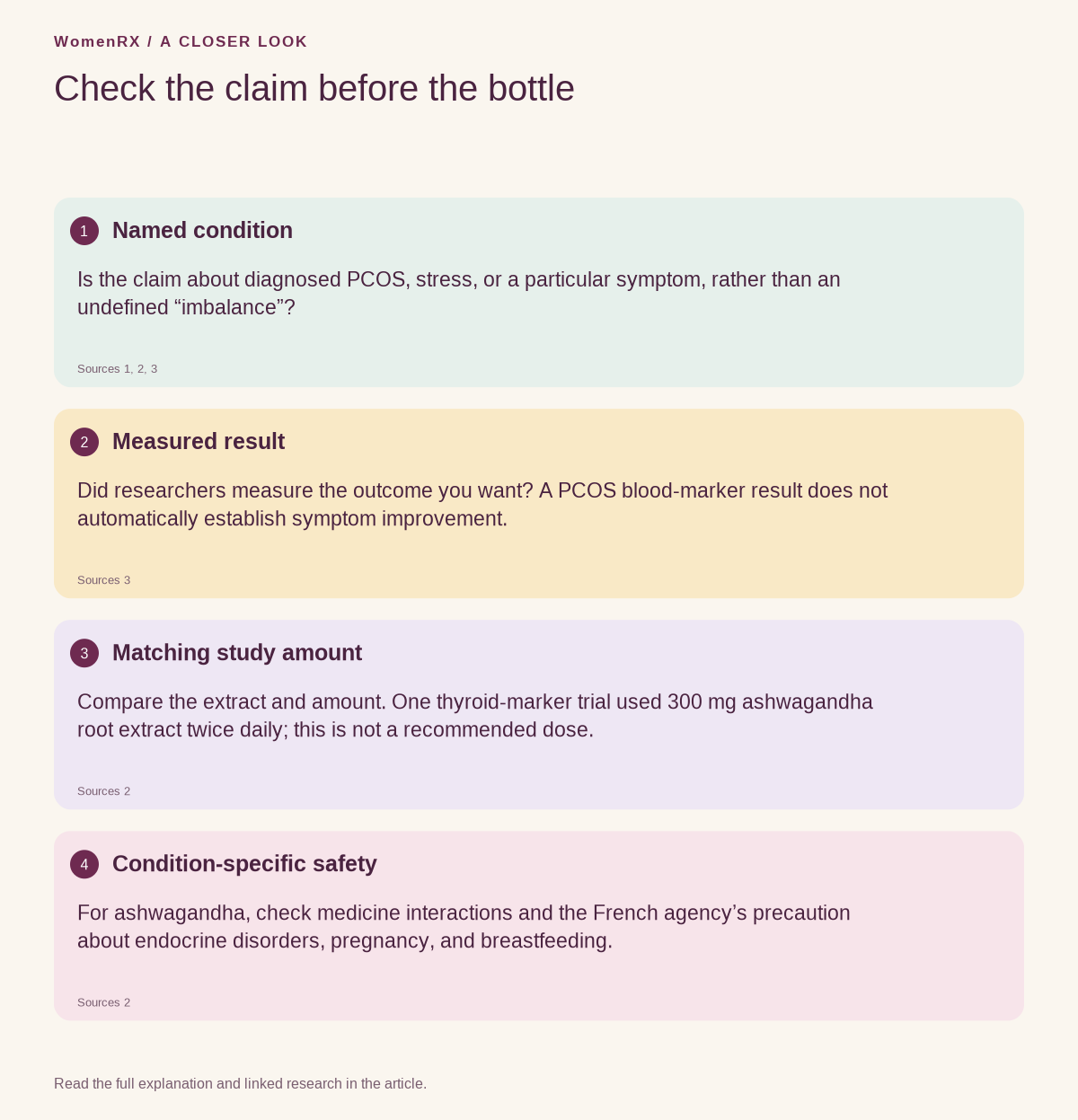
Check the claim before the bottle
Named condition: Is the claim about diagnosed PCOS, stress, or a particular symptom, rather than an undefined “imbalance”?123
Measured result: Did researchers measure the outcome you want? A PCOS blood-marker result does not automatically establish symptom improvement.3
Matching study amount: Compare the extract and amount. One thyroid-marker trial used 300 mg ashwagandha root extract twice daily; this is not a recommended dose.2
Condition-specific safety: For ashwagandha, check medicine interactions and the French agency’s precaution about endocrine disorders, pregnancy, and breastfeeding.2
Read the figure as text
Use these four checks to compare a product’s promise with research that actually applies to it.- Named condition: Is the claim about diagnosed PCOS, stress, or a particular symptom, rather than an undefined “imbalance”?123
- Measured result: Did researchers measure the outcome you want? A PCOS blood-marker result does not automatically establish symptom improvement.3
- Matching study amount: Compare the extract and amount. One thyroid-marker trial used 300 mg ashwagandha root extract twice daily; this is not a recommended dose.2
- Condition-specific safety: For ashwagandha, check medicine interactions and the French agency’s precaution about endocrine disorders, pregnancy, and breastfeeding.2
More questions, answered
Does a change in a hormone blood test mean my symptoms will improve?
Not necessarily. The inositol review found changes in androgen-related blood markers in women with PCOS, but its authors called for stronger evidence on outcomes such as ovulation, excess hair growth, and symptoms women report themselves. Check which outcome a product’s claim actually rests on. 3
Sources you can check
- Irregular periods - NHSAccessed 2026-09-25Return to first citation
- Ashwagandha: Is it helpful for stress, anxiety, or sleep? - Health Professional Fact SheetAccessed 2026-09-25Return to first citation
- Metabolic Phenotype Predicts Biochemical Response to Inositol Supplementation in Polycystic Ovary Syndrome: A Systematic Review and Meta-Analysis.Tienforti D, Puocci G, Venditti C, Gizzi V, Pisanò C, Cocci E, Perfetto E, D'Alessandro F, Spagnolo L, Baroni MG, Barbonetti A. · Clinical endocrinology · 2026Return to first citation
- Multimodal Therapy With Metformin, Inositol and Dietary Restriction Improves Insulin Resistance and Endocrine Outcomes in Women With Polyendocrine Metabolic Ovarian Syndrome: A Randomized Controlled Trial.Irfan NU, Saleem S, Irfan A. · Clinical endocrinology · 2026Return to first citation