Chasteberry Long Term: What Safety Evidence Actually Shows
Research includes short trials and one 90-day combination-product study, but it doesn’t establish a universally safe duration or long-term safety.
Chasteberry studies generally cover a few menstrual cycles or a few months, not enough to establish what happens with longer use. Nausea and abdominal pain were reported in studies of menstrual bleeding, but the evidence is limited and doesn’t give a reliable picture of how often reactions occur. A 90-day study of chasteberry combined with vitamin B6 and magnesium found no serious side effects, but that cannot establish long-term safety for chasteberry alone. 2 3 5

The length of a study isn’t a safe-use limit
If you’ve been taking chasteberry for months, the main thing to know is that research hasn’t established a standard duration that’s safe for everyone. Trials of chasteberry for premenstrual symptoms lasted at least two menstrual cycles. A review of chasteberry trials for cyclic breast pain lists examples with two- or three-month follow-up, but its table doesn’t specify how long participants took chasteberry in those examples. These figures don’t tell us how long someone can safely continue taking it. 1 2
One 90-day real-world study enrolled 64 people with premenstrual symptoms. It tested a product containing chasteberry extract, vitamin B6, and magnesium, either alongside standard treatment or separately. Five participants were lost to follow-up, leaving 59 in the analysis; researchers reported no serious side effects. Because the product had three ingredients and follow-up lasted 90 days, this finding can’t tell us whether chasteberry alone is safe over longer periods or rule out less serious reactions. 5
What has been reported about side effects
A systematic review of five studies examining chasteberry and menstrual bleeding reported nausea and abdominal pain as side effects. The review found no significant effect on menstrual bleeding compared with placebo in the first or second cycle, and described the underlying studies as relatively low quality. It doesn’t provide a dependable estimate of how often those symptoms happen or a complete account of possible reactions. 3
That’s a limited list, not proof that other reactions never occur. A separate review of premenstrual-symptom trials found substantial differences among studies and a high risk of bias, so its pooled result couldn’t support a definitive conclusion about benefit. It also doesn’t settle long-term safety. 2
Your health context matters
Chasteberry is being studied for reproductive symptoms, and a review describes possible effects on hormone and dopamine-related pathways. That proposed activity is not proof that it will interfere with a particular medicine. The cited reviews do not report findings that establish whether chasteberry interacts with hormonal contraception or fertility treatment. If either applies to you, including chasteberry in a medication review before continuing is a practical precaution; bring the product label so the exact preparation is clear. 2 4
Pregnancy and breastfeeding are different situations from the menstrual-symptom trials: those studies don’t establish safety during either. 2 3
A useful review before continuing
Take the actual package or a clear photo of its label. Record the brand, listed ingredients, preparation, how long you’ve used it, and what you hoped it would help. Note any new symptoms and when they began, without assuming that chasteberry caused them. Make a complete list of medicines and supplements, including hormonal contraception or fertility treatment.
Then weigh what you’ve noticed against the limits of the evidence. For example, if you’re taking it for premenstrual symptoms, ask whether you’ve seen a meaningful change in the symptoms you care about, and whether that change is worth continued use given the limited longer-term safety information. The point isn’t to treat a trial length as a deadline or a guarantee; it’s to make a decision with the product and your circumstances in view.
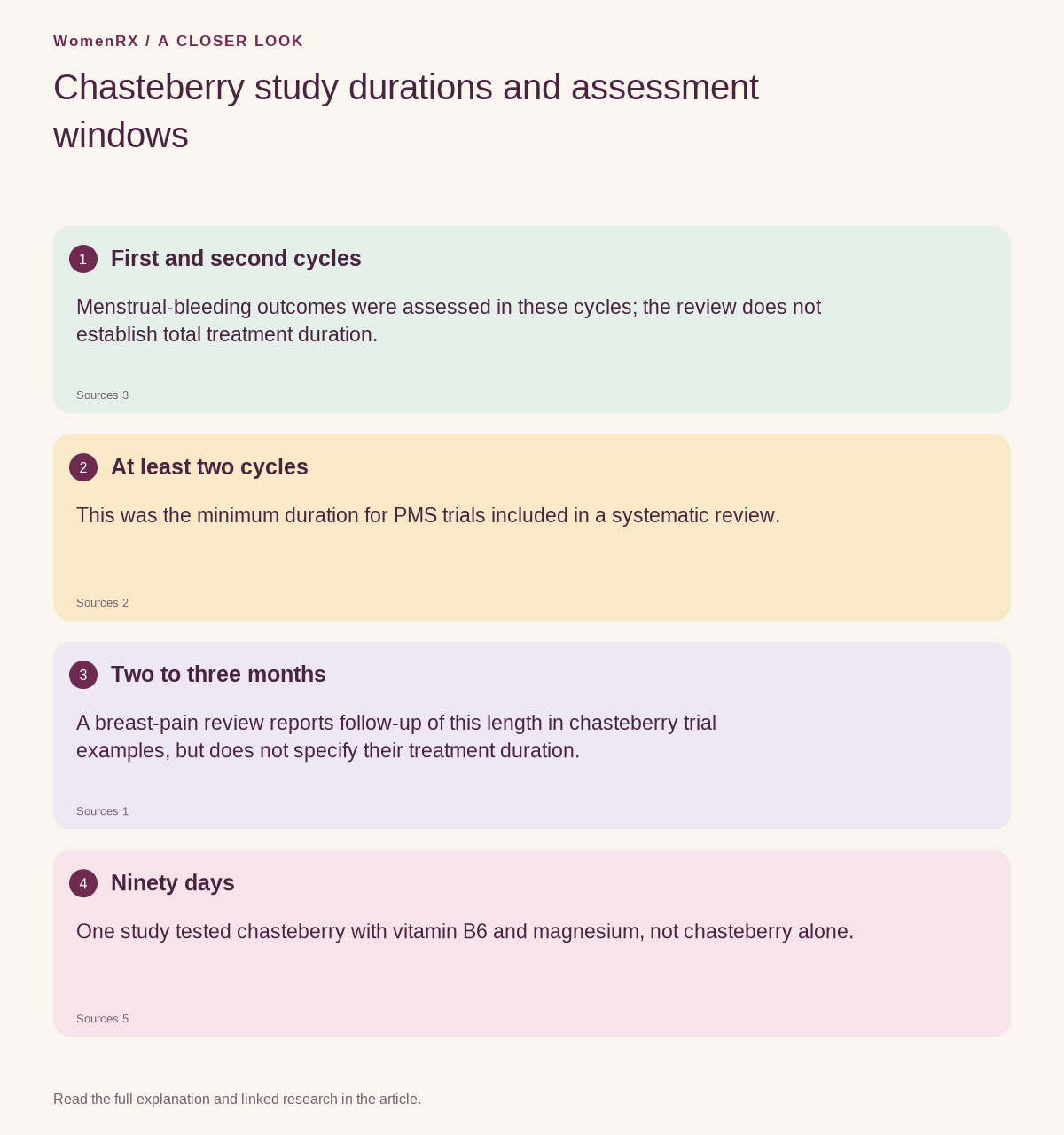
Chasteberry study durations and assessment windows
First and second cycles: Menstrual-bleeding outcomes were assessed in these cycles; the review does not establish total treatment duration.3
At least two cycles: This was the minimum duration for PMS trials included in a systematic review.2
Two to three months: A breast-pain review reports follow-up of this length in chasteberry trial examples, but does not specify their treatment duration.1
Ninety days: One study tested chasteberry with vitamin B6 and magnesium, not chasteberry alone.5
Read the figure as text
These are reported study durations, follow-up periods and outcome-assessment windows, not a safe-use schedule. Follow-up does not necessarily mean participants took chasteberry throughout.- First and second cycles: Menstrual-bleeding outcomes were assessed in these cycles; the review does not establish total treatment duration.3
- At least two cycles: This was the minimum duration for PMS trials included in a systematic review.2
- Two to three months: A breast-pain review reports follow-up of this length in chasteberry trial examples, but does not specify their treatment duration.1
- Ninety days: One study tested chasteberry with vitamin B6 and magnesium, not chasteberry alone.5
More questions, answered
Does a 90-day study mean chasteberry is safe to take for three months?
Not by itself. The study lasted 90 days, included chasteberry with vitamin B6 and magnesium, and reported no serious side effects among participants. It can’t establish the safety of chasteberry alone or guarantee safety for every person. 5
Are nausea and abdominal pain proven to be common?
No. They were reported as side effects in the studies included in a review of menstrual bleeding, but the review doesn’t provide a reliable rate or a complete account of possible reactions. 3
Sources you can check
- The Effectiveness of Herbal Medicines on Cyclic Mastalgia: A Systematic Review on Meta-analysis.Mirzaee F, Fakari FR, Babakhanian M, Roozbeh N, Ghazanfarpour M. · Revista brasileira de ginecologia e obstetricia : revista da Federacao Brasileira das Sociedades de Ginecologia e Obstetricia · 2022Return to first citation
- The treatment of premenstrual syndrome with preparations of Vitex agnus castus: a systematic review and meta-analysis.Verkaik S, Kamperman AM, van Westrhenen R, Schulte PFJ. · American journal of obstetrics and gynecology · 2017Return to first citation
- The effects of Vitex agnus-castus on menstrual bleeding: A systematic review and meta-analysis.Mollazadeh S, Mirghafourvand M, Abdollahi NG. · Journal of complementary & integrative medicine · 2019Return to first citation
- Effects, Mechanisms of Action and Application of Vitex agnus-castus for Improvement of Health and Female Reproduction.Sirotkin AV. · Phytotherapy research : PTR · 2025Return to first citation
- Efficacy and Tolerability Evaluation of a Nutraceutical Composition Containing Vitex agnus-castus Extract (EVX40™), Pyridoxine, and Magnesium in Premenstrual Syndrome: A Real-World, Interventional, Comparative Study.Sureja VP, Kheni DB, Dubey VP, Kansagra J, Soni ZK, Bhatt SP, Mathuria A, Deshpande SS. · Cureus · 2023Return to first citation