Does Chasteberry Help PMS? What Studies Show
Chasteberry may ease overall PMS symptoms, but the studies don’t show that every product reliably helps every symptom.
Chasteberry, also called Vitex agnus-castus, has shown promise for overall PMS symptoms in randomized trials. But many studies have weaknesses, and their results vary widely, so the size of any benefit remains uncertain. One placebo-controlled trial found greater improvement with a specific extract over three treatment cycles; that finding doesn’t apply automatically to every supplement. 2 4
The overall result is promising, but hard to pin down
A systematic review found 17 randomized trials of Vitex for PMS, with 14 included in its quantitative analysis. Thirteen of those 14 reported positive effects on total PMS symptoms. That sounds persuasive until you look at how dependable the results are: most trials had a high risk of bias, their findings varied greatly, and the reviewers found signs of publication bias. They cautioned that the pooled benefit may overestimate the real effect. 4
A placebo-controlled trial in China gives a more concrete picture. Researchers randomized 217 women with moderate to severe PMS to a particular Vitex extract or placebo for up to three treatment cycles, following a three-cycle preparation period. Among the 104 participants in each group who provided efficacy data, the reported mean reduction in total symptom score by the third treatment cycle was 22.71 points with the extract and 15.50 points with placebo. The extract group improved more, but both groups improved. The numbers describe that trial’s scoring tool, not a promised amount of relief for an individual. 2
Total PMS scores aren’t the same as relief for one symptom
PMS follows a cycle: symptoms arise before a period and resolve during menstruation or within the following week. Your mix of symptoms may differ from someone else’s and can change from cycle to cycle. An overall symptom score combines those experiences, so an improvement in the total doesn’t tell you that chasteberry will reliably ease your particular breast tenderness, cravings, mood changes, or cramps. 1 6
There are clues about specific symptoms, but they’re less convincing than the overall trial result. For example, a retrospective study reported less breast tenderness among people using Vitex-containing products. Because researchers looked back at treatment rather than randomly assigning people to Vitex or placebo, that change can’t establish that Vitex caused the improvement. 7
This distinction matters when you’re deciding whether the supplement matches your concern. If one symptom is driving your decision, the evidence for overall PMS relief is a reason to ask about chasteberry, not proof it will help that symptom.
The extract and the comparison both matter
A study of one named extract tells you about that preparation under the conditions tested. It doesn’t show that a different chasteberry supplement will work the same way. The trial review found substantial differences between study results that its authors could not satisfactorily explain, making it harder to predict what to expect from a product simply labeled “chasteberry.” 2 4
Combination products raise a separate question: which ingredient, if any, made a difference? A small randomized pilot tested a supplement containing Vitex, gamma-aminobutyric acid (GABA), Rhodiola, vitamin B6, and melatonin against placebo. It found no statistically significant differences between groups. Even a positive result for that mixture would not isolate an effect of Vitex. 3
The China trial assessed treatment for up to three cycles. It supports a finding over that period, not a claim about lasting benefit or how quickly another extract might work. 2
Where chasteberry fits in a decision
If PMS symptoms keep returning, chasteberry is reasonable to discuss as a possible option for overall symptoms, with clear expectations about the uncertainty. If you take medicines, check with a doctor or pharmacist before adding a regular supplement. Bring the product label so the conversation is about the ingredients you’d actually take. 1 4
You also have options beyond supplements, particularly if symptoms disrupt daily life. A 2025 clinical review identifies selective serotonin reuptake inhibitors (SSRIs) as first-line treatment for PMS and premenstrual dysphoric disorder (PMDD), while also describing cognitive behavioral therapy and exercise as options. PMDD involves substantial distress or interference with work, school, relationships, or social activities. 6
Finally, keep the life stage in view. These PMS trial findings concern people with menstrual cycles; they don’t establish chasteberry’s effectiveness or safety during pregnancy or breastfeeding. Nor do they establish a benefit for menopause symptoms. A small study of PMS-like symptoms in late perimenopause tested Vitex together with St. John’s wort in a subgroup of 14 people, so it couldn’t tell which herb accounted for the result. 2 4 5
What chasteberry studies actually test
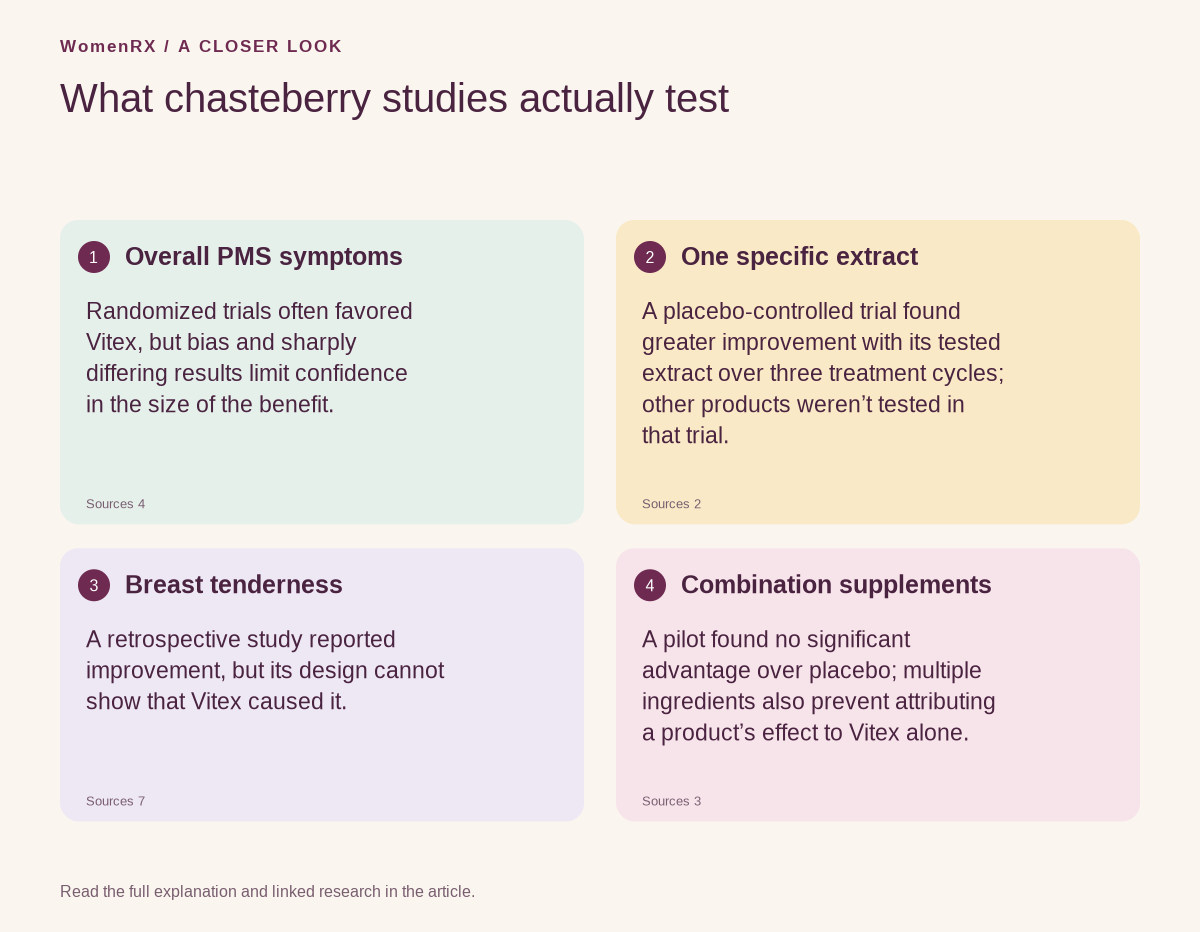
Overall PMS symptoms: Randomized trials often favored Vitex, but bias and sharply differing results limit confidence in the size of the benefit.4
One specific extract: A placebo-controlled trial found greater improvement with its tested extract over three treatment cycles; other products weren’t tested in that trial.2
Breast tenderness: A retrospective study reported improvement, but its design cannot show that Vitex caused it.7
Combination supplements: A pilot found no significant advantage over placebo; multiple ingredients also prevent attributing a product’s effect to Vitex alone.3
Read the figure as text
The kind of outcome and the product tested change what a study can tell you.- Overall PMS symptoms: Randomized trials often favored Vitex, but bias and sharply differing results limit confidence in the size of the benefit.4
- One specific extract: A placebo-controlled trial found greater improvement with its tested extract over three treatment cycles; other products weren’t tested in that trial.2
- Breast tenderness: A retrospective study reported improvement, but its design cannot show that Vitex caused it.7
- Combination supplements: A pilot found no significant advantage over placebo; multiple ingredients also prevent attributing a product’s effect to Vitex alone.3
More questions, answered
Is the evidence stronger for breast tenderness than other PMS symptoms?
A retrospective study reported improvement in breast tenderness among people using Vitex-containing products, but it couldn’t establish cause and effect. The randomized-trial review offers a clearer, though still uncertain, signal for overall PMS scores than for any one symptom. 4 7
Sources you can check
- PMS (premenstrual syndrome) - NHSAccessed 2026-09-25Return to first citation
- Treatment for premenstrual syndrome with Vitex agnus castus: A prospective, randomized, multi-center placebo controlled study in China.He Z, Chen R, Zhou Y, Geng L, Zhang Z, Chen S, Yao Y, Lu J, Lin S. · Maturitas · 2009Return to first citation
- Effects of the PREMEN-CALM® in the Management of the Premenstrual Syndrome: A Randomized, Double-Blind, Placebo-Controlled Pilot Study.Herrera A, Al Adib M, Rodríguez AB, Carrasco C. · Journal of dietary supplements · 2024Return to first citation
- The treatment of premenstrual syndrome with preparations of Vitex agnus castus: a systematic review and meta-analysis.Verkaik S, Kamperman AM, van Westrhenen R, Schulte PFJ. · American journal of obstetrics and gynecology · 2017Return to first citation
- Effects of a combination of Hypericum perforatum and Vitex agnus-castus on PMS-like symptoms in late-perimenopausal women: findings from a subpopulation analysis.van Die MD, Bone KM, Burger HG, Reece JE, Teede HJ. · Journal of alternative and complementary medicine (New York, N.Y.) · 2009Return to first citation
- Premenstrual Syndrome and Premenstrual Dysphoric Disorder: Common Questions and Answers.Biggs WS, Romeu JM, Gaudard T. · American family physician · 2025Return to first citation
- Use of Vitex agnus-castus in patients with menstrual cycle disorders: a single-center retrospective longitudinal cohort study.Höller M, Steindl H, Abramov-Sommariva D, Kleemann J, Loleit A, Abels C, Stute P. · Archives of gynecology and obstetrics · 2024Return to first citation